

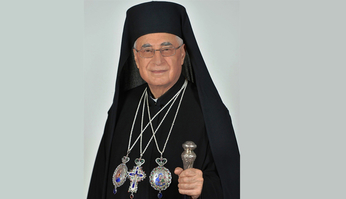
Patriarch Youssef
On pilgrimage to Trier - Germany
A Patriarch on pilgrimage to the Undivided Robe 22.04.12
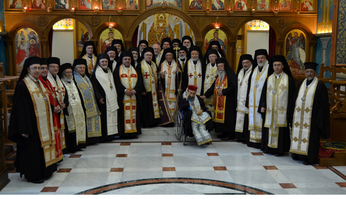
70 Knights and Ladies of the Patriarchal Order of the Holy Cross of Jerusalem in Trier
Trier – About seventy members of the "Pariarchal Order of the Holy Cross of Jerusalem" of the Melkite Greek Catholic Church, a church united with Rome, that is, in complete ecclesial communion, have been making a pilgrimage to the Holy Tunic. The Melkite Greek Catholic Church is a guardian of the Byzantine Liturgy in the Catholic Church: the members of the Order were invited together with the leader of their Church, Patriarch Gregorios III of Antioch.
Pastor Hans Wilhelm Ehlen has had to welcome numerous groups to the newly restored Church of Our Lady in Trier since its re-opening in 2011. Yet probably none of them dressed in such a colourful and ornate way as those of the Patriarchal Order of the Holy Cross of Jerusalem. The German and Belgian members of the patriarchal lay-order, which has its headquarters in Aachen, appeared in their costumes as Ladies and Knights, to celebrate a solemn Mass of the Byzantine Liturgy and tradition. The chief celebrant was the leader of the Melkite Greek Catholic Church: His Beatitude the Grand Master and Patriarch Gregorios III of Antioch.
The Grand Master Gregorios III, Patriarch of the Melkite Greek Catholic Church of Antioch and All the East (born in 1933) answered with a smile the question as to whether this was his first visit to Trier. In fact the Patriarch, resident in Damascus (Syria) is something of a Holy Tunic veteran: "I’ve known Trier since 5 August 1959, when I took part in the Pax Christi walk from Metz to Trier and the holy Tunic. Since then I’ve come back again and again."
The Undivided Robe is for him a symbol of the unity of Christendom, which symbolises the passion, but also the resurrection of Christ. Christians from West and East, the Patriarch suggests, ought to stand together, so that there is less violence – above all, especially in his homeland of Syria. "Alas, the situation is very tense there. Syrians should be able to look to the future together. That is why I tell Europe: help us, since you can give some people in the country more confidence and trust.. We can survive this crisis." The Patriarch and the members of the order were welcomed by Suffragan Bishop Jörg Michael Peters. The Melkite Greek Catholic Church has about two million faithful. The Order of the Holy Cross of Jerusalem carries out numerous aid projects in the Middle East, including projects of church conservation and preservation of holy sites, the construction of educational facilities and institutions of health care.
In conversation: Suffragan Bishop Jörg Michael Peters (left) and Patriarch Gregorios III of Antioch in the Liebfrauenbasilika.
Until 13 May the Diocese of Trier invited people to make pilgrimage to the Holy Tunic in Trier. This was the first occasion since 1996 that the holy Tunic could be seen again in Trier Cathedral. The pilgrimage took place under the heading "and bring together what is separated." The holy robe, the tunic of Jesus Christ, is the most important relic of the Cathedral of Trier. Helena, the mother of Emperor Constantine, is supposed to have brought it to Trier in the fourth century. Information about the Holy Robe Pilgrimage can be found on the Internet at www.heilig-rock-wallfahrt.de or at the Pilgrimage Office, Tel.: 0651-7105-8012.
Source: http://www.heilig-rock-wallfahrt.de/start/aktuelles/meldung/ein-patriarch-pilgert-zum-unzerteilten-gewand.html
German translated by V. Chamberlain
Saturday, 21. April 2012, at 10 a.m.
Patriarchal Liturgy with H.B. Patriarch Gregorios III. In the Cathedral Church of our Lady, Trier
Sunday, 22. April 2012, at 10a.m.
Patriarchal Liturgy with H.B. Patriarch Gregorios III. In the church of the Priests’ Seminary, Trier Jesuitengasse
http://www.kath.de/zentrum/termine/liturgie/feier_alle.htm
2012-04-14 Vatican Radio Christ’s Holy Tunic venerated in Trier
jkhckzxhcvkOn Friday of Easter Week, Pope Benedict XVI’s special envoy Cardinal Marc Ouellet, presided over a ceremony opening the pilgrimage to the Holy Tunic, preserved in the Cathedral of Trier in Germany. The relic, piously believed to be the ‘seamless garment’ worn by Christ at the Passion, was exposed for the veneration of the faithful for only the fourth time in the last hundred years. According to legend, the Holy Tunic was brought to Trier – at the time, the capital of Gaul – by St. Helena, the mother of Emperor Constantine.
This year’s pilgrimage marks the 500th anniversary of the first public exposition of the Tunic in the year 1512. In a message to the Bishop of Trier, Stephan Ackermann, Pope Benedict said he would be present in thought with all the pilgrims who come to venerate the relic. The Holy Father said the Tunic is a symbol of the Church, which lives “not by its own power, but through the action of God.” “This garment,” the Pope said, “is the undivided gift of the Crucified One to the Church, which He has sanctified with His blood. For this reason, the Holy Tunic reminds the Church of her dignity.” As many as half a million pilgrims were expected to visit Trier during the four weeks (April 13 – May13) when the Sacred Tunic was exposed.
http://www.radiovaticana.org/en1/articolo.asp?c=579806
Pilgrims from all over the world to meet in the Marian city of Kevelaer, Germany
KEVELAER. On Pentecost weekend Kevelaer will be dominated by the "international pilgrimage" of the Order of Saint Lazarus of Jerusalem, in short, the Lazarus Order. At the invitation of the Grand Master of the global order, HE Don Carlos Gereda de Borbón, Marquis d'Almazàn, and the Spiritual Protector, His Beatitude Patriarch Gregorios III of Damascus, some 200 members of the Ecumenical Order will be meeting from 24 to 27 May in the Marian town. Whether from Malta, the headquarters of the Order, or from Ireland, whether from Germany, Finland, Spain, Nigeria, Canada or the United States - the members, Knights and Ladies from more than 20 nations, are also using the pilgrimage for various Lazarus Order events. The tourist office of Kevelaer and district is the contact for the individual applications of international visitors and will be serving as a registration office on guests' arrival. The highpoint of the pilgrimage of the Order of St. Lazarus will be the walk from Kerken-Eyll to Kevelaer on Saturday. The international pilgrimage ends with an invitation to a festive High Mass in St. Mary's Basilica on Pentecost Sunday.
Photo: About 200 members of the Order of St. Lazarus are meeting on Pentecost weekend for the "International Pilgrimage 2012" at the Kevelaer shrine.
“Foreign countries should keep out”
So it seems to Gregorios III, an authentic voice from Syria, from where there is no objective reporting
07.05.12
Currently a guest in Trier: Patriarch Gregorios III Photo: Bost
Bodo Bost spoke for PAZ with Patriarch Gregorios III, head of some two million Melkites, one of the largest Eastern Churches in union with Rome, based in Damascus, Syria.
PAZ: You have come from a region in crisis. Do you hope that the situation in Syria will settle down again?
Gregorios III: Unfortunately we cannot expect that tomorrow, but perhaps the day after tomorrow. The situation is very tense and will get increasingly so, as there are many outside influences that stoke the fire and exacerbate the situation, by supplying weapons and funds … Syrians have to find one another, talk with one another, that is the only way for the situation to settle down. That is why I am telling Europe, not to further inflame the situation in Syria, but rather help our people through more trust and confidence. Europe and the USA must stay out of this conflict, as only Syrians alone can resolve this conflict. If Israel is allowed nuclear weapons and other countries not, this generates one-sidedness, which just further inflames hatred, not lessens conflicts in the region. We Eastern Christians are hated by Muslims on account of you, because Christian countries in Europe and the USA cannot manage to bring about a just peace in the Middle East. We want to pray for peace in Jerusalem and the peace of the Holy Land.
PAZ: Will President Bashar Assad reach out to the opposition, even if Europe does nothing towards resolving the crisis in Syria?
Gregorios III: Help us, so we can agree. We have been living together as Christians and Muslims now for over a thousand years. No-one can prescribe for us how we should be shaping our life together. Give us an opportunity, for people in Syria to find one another and shape their future by themselves peacefully.
PAZ: Does the Church support President Assad?
Gregorios III: We don’t need to support any system. We were there already before Assad and before his father and we shall be there after Assad. We are a free Church; we speak with the government to help the people, not to support the regime.
PAZ: What hopes do you place in the Annan plan?
Gregorios III: Without faith in the future there will be no peace and no peace plan can help then. We need optimism and faith in a better future.
PAZ: In what way does foreign influence have a detrimental effect on Syria?
Gregorios III: A good example of that is the report of the Arab League’s leader of the Observer Mission, General Dabi. His report was objective and fair and issued a good account of the Assad Government; therefore nobody wanted to take any notice of this report.
PAZ: Do you also have any contacts with the Observer Mission?
Gregorios III: Not directly, but people have come and reported to us, so we have learned from their report.
PAZ: What future do you see for Syria?
Gregorios III: The world is not fair. Only God is just and only God can bring peace. The world is ruled by economic interests. Formerly Saudi Arabia and Qatar were quite staunch friends of Syria. Why are they now against Assad? Are the regimes there better for Christians or for human rights? Today Syria is a huge weapons cache and the international community wants to give even more money to Syrian rebels.
PAZ: At the beginning of March the Um Al-Zennar Church (Church of the Mother of God’s Belt) of Homs was torched. This Church is the most significant Christian symbol in the centre of the civil war-torn city of Homs, where the Syrian Orthodox Patriarch had his headquarters from 1933 to 1959 and here there was one of the most important relics in Syria with the Mother of God's belt. What do you know of its destruction?
Gregorios III: The church was damaged, as it lay in the field of fire of the opposing factions. Actually this important church is in the Christian quarter of Homs. The rebels have dug into this quarter, from which the Christians have fled, and shoot from there at the security forces, which have their positions in the outer suburbs and return the fire from there. We haven’t been able to talk about peaceful demonstrators for a long time now.
PAZ: How is Muslim-Christian dialogue in Syria?
Gregorios III: We have no problems with one another. Interference from abroad is the problem.
PAZ: Why have you come to Trier on pilgrimage to the holy tunic?
Gregorios III: I came for the first time to the holy tunic in Trier with a group organised by Pax Christi in August 1959. At that time the German-French friendship was being prepared. Robert Schuman went at that time on pilgrimage to the holy tunic. It was my first visit to Germany. Since then I have been captivated by the land, its people and its culture. I have such a close relationship to Trier and its people. Through Saint Athanasios, who in the fourth century was banished from Egypt to Trier, Trier also has a relationship to Eastern Christians. And the holy tunic also came originally from Jerusalem, where I was for many years patriarchal vicar of my Church.
PAZ: What meaning does the holy tunic have for you?
Gregorios III: It is a symbol of the unity of the Church. This tunic symbolises the suffering of Christ, but also his resurrection. Yet we must do much more, to reach the communion of all Christians. Unfortunately Europe is weak in faith, so it is afraid of Islamisation. We Christians of East and West must stand together more. The more faith and love and hope there is in the world, the less violence there will be in the world. But this can only come about through God’s grace.
Source: http://www.preussische-allgemeine.de/nachrichten/artikel/das-ausland-soll-sich-heraushalten.html
Translation from German: V. Chamberlain