

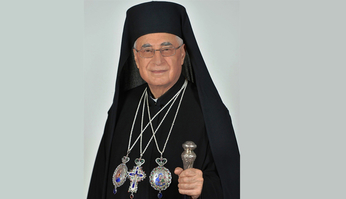
Patriarch Youssef
Reports on the Bimillennial Year of the Birth of Saint Paul 2008-2009 V.C.
29 6 2008
General Report on the Bimillennial Year of the Birth of Saint Paul
In Damascus, City of Paul, Apostle to the Nations
28 June 2008 to 29 June 2009
Proclamation and Preparation
After the proclamation of the Year of Saint Paul by His Holiness, Pope Benedict XVI, Patriarch Gregorios III and his Vicar General, Archbishop Joseph (Absi) went to the President of the Syrian Arab Republic, Doctor Bashar al Assad to inform him officially about the year and to ask what could be done. His Excellency’s reaction was very positive and he offered help in every way, especially from the Ministries of Tourism, Information and others.
The Patriarch wrote a letter in readiness for the Opening of the Year (see the Patriarchal website) to all his bishops, priests and laity in Syria and around the world outlining the plans for the forthcoming year and explaining its spiritual significance.
Opening the Year
The year was opened by His Holiness in Rome. Patriarch Gregorios wished to take part in it personally and to represent Damascus and Syria. So on the evening of 28 June 2008 he attended Solemn Vespers in the Basilica of Saint Paul-without-the-Walls, where Cardinal di Montezemolo is Archpriest. The Pope celebrated Vespers with the participation of the Ecumenical Patriarch Bartholomew at his side.
In Damascus there was the usual official annual celebration of the Feast of the Holy Apostles at Tel Kawkab, the place of the risen Lord’s appearance to Saint Paul. The three Patriarchs (Greek Orthodox, Greek Catholic and Syrian Orthodox) took part in it, Patriarch Gregorios being represented by his Patriarchal Vicar, Archbishop Joseph (Absi). Also present was the Minister of the Awqaf, Muhammad abd-as-Sattar as-Sayyid, and the Grand Mufti of Syria Shaykh Muhammad Badr Hassoun. The Greek Orthodox Patriarch Ignatios IV (Hazim) spoke, then the Mufti and the Minister.
In Rome, Patriarch Gregorios contacted Cardinal di Montezemolo, (with whom he had maintained a friendship since the latter’s time as Papal Nuncio in Jerusalem) and also the Italian Episcopal Conference, since he knew that an exhibition was being prepared for the Pauline Year. He also was in contact with Mr. Motta for all news relating to Saint Paul and with the review Paulus, founded for the occasion.
The Year takes Shape
After the opening of the year, Patriarch Gregorios sent a letter to all churches under his jurisdiction, giving guidance to their clergy on celebrating the year. (The text was published in Arabic. Ten recommendations for clergy and people were also published in English on the Patriarchal website and on the website of the Eparchy of Newton.) During the year, priests were advised to preach on the Epistle rather than on the Gospel.
In Damascus a committee was set up, presided over by Archimandrite Antoine Mousleh. The committee did all in its power during the year to arrange processions in Straight Street, especially in the vicinity of the Eastern Gate (Bab Sharqi), Saint Ananias’ and the Pauline quarter of the Old City. Several parishes held their own processions, always kindly assisted by a police presence. For several months, the committee also published a little monthly bulletin which from time to time carried a word from the Patriarch, who would take an Epistle and choose verses that seemed most relevant to people. Inside the bulletin would be an article headed, Letter of Saint Paul to the Damascenes, in which were set out the main ideas from some Pauline theme found in the Epistles. Thus, the people of Damascus were addressed in the name of Saint Paul by writers hidden by the Apostle. Also inside the bulletin were the Holy Father’s discourses and other information on Saint Paul’s life and on related events worldwide.
Walks of Witness
On the evening of Tuesday 23 September 2008, in the old city of Damascus, some 2,500 pilgrims took part in a walk in honour of Saint Paul as part of the celebrations for the Year dedicated to the Apostle of the Gentiles.
The walk, headed by Patriarch Gregorios III, included eleven stations, while meditations, prayers and chants accompanied the way from the Greek Orthodox Patriarchate of Antioch as far as the Melkite Greek Catholic Chapel of Saint Paul-on-the-Wall, via Straight Street and the Eastern Gate (Bab Sharqi.)
The meditations focused on the conversion of Saul of Tarsus on the road to Damascus, his baptism in Damascus by Saint Ananias and the faith of the first Christians of Damascus.
The walkers were welcomed on their arrival at the Eastern Gate, by the unfurling of a giant canvas portrait of the Apostle, depicting his return to Damascus, after his flight into the Arabian wilderness (the present day Syrian district of Hauran.)
Syrian television covered the walk, accompanied as it was by choral groups and bands from the city’s different Christian communities and by firework displays.
At the conclusion of the walk, in the big square that separates the Chapel of Saint Paul-on-the-Wall from the adjacent children’s home and old people’s home, the walkers could view on a giant hoarding the different designer posters produced by the Syrian Ministry of Tourism for the Year of Saint Paul.
A brief address from Patriarch Gregorios III closed this walk of witness, which was also part of the celebrations of Damascus, Capital of Arab Culture 2008 – a culture that is both Christian and Muslim.
The next walk in honour of Saint Paul took place on 30 September in Damascus, on the eve of the feast of Saint Ananias, first bishop of the city.
Damascus Conference (23-25 April)
One very important event during the year was the Damascus Conference on Saint Paul held from 23-25 April, Reading Paul from the East.
Scholars from the Middle East, the United States of America, Great Britain and the Netherlands took part in the conference, which was held under the auspices of the Franciscan Centre of Oriental Studies in Cairo, Syriaca, University of Padua, Italy and the Melkite Greek Catholic Patriarchate.
The following programme appears with grateful acknowledgment to the website of the Custodie de Terre Sainte: http://www.custodia.org/spip.php?article5058
PROGRAMME
Thursday 23rd - Moderator : Vincenzo Ianniello, director of FCCOS
5:30 pm : Opening welcome by the Religious Authority
5:45 pm : Welcome by the Civilian Authority
6 pm : Presentation by Ignazio De Francesco, Piccola Famiglia dell’Annunziata
6:15-7:00 pm : "Paul in Damascus" - Prof. Marcello Buscemi, Studium Biblicum Franciscanum
7:00-7:45 pm : "Reaction to Paul’s teaching from the II century East of the Jordan - Prof. Fréderic Manns, Studium Biblicum Franciscanum
7:45-8:15 pm : "Towards and beyond Damascus : the roads followed by St. Paul" - f. Romualdo Fern?ndez, Memorial St. Paul - Damascus
8:15-8:45 pm : discussion
Friday 24th - Moderator: Dr. Shafiq Abou Zayd
9:00-9:30 am : "St. Paul in the Syriac Literature between the II and V cent." - Dr. Monica Casadei, Syriaca Association - Italy
9:30-10:00 am: "St. Paul in the exegesis of St Ephrem the Syrian" - Prof. Emidio Vergani, Pontifical Oriental Institute - Rome
10:00-10:30 am: "St. Paul as conceived by Gregory of Nazianzus - are there Syriac influences ?" - Prof. Susanna Elm, University of California, Berkeley
10:30-10:50 am: discussion
11:10-11:40 am: "Hospitality in St. Paul’s letters and in Rabbula’s legislation" - Dr. ClaudiaTavolieri, Syriaca Association - Italy
11:40-12:10 pm: "St. Paul in the Syriac liturgical hymnography" – Msgr. Luis Sako, Chaldean Archbishop of Kirkuk - Iraq
12:10-12:30 pm: discussion
Friday 24th - Moderator : Prof. George Khawam
4:00-4:30 pm: "St. Paul in Syriac Monastic Tradition before Chalcedon 452 AD" - Dr. Shafiq Abou Zayd, Oxford University
4:30-5:00 pm : "St. Paul in the Arab-Christian Coptic literature" - Prof. Awad Wadi, FCCOS - Cairo
5:00-5:15 pm : discussion
5:30-6:00 pm : "Le Grand Commentaire arménien des Lettres de St. Paul par le Mekhistariste Gabriel Avedikian, Venise 1806" - Prof. Vincenzo Mistrih, FCCOS - Cairo
6:00-6:30 pm: "St. Paul “perfumed tongue” : the people’s Teacher in the Ethiopic tradition" - Prof. Tedros Abraha,
6:30-7:00 pm: "Paul’s influences on Byzantine liturgy" - Msgr. Boulos Yazji, Greek-Orthodox Archbishop of Aleppo
7:00-7:15 pm: discussion
Saturday 25th - Moderator : Prof. Paul Feghali
9:00-9:30 am: "St. Paul in the Coptic liturgical feast of the Holy Apostles" - Prof. Basilios Mamduh, FCCOS - Cairo
9:30-10:15 am: "St. Paul in al-Mu’taman Ibn al-‘Assal works" - Prof. Bartolomeo Pirone, Oriental Studies, University of Naples, “L’Orientale”
10:15-10:30 am: discussion
11:00-11:45 am: "St. Paul in the Christian apocryphal literature" - Prof. Giovanni Rizzi, Pontifical University "Urbaniana" - Rome
11:45-12:15 pm: "Paul, a mystic and a missionary" - Prof. Georges Khawam, Director of the Theological and Philosophical Institute of St. Paul Missionaries - Harissa, Lebanon
12:15-12:30 pm: discussion
Saturday 25th - Moderator : Prof. Bartolomeo Pirone
4:00-4:30 pm: "St. Paul in the traditional and modern preaching of the Syrian-Orthodox Church” - Msgr. Silvanus Boutros Naame, Syrian-Orthodox Archbishop of Homs
4:30-5:10 pm: "Reading and understanding St Paul today" - Prof. Paul Feghali, Lebanon
5:10-5:30 pm: discussion
5:30-5:45 pm: Conclusions and projections - Ignazio De Francesco, PFA, f. Firas Lutfi, OFM
6:00-6:30 pm: "St. Paul and the dialogue between cultures in the Middle East" - H.B. Gregorios Laham, Melkite Patriarch - Damascus
6:30-7:00 pm: Rediscovering the Apostle : an overview of Pauline celebrations all around the world - H.E. Card. Andrea Cordero Lanza di Montezemolo, Archpriest of the St. Paul Outside the Walls Basilica in Rome
Saturday 25th (evening) - Paul in music:
20,30: "Love never ends" (1Co 13:8) - Youth concert at the Latin Parish of St. Paul – Bab Touma
The conference was held at the Patriarchate where the Patriarch gave a lecture entitled Paul and the Dialogue of Cultures in the Middle East. (The text of the lecture was published in Arabic, and will soon appear in print in French and English. At present it can be read in English on the Patriarchal website.)
On the 25 April, as the conference closed, there was the formal opening of Mr. Eugenio dal Pane’s exhibition on Saint Paul, sent courtesy of the Episcopal Conference of Italy.
It so happened that the 26 April was the fourth anniversary of the Holy Father’s pontificate, so there was a Liturgy followed by a reception at the Patriarchate in Damascus, which gave the opportunity to ambassadors and other guests from various countries to see the exhibition.
Syrian Films and Exhibitions
Besides the exhibition, there was a very good film on Saint Paul, made by Syrian television and the Syrian Ministry of Tourism, and shot in all the places relating to Paul’s life.
There was also a fine art exhibition from the collection of Mr. Salah Muhammad, showing sixty or so significant pictures, portraits and icons of Saint Paul from around the world. Similarly, the Ministry of Tourism produced three posters on Saint Paul, one showing the Pauline places in Damascus, the second, some of the world’s most beautiful paintings of Saint Paul, while the third shows the Orthodox Institute of Saint Paul at Tel Kawkab, presented by the Russian Church to the Church of Antioch.
At the Patriarchate, there was created a very beautiful poster that has become well known, entitled Syria, the Cradle of Christianity, showing an icon of the Apostle against the background of Saint Paul-on-the-Wall (Bab Kisan), and surrounded by four medallions showing the scenes from his conversion, while below is the caption, Damascus, City of Saint Paul, Apostle to the Nations. (All the wording on the poster has been translated into English and German and can be seen on the Patriarchal website.)
Patriarch Gregorios was able to show the posters during the Episcopal Synod in Rome in October 2008. They were sent to many envoys, in many embassies. The Ministry of Tourism sent out hundreds of them to various places.
Then there was the well-known film, Damascus, produced by Agape Films, a special institution founded by Pastor Jamal Makar. The film received its world premiere, presided over by Patriarch Gregorios III, on 30 March at the Damascus Opera and was subsequently shown in different parishes in Damascus, other Syrian eparchies, and in Jordan and in Lebanon.
On 16 May, the same film received its European premiere in the Vatican in the Augustinianum, in the presence of His Beatitude, Patriarch Gregorios, Pastor Makar, Cardinal di Montezemolo and three other Cardinals together with representatives from eighty different embassies and countries – a splendid occasion.
So it can be said that Syria did a great deal for this Year of Saint Paul.
Four Patriarchal Letters
The Patriarch also wrote four letters during the Pauline Year: that of Christmas 2008, “For to me, to live is Christ,” which mentions how the conversion of Saint Paul gave him a direction in life and a sense of mission.
The second letter, for Lent 2009, “I am crucified with Christ,” aims to explain how life in Christ is not easy, but is really a way of the cross, but with Christ.
The third letter, for Pascha “…Ye be risen with Christ,” demonstrates how the way of the cross does not end with the cross but with the resurrection and that just as we participate in the resurrection, so we have to enable people, our fellow-citizens, to participate in the resurrection.
Fourthly and lastly, is the letter for the Closure of the Pauline Year, The Collaborators of Saint Paul, in which the Patriarch collected about a hundred names of those whom the Apostle called to collaborate with him, in order to show the importance in apostolic work of all categories of people, mostly laymen and women, and how they too are called to continue that work. (These letters, as well as being published in Arabic, have been translated into English and French and can be found on the Patriarchal website.)
The Closure Month
So we come to the month of June, for which a leaflet containing the whole programme was produced. The Synod of the Melkite Greek Catholic Church opened with an introductory talk from Bishop Issam (Darwish) of Australia on the characteristics of Saint Paul’s personality.
Then, still on the Pauline theme, there was the annual retreat, (9-12 June) for the priests of Damascus, at which the Patriarch presented his four letters, which enabled the priests of the Eparchy, with the Patriarchal Vicar, really to share, communicate and meditate together on Saint Paul.
On Sunday, 7 June, at six in the evening, the Patriarch, accompanied by the Patriarchal Vicar, and the Apostolic Nuncio, Archbishop Mario Zenari and Archbishop Nicholas (Sambra) from America and Archbishop Issam (Darwish) and some priests from Damascus celebrated in the town of Mismiyeh in the Hauran, being officially received by Archbishop Boulos (Borkhosh), Metropolitan of Hauran and Jabal al Arab and a crowd of faithful, with all the priests of the Eparchy (some twenty). Also present for the official reception was a representative of the Governor of Dara al Swayda. Both at the celebration of the Liturgy in church and afterwards outside in the square there were about four thousand faithful. The place that commemorates Saint Paul’s stay is called Koum Khaled. There were some beautiful banners there, both religious, on Saint Paul, and national. The Patriarch explained the meaning of the Pauline celebrations and (as in his letters) the meaning for Paul’s life of his three-year stay in the Hauran and Mismiyeh, during which the Apostle recapitulated the whole Old Testament with a new vision. Archbishop Boulos said a word of welcome. This ceremony thus opened the final month of celebrations of the Pauline Year.
Monday, 8 June at six in the evening the Patriarch, with the Patriarchal Vicar and the parish priest, Father George (Jbeil) and other priests with the faithful celebrated Vespers in the church of Saint Joseph in Tabbaleh in Damascus. Afterwards, souvenir key-rings showing icons of Saint Paul and the Theotokos were distributed. Then they all went in procession from the Church of Saint Joseph to the church at the Memorial Saint Paul, in the care of the Franciscan Fathers. The police accompanied the procession, during which hymns were sung and meditations on the life of Saint Paul were read at each station. The Franciscan Father Romualdo (Fern?ndez) received the pilgrims at the Memorial Saint Paul as they prayed and sang in the church and gave them an explanation about the meaning of the Memorial, which was constructed on the occasion of the visit of Pope Paul VI to the Holy Land in 1964. He also explained the different routes that Saint Paul may have taken from Jerusalem to Damascus. As Father Romualdo spoke in Spanish, the Patriarch translated into Arabic. Afterwards there was a hymn and final blessing.
Friday, 19 June was a big day since at six in the evening there was a celebration of the Divine Liturgy in the patriarchal school at Mleiha in Damascus and the young people from the catechetical classes and their directors participated at their Solemn Communion together with Youth groups, Scouts, Faith and Light groups of handicapped people and other pastoral movements in the Eparchy. In all there were about eighteen hundred persons. The title given to the occasion was Meeting of the Children of Damascus with the Lord Jesus and with the Apostle Paul. To all there were distributed tee-shirts, showing two Saint Paul medallions with the slogan “For to me, to live is Christ,” and Saint Paul hats and scarves. All received little souvenir images showing Saint Paul with the background of Saint Paul-on-the-Wall (Bab Kisan). All those were offered by Mr. Kheirallah Khouli, a benefactor of the Church.
The Patriarch, the Patriarchal Vicar and the priests were received by the young people with a great ovation and a speech was given by the Patriarch on The Way of Saint Paul, by analogy with the way of the cross. What the Patriarch calls Saint Paul’s way begins with Saint Paul’s vision at the place of the appearance on his way to Damascus from Jerusalem, then Straight Street and the House of Ananias, the flight down from the wall, the cave at the Memorial Saint Paul, leading thence to the desert. That is the way of the cross, or Saint Paul’s way in Damascus. The Patriarch above all thanked the Damascenes and especially the President of the Republic who really wished to make this Jubilee a feast for Damascus and Syria. At the end of the celebration refreshments were handed out and sweets distributed. Then a popular dance was held as all rejoiced, like true children of Saint Paul.
On Saturday, 20 June, at about six in the evening, there was a celebration at the same school for all the confraternities for men and women of the Patriarchal Eparchy with the Legio Mariae, about one thousand people in all, who all participated in the Divine Liturgy, with the Patriarch, the Patriarchal Vicar and the priests of the Eparchy. The Patriarch, in his talk, again emphasised the way of Saint Paul and the role, especially of parents – since husbands and wives in the confraternities were present – in keeping the deposit of faith in their children, as Saint Paul did with Timothy, and for continuing too as families to be collaborators in the mission of Saint Paul. Just as Paul needed collaborators, the clergy today need collaborators too, from among the lay-people, the sons and daughters of the Church in Damascus. At the end, refreshments were served and souvenir photos and Saint Paul tee-shirts, hats and scarves distributed. A dance by the young people followed.
On Sunday, 21 at six in the evening there was a celebration unconnected with Saint Paul, at Saint Cyril’s at Qasaa, as the patronal feast of the church had been postponed from 9 June to that day. Patriarch Gregorios presided, accompanied by the Patriarchal Vicar and by Archimandrite John Faraj, Superior General of the Basilian Order of the Holy Saviour, since the Salvatorian Basilian Fathers run that parish’s pastoral service (Father Joseph Lajin, Father George ‘Abboud and Father Tony AbouArraj.) The Patriarch on that occasion issued a decree to enable those priests of Damascus who wish to wear the cross of the Patriarchal Eparchy of Damascus without the archimandrite’s veil to do so – a token of recognition for the work of the Salvatorian Fathers in the Eparchy’s parishes.
On Thursday, 25 in the evening there was a celebration of the Divine Liturgy in the Melkite Chapel of Saint Paul-on-the-Wall, Damascus, which is always visited by pilgrims and where there is a beautiful statue of Saint Paul, given some time ago by Mgr. Pierrino Gelmini. The Patriarch was accompanied by the Patriarchal Vicar, some priests and many faithful, especially the Aleppine Sisters and the Council of the centre, who sought to commemorate Saint Paul in the best way, since close by the sanctuary is a small orphanage for thirty orphans and an old people’s home, also for thirty, run by this patriarchal commission and the Aleppine Sisters. So the Liturgy to celebrate this place was held a little in advance of its usual feast day, 29 June. There too the Patriarch presented The Way of Saint Paul, to make known the places and their spiritual meaning to the sons and daughters of the Damascus Church. The Patriarch invited the faithful present (as he had at all the other celebrations) to come and take part in the final triduum of the Year of Saint Paul.
By 26 June delegates from fourteen countries had arrived – from Austria, Brazil, Chile, France, Germany, Italy, the Maghreb, Mexico, the Netherlands, Poland, Romania, Scotland, Spain, and Ukraine. The Patriarch had invited the delegates of thirty Episcopal Conferences which responded by sending about forty people to represent those conferences and their countries. Heading the delegations was the representative of the Holy Father, Benedict XVI, who had decided to send extraordinary delegates in his name to seven different places. The delegate for Damascus was Cardinal Antonio Mar?a Rouco Varela, Archbishop of Madrid and President of the Spanish Episcopal Conference. With him came another Cardinal, Cardinal Mart?nez Sistach, Archbishop of Barcelona and Vice-President of the Spanish Episcopal Conference. (In fact, he practically represented the Conference, since Cardinal Varela represented the Holy Father.) In the evening, then, the Cardinal, as Envoy of the Holy Father, was officially received by the Patriarch, the Patriarchal Vicar and the Apostolic Nuncio and by representatives of the Ministries of Tourism and of the Awqaf and by the Mufti of Damascus. The Ministry of Tourism placed at the Patriarchate’s disposal two coaches to receive the delegates, with two guides, speaking English and French, to accompany the delegates during the three days of celebrations.
The delegates were accommodated in two hotels, Bayt Zaman and Bayt Rose, which are both in the Old City, on Straight Street. So the delegates were able to feel physically the holy places associated with Saint Paul, between Bab Touma and Bab Sharqi, not far from Saint Ananias’ Chapel, Saint Paul-on-the-Wall and the Melkite Greek Catholic, Greek Orthodox and Syriac Orthodox Patriarchates and the Syrian Catholic, Armenian Orthodox, Latin and Maronite Bishoprics which are all in the Old City. The Patriarchate funded the delegates’ stay and some of their meals were offered courtesy of Khayrat Kheirullah while other meals were also offered free of charge.
On the evening of 26, the Syrian National Symphony gave a concert at the Greek Orthodox Cathedral of Damascus attended by those delegates who had already arrived.
The Final Triduum
So we arrive at the final triduum of the Pauline Year.
On 27 June at 8a.m. the Cardinal presided at the celebration of the Latin Mass in Saint Ananias’ Chapel. All the delegates (about forty of them) took part, together with the Patriarch and the Patriarchal Vicar and some priests of the Eparchy. Then the Patriarch spoke, as did the Cardinal. (The latter’s talks are available in Spanish and French.)
After a meal at the hotel, at 10:30a.m. the delegates were welcomed by Scouts in the courtyard of the Patriarchate, which was adorned by the flags of the delegates’ various countries. There was a short service in the Cathedral to open the conference and explain a little about the Patriarchal Church.
Then followed the study session Paul and Damascus, led by the Patriarch, based on his lecture given during the Conference Reading Paul from the East. He especially wished to set out the rich heritage of Paul, his cultural pluralism and the fact that his spiritual legacy remains till now as a deposit in the hands of the Middle East’s Christians and a mission given to the Christian faithful in Syria and other Arab countries for them to continue this multicultural presentation of faith there. In his presentation, the Patriarch wished to emphasise the relationship between cultures in Saint Paul’s day and in our own time in Syria and how Christians are called to continue that enculturation of faith. We could conclude thus: that the triduum and celebration of the Year of Saint Paul is a continuation of the celebration of Damascus, Capital of Arab Culture 2008.
The second session was on Christian Remains in Syria, given in English by Mr. Abdullah Hajjar of Aleppo, which set out the very important sites for historic Christian culture in Syria and how they constitute the vestiges of Christian presence since the first years of Christianity in Syria.
At noon the delegates left Damascus by coach to go to the Greek Orthodox Monastery of the Theotokos at Saydnaya where they were received by Bishop Ghattas (Hazim), representing Patriarch Ignatios IV (Hazim) and by the Abbess of the Monastery and the many faithful present. They visited the church where the nuns sang a welcoming hymn and Eis polla eti for the Patriarch, the Cardinal and the other bishops. The visitors venerated the holy place, a little cave dedicated to the Mother of God, where they were anointed with holy oil and prayed in Latin and Arabic.
They were invited to dine at Janna Saydnaya, the meal being offered by the owners of the restaurant, Elie Maari and Elie Rahhal. The delegates were delighted to see the big variety of rich Arabic dishes at the restaurant.
After that at about four in the afternoon they arrived at Maaloula, where the priests, Father Faris and Father Tawfiq welcomed them. Other priests accompanied the visitors from the entrance to the town and there was folk singing and dancing. The Scouts were there too and singing in Aramean until the visitors arrived at the parish Church of Saint George, where they were welcomed in for prayers. The Cardinal said a few words, as he had earlier at the Church of Saydnaya. Then they briefly visited the very beautiful little church of Saint Leontius (Lawandios) and the little Monastery of Repentance, both of which were stations on the pilgrim way to Jerusalem.
The delegates then visited the Greek Catholic Monastery of Saints Sergius and Bacchus, which belongs to the Order of the Holy Saviour. There they listened to Aramean chant and Father Tawfiq explained the history of the church and the icons. The Our Father was recited in Arabic and Aramean and Greek and then the Patriarch invited three delegates to say it too, each in his own language. This was very beautiful and witnessed by a little group of faithful there.
On returning to Damascus, everyone gathered at the Patriarchate at about seven in the evening to go in the two coaches to the al Assad Opera, where at eight there was a concert, with the participation of six choral groups from different Christian communities in Damascus, singing religious songs in different languages used in church: Syriac, Aramean, Chaldean, Greek, Assyrian, Arabic, Armenian and Latin. Present in an official capacity was the Vice-President of the Ministry for Foreign Affairs. Also present were the Patriarch, the Patriarchal Vicar and other bishops from different communities, priests, monks and nuns, so the Opera was full to capacity with one thousand two hundred persons. Between one hundred to one hundred and fifty members of the press were there, (as for the Opening of the Year) invited by the Ministry of Tourism, which also paid for their tickets and stay. At the end of the concert, the Patriarch congratulated the choirs and gave a present - the Patriarchate’s poster for the Pauline Year in a framed mosaic - to the Cardinal representing the Pope. The Cardinal replied. The Patriarch gave a presents also to the Vice-President of the Ministry of Foreign Affairs, Dr. Faisal Mikdad and to Mr. Shadi Tharwi who organised the concert.
Mr. Kheirallah Khouli, the great benefactor of the Pauline Year, invited the group to an excellent evening meal. (He had also organised the Christmas Carnival on 23 December, 2008 with a big parade on the Damascus road from 6-9p.m of 3500 Scouts, for whom he provided festive clothing.)
On the morning of Sunday 28 June, there was a Mass at the Franciscan Memorial Saint Paul, presided over by Cardinal Rouco Varela and assisted by the Latin Bishop, Nazzaro. The Patriarch was present and gave a short speech of welcome.
Afterwards the delegates went back to the Patriarchate to continue with the study session. At eleven was the talk The Church in Syria Today in which the Patriarch explained something of relations between Christian groups and Christian-Muslim relations, freedom of conscience and freedom of worship, catechism, the personal statute – everything concerning inter-Christian and Christian-Muslim relations in Arab and Muslim countries.
Then there was a presentation on the Church in Damascus, with different contributions at a round table. Mgr. Samir Nassar gave a presentation on the Maronite Church and Mgr. Joseph Arnaouti on the Armenian Church, Mgr. Joseph Tabi on the Syrian Catholic Church and Mgr. Joseph Absi the Melkite Greek Catholic Church in Syria. As the day before, the attention had been focused on the time of Saint Paul and Damascus and the ancient remains of Christianity in Syria, the aim of this day was to look at the Church in Syria today which is still very much alive. So the subject of discussion was today’s Church, with its faithful, the schools, clinics, different youth movements, leagues, religious confraternities and so on. At the end of the study session the Patriarch presented different gifts to the delegates and gave a brief talk on Saint Paul and Damascus, stressing the importance of Damascus to the celebration of the whole year.
At 1p.m., the delegates dined at the restaurant and were ready by half-past three in the afternoon to meet at the entrance to the Great Umayyad Mosque. There they were welcomed officially by the Minister of the Awqaf, Muhammad abd-as-Sattar as-Sayyid, together with about twenty shaykhs. In the great hall of the mosque the Minister gave a short speech of welcome to the Cardinal representing the Holy Father, and to the Patriarch and those in attendance, the Patriarchal Vicar, about twenty priests from Damascus and to the delegates. The Cardinal replied to the Minister in a prepared speech. The Patriarch rounded off the exchange with a spiritual word on the meaning of the place and of the meeting and ended by reading Saint Paul’s hymn to love. (I Corinthians 13)
Then the Cardinal, Patriarch and all the delegates went inside the mosque to the tomb of Saint John the Baptist. After a moment of silent prayer, the Minister recited some verses of the venerable Qur’an on the subject of Saint John the Baptist’s birth, then the priests recited litanies to which everyone replied by singing, “Kyrie eleison,” three times. Then the Patriarch closed with the great litany of Vespers and everyone sang the hymn of the Holy Cross, “Save thy people…” An explanation was given, a tour of the mosque was made and the party left to continue their walk.
They crossed Straight Street to the wonder of the folk on that over-crowded street, and went towards the Greek Orthodox Cathedral of the Dormition. They were received at the cathedral by two bishops. There they venerated the icons, the Gospel Book on the altar, lit candles and sang a hymn to the Virgin. The bishops gave a little explanation after which everyone went to the reception hall of the Patriarchate. His Beatitude Patriarch Ignatios IV (Hazim) received them in very friendly fashion and informal greetings were exchanged.
Then the delegates returned to their hotels, emerging at about six thirty in the evening to go, led by the Cardinal and the Patriarch, to Tel Kawkab, the traditional Orthodox site of Jesus’ appearance to Saint Paul. Vespers were celebrated with the participation of a great crowd of faithful of all denominations. At the end, there was a formal speech from Patriarch Ignatios IV, the Grand Mufti of Syria, Muhammad Badr el-Din Hassoun and the Minister of Tourism.
At nine in the evening Mr. Muhammad abd-as-Sattar as-Sayyid greatly honoured the Cardinal , the Patriarch, some bishops and priests from Damascus, the members of the delegations and some shaykhs by taking them to a fine open air restaurant not far from Ebla, the exhibition centre of Damascus. Throughout the meal, the choir from the Ummayyad Mosque sang religious and national songs and the dervishes danced for the group, gyrating around them – an extraordinary sight. The delegates returned to their hotels at midnight.
On Monday 29 June, after some free time, the Patriarch and Patriarchal Vicar, with some priests, together with the Cardinal and about thirty of the delegates, were received at the presidential palace by the President of the Syrian Arab Republic, Doctor Bashar al Assad. The President gave a short speech of welcome, stressing the importance of dialogue and living together in the country as Christian and Muslim fellow-citizens, the importance of citizenship and the importance of Christianity in the country’s culture. The Cardinal also spoke from a prepared text in Spanish, while the Patriarch did his best to provide the translation into English and French in the presence of the President and the delegates. The Cardinal particularly thanked Syria and its President for all that they did during the Pauline Year to make it such an exceptionally enjoyable time. Responding to the Cardinal’s conveying the Holy Father’s greetings, the President charged him with taking his greetings to the Holy Father together with an invitation to visit Syria.
After the midday meal, all returned to the hotels.
In the afternoon at about four fifteen, the delegates reassembled in the courtyard of the Patriarchate. The Patriarchate and the surrounding streets were decorated by the flags of the delegations, by country and by some banners welcoming the delegates in Arabic and English, with other banners of Saint Paul. From the courtyard of the Patriarchate they went out in procession, dressed in their respective liturgical vestments, whether Eastern or Western. The clergy entered in procession with the Scouts amidst the flags of the different communities. All the squares around the Cathedral were filled with seating in front of television screens so that people could follow the Liturgy taking place inside the Cathedral.
For the Divine Liturgy, there concelebrated the Patriarch, the Patriarchal Vicar, Metropolitan Jean (Jeanbart), Archbishops Issam (Darwish) and Isidore (Battikha) and two Romanian Greek Catholic Bishops, Virgil (Bercea) and Florentin (Crihalmeanu), thirty-one priests of the Damascus Eparchy and others from other eparchies, accompanied by the singing of three choirs. These were: Mr. Bassam ‘Abboud and the choir of Saint Gregory the Theologian from the Patriarchate, the choir of Saint Cyril’s, directed by Mr. Wissam and a youth choir. Then the Scouts accompanied and organised everything. As the Liturgy began, the Cardinal was on the parathrone. The delegate bishops were all seated, as were the bishops from Damascus, including Syrian Catholic and Armenian Catholic and there was translation from Arabic to Spanish. Also present were the Greek, Armenian and Syrian Orthodox, so all Christian communities were there.
The Liturgy began in Arabic and Greek. During the Little and Great Entrances, children celebrating their Solemn Communion this year accompanied the processions, carrying their own copies of the New Testament, or other symbols. The Gospel was read in Arabic and Aramean by deacon-elect Sleiman Kalloumeh.
Afterwards, the Cardinal gave a sermon in Spanish translated into Arabic by Mgr. Joseph Arnaouti. The Cardinal especially thanked everyone and was delighted at the brotherly atmosphere and the fact of the different religions living together and the shared Muslim-Christian life, especially under the guidance of the President of the Republic. The Patriarch also gave a sermon about Saint Paul and his collaborators, showing how Saint Paul is not saying farewell but bidding today’s Christians to continue his mission. (His words can be found on the Patriarchal website in English, French and Arabic.) Towards the end, the Our Father was recited in Arabic, Greek and Aramean.
During communion, the choirs who had sung at the Opera sang again in Greek, Latin, Syriac, Aramean, Chaldean, Assyrian and Armenian. The Patriarch gave the final blessing and the choir sang the Polychronion for the Pope after which the Cardinal gave his final blessing.
There followed a big procession on this day of Closure. All went out, the confraternities with their flags, Scouts, singers with loudspeakers, some six to eight thousand people, with hymns, prayers, Christian folk-songs, stopping at different stations to commemorate Saint Paul, at the entrance to the Patriarchate, in front of the minaret of the little mosque, then outside the Syrian Catholic church, the Armenian Orthodox church, opposite Saint Ananias’ Chapel, then by the Eastern Gate (Bab Sharqi). At this last place there were more prayers and hymns. The police accompanied the whole procession and the Scouts lowered down from the wall a big picture, showing Saint Paul returning to Damascus to remain there always. There followed a firework display. The walk continued outside the walls, with Scouts, singing, prayers, still with the police accompanying as far as the Melkite Greek Catholic Patriarchate’s Chapel called Saint Paul-on-the-Wall, at which point the procession came to an end. The Patriarch and Cardinal gave the blessing and thanked all in Syria, beginning with the President of the Republic, who participated in celebrating that year.
A small meal was offered in the orphanage, presented by the committee which runs the establishment. After that, all went by coach to the Citadel of Damascus, which is just by the entrance to the mosque. At the entrance, the Minister for Tourism Saadallah al Qallah al Agha and the representative of the Ministry of the Awqaf welcomed the party. The Patriarch was invited to give a speech to open the evening, which he did, concluding with chanting the hymn to love from the thirteenth chapter of Saint Paul’s First Epistle to the Corinthians - a first in the history of the citadel. After that, the Minister for Tourism spoke a word of welcome to the delegates to explain all that his ministry had done in the course of the year to celebrate Saint Paul, especially as there was about a half million more visitors than usual because of the Pauline Year. Both the Patriarch and the Minister agreed that no other State and Church had done more to celebrate Saint Paul than had Syria’s. The Minister thanked the President of the Republic for the success of this Pauline Jubilee in Syria and the Patriarch for all his efforts to present the year as a continuation of the year of Damascus, Capital of Arab Culture. He thanked him too for inviting the delegates from Episcopal Conferences throughout the world to come and participate in Saint Paul. Saint Paul went out from Damascus into the whole world and the world came to Damascus to celebrate Saint Paul.
After that, came the event which was a great surprise – a ballet arranged and performed by the theatrical company Ornina and representing the life of Saint Paul – very beautiful and impressive. The ballet begins with the persecution of Christians by Saint Paul, then shows his conversion, and baptism on stage in the theatre, when Ananias baptizes him, saying in Arabic, “I baptize thee in the name of the Father and of the Son and of the Holy Spirit, one only God. Amen.” It continues by showing all the stages of the life of Saint Paul and his global mission. It also touches upon the Christian-Muslim religious aspect, the political aspect with Damascus and the importance of Syria and above all, of peace in the region. After that, came an address from the Cardinal. Then thanks were exchanged, the Minister took his leave and the Patriarch said farewell to the delegates because that very night he had to leave Damascus to go to Ain Traz, Lebanon.
On the 30 June, the Patriarchal Vicar was left to accompany the delegates, saying his farewells and seeing them to the airport.
Thanksgiving
So let us thank the Lord for the beautiful ending to the Year of Saint Paul! In some small way we have repaid a little of our debt to Saint Paul. Damascus enriched Saint Paul and Paul Damascus. The faith of the first Christians drew Saul the persecutor to Damascus and Paul made Damascus famous throughout the world, by everywhere and always speaking in his Epistles about his experience of having met at Damascus the Lord, risen from the dead, who gave him his mission. Since this meeting with Jesus, Damascus speaks always of Paul and of Jesus. May Damascus, Syria and their Christians continue with Saint Paul’s mission!
Patriarch Gregorios III of the Melkite Greek Catholic Church
July 2009
Translated from the French by V. Chamberlain
July 2009
Translated from the French by V. Chamberlain
Closure of the Year of Saint Paul
Damascus
Programme
(26-30 June 2009)
Friday 26 June 2009
Delegations arrive. Accommodation in two hotels in the Old City
20.00 Concert by the Syrian National Symphony Orchestra in the Greek Orthodox Patriarchal Cathedral
Saturday 27 June
08.00 Holy Mass in the Church of Saint Ananias
09.30 Hotel breakfast
10.30-12.30 Study sessions in the Melkite Greek Catholic Patriarchate on the following topics:
Paul, spiritual son of Damascus
Christian remains in Syria: churches and other ancient buildings
12.30 Departure for Saidnaya (visiting the Greek Orthodox monastery of the Mother of God) and Maaloula (visiting the Greek Catholic Monastery of Saints Sergius and Bacchus) Restaurant lunch
20.00 Recital of Christian music at the Damascus Opera, by different communities in indigenous languages
22.00 Dinner at a villa on the Damascus hills
Sunday 28 June
07.00-09.00 Holy Mass at the Memorial Saint Paul
09.30-10.15 Hotel breakfast
10.30-12.30 Study session in the Melkite Greek Catholic Patriarchate:
The Church in Syria today (round table)
13.00 Restaurant lunch
15.00 Visit to the Umayyad Mosque and the Old City of Damascus (from Bab Touma to Bab Sharqi)
17.00 Visit of His Beatitude Ignatius IV (Hazim), Greek Orthodox Patriarch of Antioch
18.00 Vespers at the Greek Orthodox Monastery of Tel Kawkab in the presence of the Greek Orthodox and Melkite Greek Catholic Patriarchs and of civil authorities
21.00 Dinner hosted by the Minister of Awqaf (Islamic charitable endowments)
22.15 Showing of the Syrian film on Saint Paul, Damascus, at the Melkite Greek Catholic Patriarchate
Monday, 29 June
08.30-09.00 Hotel breakfast
09.15 Leaving Bab Sharqi for the audience granted by His Excellency the President of the Syrian Arab Republic (1000) to His Eminence Cardinal Antonio Mar?a Rouco Varela, Envoy of the Holy Father, and the Representatives of the Episcopal Conferences
Free time
Restaurant lunch (if wished)
17.00 Solemn Divine Liturgy in the Melkite Greek Catholic Patriarchal Cathedral of the Dormition, in the presence of His Eminence, Cardinal Antonio Mar?a Rouco Varela (Archbishop of Madrid and President of the Spanish Episcopal Conference), Representative of the Holy Father, of the Apostolic Nuncio, the Right Reverend Archbishop Mario Zenari and of Bishops of Syria and other countries (delegated by their Episcopal Conferences), then a procession to Saint Ananias’ and Saint Paul-on-the-Wall.
20.00 Cocktail buffet at the Melkite Greek Catholic Patriarchate
21.00 Concert at the Citadel of Damascus
Tuesday, 30 June
Departure
Celebrations in the Closure month of the Year of Saint Paul
On Sunday 7th. June, in the evening, His Beatitude Patriarch Gregorios III, together with four bishops, celebrated the Divine Liturgy at Mismiyeh, where Saint Paul is traditionally thought to have stayed during his three years spent in the Hauran wilderness, meditating on his experience of Christ and working as a tent-maker. Some four thousand people, including troops of scouts, attended the Liturgy.
In the evening of Monday 8th. June, His Beatitude led a pilgrimage, accompanied by prayers and hymns, from the Melkite Greek Catholic Church of Saint Joseph, Damascus, to the sanctuary of Memorial Saint Paul, not far from Bab Sharqi, where he presided at a service initiated by the Melkite Greek Catholic Patriarchate. The Memorial, which is in the care of the Franciscans, was founded by the late Pope Paul VI after his pilgrimage to the Holy Land and his fraternal meeting with the late Patriarch Athenagoras in 1964. The grotto in the garden of the Memorial is traditionally venerated as the place where Saint Paul rested after escaping in a basket down from the walls of the city.
V.C.
His Beatitude visits Vatican City
For the European Premiere of Damascus
And Rome
To Celebrate the Divine Liturgy
At Santa Maria in Cosmedin
16-17 May 2009
The film Damascus, centring on St. Paul, received its European premiere in the Augustinianum theatre in Vatican City on May 16th. during this year declared by His Holiness Pope Benedict XVI a special jubilee year dedicated to Saint Paul.
European launch
The launch ceremony and screening was attended by leaders and representatives of churches, states and religious leaders of various traditions, including representatives of 52 countries.
Patriarch Gregorios III (Laham) of the Melkite Greek Catholic Church of Antioch and All the East, President of the Bimillennial Jubilee Year of St. Paul Celebrations, Cardinal Andrea Cordero Lanza di Montezemolo, Archpriest of St. Paul-without-the -Walls, President of the Pontifical Council Cor Unum, Cardinal Paul Josef Cordes, and President of Youth Arise International, Dr. Henry Capello, were among the distinguished guests.
Also present were Melkite Greek Catholic Archbishop Emeritus of Jerusalem, Hilarion (Capucci) and chargé d'affaires of the Syrian Embassy in Rome, Ms. Suha al-Jamali.
Dr. Capello introduced the documentary, explaining the significance of its screening at Vatican City and lauding the skills of the cast and production company.
In his speech Patriarch Gregorios stressed the key role of Damascus in the life of St. Paul and in the history of Christianity, saying that Damascus is still speaking to the world and that Syria is committed to dialogue and preserving the spirit of Paul’s message.
Cardinal Cordero Lanza di Montezemolo, who had seen the film in Arabic on his recent visit to Damascus, emphasised how apposite it was that the European premiere should round off the Jubilee Year of Bimillennial Celebrations of St. Paul, and noted that Pope Benedict XVI himself was delighted to host the European premiere of the film in Vatican City. (A copy of the documentary was presented to Pope Benedict XVI upon his return from his journey to the Middle East.)
During his recent meeting with Patriarch Gregorios III, Pope Benedict XVI had praised the atmosphere of dialogue, amity and tolerance in Syria, underlining the importance of Damascus’ hosting the patriarchal seat since it was on the Damascus road that St. Paul encountered the risen Christ and thence spread the Gospel throughout the world.
World premiere
The film’s message of peace, redemption and hope has a universal appeal. No doubt this explains why, thanks to its promotion by the President of the Syrian Arab Republic, Dr. Bashar al-Assad, the world premiere took place on 2 March at the Opera House, Dar al-Assad for Culture and Arts in Damascus, in the presence of more than one thousand religious, political and business leaders. The cast comprises over twenty well-known Syrian Muslim actors. A Syrian Protestant film company, Agape4Media, has produced the film, written by Maysaa Salloum and directed by Khaled al-Khaled. Thanks to grants from Catholic and Protestant foundations, the film will be shown in theatres and churches of all denominations and distributed on DVD throughout the Middle East and the rest of the world. Produced originally in Arabic with English subtitles, it has since been dubbed into a number of languages.
Website: www.damascusspeaks.com (Arabic)
SEE THE TRAILER with ENGLISH SUBTITLES and COMMENTARY
http://www.youtube.com/swf/l.swf?swf=http%3A//s.ytimg.com/yt/swf/cps-vfl97124.swf&video_id=CZQysKvIdjM&rel=1&eurl=http%3A//www.damascusspeaks.com/&iurl=http%3A//i4.ytimg.com/vi/CZQysKvIdjM/hqdefault.jpg&sk=TTztA13n7MWR5pqVz8-HUi-35qGKWOdeC&fexp=903700%2C900029&fs=1&hl=en&cr=US&avg_rating=4.66666666667&length_seconds=297&allow_ratings=1&allow_embed=1&title=Damascus%20Trailer
Sunday Liturgy and Parish FeastOn Sunday, 17th. March, His Beatitude celebrated the Divine Liturgy in the Church of Santa Maria in Cosmedin. Also taking part were Archbishop Hilarion and clergy of the Melkite Church studying and working in Rome.
Afterwards, His Beatitude was invited to a convivial lunch at a Syrian restaurant in Rome, by parishioners and guests, together with visiting clergy and monastics.
V.C.
Damascus Walk in honour of Saint Paul
In the evening of Tuesday 23 September 2008, in the old city of Damascus, some 2,500 pilgrims took part in a walk in honour of Saint Paul as part of the celebrations for the Year dedicated to the Apostle of the Gentiles.
The walk, headed by His Beatitude Gregorios III, Patriarch of the Melkite Greek Catholic Church, included eleven stations, while meditations, prayers and chants accompanied the way from the Greek Orthodox Patriarchate of Antioch as far as the Melkite Greek Catholic chapel of Saint Paul-on-the-Wall, via Straight Street and the Eastern Gate (Bab Sharqi.)
The meditations focused on the conversion of Saul of Tarsus on the road to Damascus, his baptism in Damascus by Saint Ananias and the faith of the first Christians of Damascus.
The walkers were welcomed on their arrival at the Eastern Gate, by the unfurling of a giant canvas portrait of the Apostle, depicting his return to Damascus, after his flight into the Arabian wilderness (the present day Syrian district of Hauran.)
Syrian television covered the walk, accompanied as it was by choral groups and bands from the city’s different Christian communities and by firework displays.
At the conclusion of the walk, in the big square that separates the Chapel of Saint Paul-on-the-Wall from the adjacent children’s home and old people’s home, the walkers could view on a giant hoarding the different designer posters produced by the Syrian Ministry of Tourism for the Year of Saint Paul.
A brief address from Patriarch Gregorios III closed this walk of witness, which is also part of the celebrations of Damascus, capital of Arab culture 2008 – a culture that is both Christian and Muslim.
The next walk in honour of Saint Paul will take place on 30 September in Damascus, on the eve of the feast of Saint Ananias, first bishop of the city.
The walk, headed by His Beatitude Gregorios III, Patriarch of the Melkite Greek Catholic Church, included eleven stations, while meditations, prayers and chants accompanied the way from the Greek Orthodox Patriarchate of Antioch as far as the Melkite Greek Catholic chapel of Saint Paul-on-the-Wall, via Straight Street and the Eastern Gate (Bab Sharqi.)
The meditations focused on the conversion of Saul of Tarsus on the road to Damascus, his baptism in Damascus by Saint Ananias and the faith of the first Christians of Damascus.
The walkers were welcomed on their arrival at the Eastern Gate, by the unfurling of a giant canvas portrait of the Apostle, depicting his return to Damascus, after his flight into the Arabian wilderness (the present day Syrian district of Hauran.)
Syrian television covered the walk, accompanied as it was by choral groups and bands from the city’s different Christian communities and by firework displays.
At the conclusion of the walk, in the big square that separates the Chapel of Saint Paul-on-the-Wall from the adjacent children’s home and old people’s home, the walkers could view on a giant hoarding the different designer posters produced by the Syrian Ministry of Tourism for the Year of Saint Paul.
A brief address from Patriarch Gregorios III closed this walk of witness, which is also part of the celebrations of Damascus, capital of Arab culture 2008 – a culture that is both Christian and Muslim.
The next walk in honour of Saint Paul will take place on 30 September in Damascus, on the eve of the feast of Saint Ananias, first bishop of the city.
Translation from the French: V. Chamberlain
Damascus to Become Focus of Pauline Year
Just as the road to Damascus was instrumental in the life of St. Paul, so the city of Damascus will be instrumental in the Pauline Jubilee Year declared by Pope Benedict XVI.
Patriarch Gregorios III (Laham) of Antioch of the Melkite Greek Catholic Church — with the help of the Franciscan custodians of the Holy Land, and in some cases, civil leaders — is overseeing the activities focused on St. Paul. The Jubilee Year marking the bicentennial of Paul’s birth is from June 28, 2008, to June 29, 2009.
The official Web site for the festivities is now in English, though the Pauline Year bulletins have not all been translated. It was in the most recent edition of the bulletin that Patriarch Gregorios III explained the preparations under way in Damascus, which is the seat of the Melkite Greek Catholic Church of Antioch.
Meetings gathering groups of all types — ranging from youth to religious — will focus on a variety of themes in a Pauline light, for example: St. Paul and the themes of love, the family, the woman, youth, marriage, baptism, and the Holy Spirit; or St. Paul and the Eucharist, the faith, the priesthood, etc.
The annual priests’ retreat in Damascus will have the Pauline phrase “My Life is Christ” as its theme. There are also hopes to produce a film; the screenplay has been written by Majidah Zanbaqua and Samir Monaqqad, from Damascus.
“We have spoken about it with the President of the Republic, Bashar al-Assad, and with the Minister of Information, Mohsen Bilal,” Patriarch Gregorios III said. “Both are interested in the framework of the celebrations in Damascus, capital of Arab culture in 2008, and because the faith of St. Paul is also a cultural theme of this city.
“This wide-ranging programme, to be carried out in cooperation with the Franciscan Friars Minor of the Custody of the Holy Land — who are the caretakers of the Church of St. Ananias in Damascus — has begun this year, so as later to continue, to enable us to discover our faith of today in the teaching of St. Paul.”
Just as the road to Damascus was instrumental in the life of St. Paul, so the city of Damascus will be instrumental in the Pauline Jubilee Year declared by Pope Benedict XVI.
Patriarch Gregorios III (Laham) of Antioch of the Melkite Greek Catholic Church — with the help of the Franciscan custodians of the Holy Land, and in some cases, civil leaders — is overseeing the activities focused on St. Paul. The Jubilee Year marking the bicentennial of Paul’s birth is from June 28, 2008, to June 29, 2009.
The official Web site for the festivities is now in English, though the Pauline Year bulletins have not all been translated. It was in the most recent edition of the bulletin that Patriarch Gregorios III explained the preparations under way in Damascus, which is the seat of the Melkite Greek Catholic Church of Antioch.
Meetings gathering groups of all types — ranging from youth to religious — will focus on a variety of themes in a Pauline light, for example: St. Paul and the themes of love, the family, the woman, youth, marriage, baptism, and the Holy Spirit; or St. Paul and the Eucharist, the faith, the priesthood, etc.
The annual priests’ retreat in Damascus will have the Pauline phrase “My Life is Christ” as its theme. There are also hopes to produce a film; the screenplay has been written by Majidah Zanbaqua and Samir Monaqqad, from Damascus.
“We have spoken about it with the President of the Republic, Bashar al-Assad, and with the Minister of Information, Mohsen Bilal,” Patriarch Gregorios III said. “Both are interested in the framework of the celebrations in Damascus, capital of Arab culture in 2008, and because the faith of St. Paul is also a cultural theme of this city.
“This wide-ranging programme, to be carried out in cooperation with the Franciscan Friars Minor of the Custody of the Holy Land — who are the caretakers of the Church of St. Ananias in Damascus — has begun this year, so as later to continue, to enable us to discover our faith of today in the teaching of St. Paul.”
April 25, 2008 Courtesy Zenit.org