

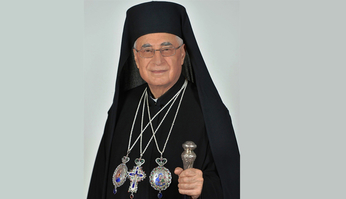
Patriarch Youssef
Visit to London 2005
Lecture at the Brunei Theatre, SOAS (University of London)
Friday 11 November 2005
Christians of the Arab World
Ladies and Gentlemen,
First of all, I would like to thank you for inviting me to this great cultural forum and this prestigious university to talk about the Arab world. I take this invitation as an honour for myself and my Melkite people who first emerged in the Syrian East and have now spread all over the world. I would like to send greetings to them and to the Melkite community who have chosen to live in this historic city as a result of the wars which have ravaged Palestinian and Lebanese territories over the last fifty and more years.
The aim of this short speech about Christians of the Arab world is to highlight the main aspects of Arab Christianity, which began life in the first century AD and has remained in the Middle East to the present. This study will show how Christians have positively interacted with Arab Islamic society, in shaping one civilization, the Arab civilization. It will also show the key role of Christians in setting up Islamic civilization, especially in the time of the Abbasid Caliphate. A further aim of this publication is to inform Western European society about the reality of the Arab world’s Christians, who have been enormously neglected and virtually forgotten by modern Europe.
Christians of the Arab world means those who belong to the Eastern Churches: the Church of Antioch, the Church of Seleucia-Ctesiphon (which originated from the Church of Antioch), the Church of Jerusalem and the Coptic Church of Alexandria. These churches have been called collectively the Levantine Church. This Levantine Christianity, arabized in the course of history despite the existence of proper Arab Christianity before Islam, ought to be called the Arab Church and we aim to show its historical identity in this study. We shall briefly explore the intellectual influence of Levantine Christianity in the Arab world, the so-called Arab Christian heritage, due to its great importance in shaping Arab Christianity, or more precisely the Arab Church. However, it is impossible to avoid mention of some of the dark stains that spoiled the fraternal relationship between Christianity and Islam throughout history, but it is to be hoped that such mistakes will not recur. Anyway, no matter how black these episodes were, they were natural occurrences, as all people everywhere have experienced and some are still experiencing such episodes of injustice, hostility, killing and destruction. On many occasions, these troubles took place even among groups of the same people, of the same religion and in the same country.
At first, the Arab Christian heritage was localised within the Arabian Peninsula, then it moved to the Levant in the days of the Umayyads and to Iraq in the days of the Abbasids. It also flourished in Egypt under the Fatimids and Ayyubids. This Arab Christian heritage emerged again after a long period of decline in the modern Arab renaissance in the Lebanon, then spread all over the Arab East. In the Abbasid era, translators were mostly Christian Melkites, Jacobites (Syriac Orthodox Christians) and Nestorian Christians (Chaldeans and Assyrians). Thanks to them, Greek sciences were passed on to Arabs and then returned, also by Arabs to modern Europe through Andalusia in southern Spain.
The Christian scholars who excelled in various Islamic ages are too numerous to mention as there are hundreds of them, and they dealt with all fields of knowledge, especially medicine, chemistry, mathematics, astronomy, philosophy and theology. These scholars interacted very closely with their Muslim brothers. This is noticeable in the glories of Arab civilization which were developed with their efforts and those of their Muslim colleagues. Jews and Mandaeans also played a major role in creating the Arab intellectual renaissance. This fraternal intellectual cooperation among Christians, Jews, Muslims and Mandaeans had its golden age in the time of the Abbasid Caliphate. Though few in numbers during the first millennium, Muslim, Jewish and Mandaean scholars cannot be referred to in detail here, since this study is focused on the Arab world’s Christians who, without exaggeration, have constituted the cornerstone of Arab intellectual renaissance across the centuries.
Arab Christians before Islam
Christianity began to spread among Arabs from the first century AD, and more specifically about fifty days after the resurrection of our Lord Jesus Christ, on the day of Pentecost, when Arabs witnessed the descent of the Holy Spirit upon the disciples of Christ and the start of the Christian mission in the world . It seems that Arab Christianity first spread in southern Jordan among Nabataeans, who offered shelter to Saint Paul after his conversion to Christ on the road from Jerusalem to Damascus. That is why the Arab Christian intellect is deeply rooted as it developed several centuries before the emergence of Islam. It is enough to mention here some aspects of such intellect in the Jahiliyah Age.
No researcher has any doubt about the great role which Arab Christians played in spreading Arabic script which originated from the Aramaic–Nabataean script. It is known that Arabic scripts from the north of the Arabian Peninsula which have come down to us were written in a Christian environment, and that they originated from the Nabataean script is commonly believed by most scholars. The oldest northern Arabic inscriptions found on the gates of churches date from 512 AD. Some of these are scripts in Zabad, to the southeast of Aleppo, written in three languages: Syriac, Greek, and Arabic. Other scripts are in Harran, inscribed in two languages: Greek and Arabic, in the year 586. It is scientifically established that Christian calligraphers in Hira are those who devised the Kufi script, which was used in writing the Qur’an.
Christianity spread among some Arab tribes and according to Ibn Qutaybah, “Christianity spread in the Rabeeah and Ghassan tribes and in parts of the Qodaah tribe.” The Bani Assad tribe were of high prestige in Makkah and the nearest to Christianity among all clans of the Quraish. According to Ya’qubi, “Most of them became Christians.” They considered as their “allies” some Ghassanid Christians who were lucky enough to inhabit the plain of Makkah, where honourable people lived and to reside next to the Ka’aba, the holiest place in Makkah. There were other Christian communities before Islam in Makkah, such as the Ethiopians, who entered Makkah in successive groups. One of the large Arab tribes that embraced Christianity was the Taghleb tribe, who inhabited the North East part of the Arabian Peninsula. The Taghleb’s neighbours, the Bakr tribe, also became Christian. The main tribe in Kindah embraced Christianity as well. The centre of Kindah, the so-called Ghamr Zi Kindah, was located a two-day walking distance from Makkah. Some historical references indicate that the majority of the Kalb tribe also embraced Christianity and Othman bin Affan married a Syriac Jacobite Christian woman called Naela who belonged to this tribe.
Nestorian Christianity also spread in the eastern part of the Arabian Peninsula and was structured into ecclesiastical dioceses and bishoprics. In Syriac, this region was known as Beit Qatraye, which means the house of Qatari people, which nowadays includes Bahrain, Qatar and Oman. To the south-western side of the Arabian Peninsula, the kingdom of Axum emerged in the first century, occupying Yemen for a short period towards the end of the third century. Axum’s king was a Coptic Monophysite Christian and the Bishop of Axum maintained links with the Coptic Church in Alexandria. To the south of the Arabian Peninsula was the Christian city of Najran, which was Monophysite, and an ally of Axum. Both Najran and Axum were allies of Byzantium. Najran maintained a continuous relationship with the Syriac Church in Iraq thanks to the commercial routes between the Arabian Peninsula and Iraq. Christian merchants took Christianity with them to the Yemen from around the middle of the second century. It seems also that the Nestorian Church was strong in several regions in Yemen, from the beginning of the fifth century. The Lakhmids were a great Arab Christian tribe who in the pre-Islamic period spread around the Euphrates River; their capital was Hira (near Kufa today), and they were allies of the Persians against the Byzantines. Christianity also spread among the Nabataean Arabs, particularly in Petra city, in south Jordan. The bishop of the kingdom of Palmyra in the Syrian desert, Paul Samusati, was an Arab who acted as the treasurer of Queen Zenobia.
This introduction to the existence of the Arab Christians in Jahiliyah, demonstrates how they participated in shaping Arab civilization right from its beginning, before Islam. It also confirms that the first Muslims knew Christianity very well from the time of the emergence of Islam in the Arabian Peninsula.
Arab Christianity at the Time of the Emergence of Islam
Islamic biographies tell the story of the priest Sa’ida, as Muhammad listened to him preaching in Oqaz Market. Another priest, Waraqah bin Nawfal, was acquainted with Muhammad for more than forty years, and looked after him and married him to Khadijah. There is a direct relation between Christians and Muhammad through his mother-in-law, Aisha’s mother Um Ruman who belonged to the Christian tribe Tay. Abu Bakr al-Siddiq married her to form an alliance and marriage relationship with her tribe. It is known that Othman bin Affan married his daughter Um Habibah to a young Christian. The marriage of Muhammad to the Coptic girl Maria had some impact in reinforcing relations between Muslims and Christians, according to parts of the Hadith, which recommend Christians to Muslims. Perhaps the worst clash with Christians in the days of Muhammad was his debate with the Christians of Najran who came to see him. This debate ended with him invoking Allah to curse the “liars.” Muhammad also had a good relationship with Ethiopian Christians who lived in Makkah. Among them were Bilal and his brother Ruwaiha; Bilal used to walk in front of the Prophet holding out his sword. They offered support to Muhammad when Muslims sought refuge with al-Najashi, the king of Ethiopia. These good relations between Muhammad and Christians paved the way for the following famous verses of the Qur’an to be revealed, “Strongest among men in enmity to the believers wilt thou find the Jews and pagans; and nearest among them in love to the believers wilt thou find those who say: We are Christians; because amongst these are priests and monks who are not arrogant; and when they listen to the revelation received by the Apostle, thou wilt see their eyes overflowing with tears, for they recognize the truth; they pray: Our Lord! We believe; write us down among the witnesses.”
There are seventy-eight verses in the Qur’an which mention Christians, including the verses which refer to the People of the Book. Besides, there are one hundred and twenty verses in the Qur’an that touch on the topic of Jesus (Issa) the son of Mary and Mary (Mariam) the daughter of Imran. These verses form about two percent of all the Qur’anic verses, bearing in mind that some of them repeat the above-mentioned verses about People of the Book (Ahlu al-Kitab). Islamic doctrinal schools elaborated on these verses, to develop a clear Islamic concept about Jesus Christ, his mother and Christians in the Qur’an. Muslims’ bestowal of honour on Mariam and on her son Issa, the Christ, is one of the best routes leading to mutual understanding, fraternity and peaceful co-existence between Christians and Muslims. Both Christians and Muslims believe in the prophets of the Bible and the apostles of Jesus Christ. More significantly, they both believe in the existence of one God (Allah al Wahid) who brings Muslims and Christians together in one religious gathering. They also believe in angels, life after death and the resurrection of the dead on the last, or judgment day. Both religions are associated together in some basic religious practices such as prayer, fasting and almsgiving, in addition to their conformity on most ethical and social matters.
The Umayyad Dynasty
When Arab Muslims conquered Damascus in 635 and Jerusalem in 638, they pledged to offer safety to Christian citizens and safeguard their money, property and churches. The Umayyad community then merged with the Christian and the two set up relations of amity and brotherhood between them. Caliph Muawiya married a Christian woman called Maysun al-Kalbieh who remained Christian throughout her life. She gave birth to his successor Caliph Yazeed. The Christian physician Hareth bin Kildah al-Thaqafi was Muawiya’s first physician. Sarjoun bin Mansour, the father of the famous theologian John of Damascus and educator of his brother, was Muawiya’s finance assistant. Christian scholars did not wait for the Abbasid dynasty to exercise their intellectual activity, but rather began with the Umayyads. One of them, called Istefan al-Qadim, translated some chemistry books for Khalid bin Yazeed bin Muawiya (died 704). Another eminent person in Muawiya’s time was Ibn Athal, about whom Ibn Abi Usaybaah says, “Ibn Athal was a first-class, talented Christian physician in Damascus. When Muawiya took power in Damascus, he chose him for himself and treated him with kindness. Muawiya used to listen to his advice on many occasions and conversed frequently with him day and night…” The physician, Abu al-Hakam al-Dimashqi, lived right from the time of Muawiya to that of Abdel Malek bin Marwan. His son, Isaac Ibn al-Hakam al-Dimashqi, widely known as Masih, succeeded him as a physician living in the days of Caliph Harun al-Rashid in the ninth century. Equally prominent as a physician was Tiyadok who died in 709. Towards the end of the Umayyad Dynasty, the monk Abu Jurayj became famous as a physician and wrote several books on medicine. Besides, there were many famous Christian poets in the Umayyad era, of whom doubtless the most distinguished was al-Akhtal al-Taghlibite.
Translation from Greek and Syriac into Arabic flourished, but only on an individual basis, which paved the way for proper translation work in the Abassid era. The monk Istefan was the first to do real translations of medicine, chemistry and astronomy books, in the hope that the deposed Caliph Khalid bin Yazeed bin Muawiya would find the philosophers’ stone which converts metals into gold. Such a skill is part of alchemy, which did not achieve any real progress under the Arabs. Thereafter, in the days of both Marawan bin al-Hakam and Omar bin Abdul Aziz, some medical books were translated, the most important of which being al-Kinash on medicine which was translated from Syriac by Masarjawayh. Then Aristotle’s letters to Alexander were translated by Salem, the clerk of the Christian Hisham. One of the first Iraqi Christians who wrote in Arabic in the seventh century was Habib Abu Ra’itah al-Tikriti. So it appears that there was an intimate relationship between Umayyad Muslims and Levantine Christians. Christians were not cut off from Muslims in isolated areas, but rather shared with them all aspects of life and built together a single civilization, the Arab civilization.
The Abbasid Dynasty
Iraqi Christians, who were mostly Nestorians, intermingled with their Arab Muslim brothers, competing in learning and mastery of the Arabic language. There emerged a group of writers who competed in composing stylistic Arabic texts and excelled in using innovative techniques. They also translated Greek books, already available in Aramaic-Syriac translation and studied and taught them at their schools. Monasteries were packed with valuable books translated from many languages. No book well-known at the time escaped being translated into Arabic and copied throughout the territories. People thus became interested in scientific knowledge; schools and intellectual forums were established and scientific institutes were overcrowded with students and teachers. Aramaic scholars, particularly those who were Nestorian-Assyrians, started teaching Arabic to people of their faith and many Christians became conversant with and proficient in Arabic literature. This impressive rise in knowledge led by Christians during the Abbasid era shows that Islamic scholars were receptive to the wisdom of ancient civilizations such as the Greek, Syriac, Persian, and Indian. They were by no means fanatical or bigoted, as in some cases yet to be discussed. Again, this trend indicates that Christians interacted quickly and unreservedly with Arab civilization and with the Islamic State. A significant feature of the Abbasid era was the brotherly cooperation between scholars and philosophers from all religious backgrounds, whether Muslim, Christian, Jewish or Mandaean.
The Arab Christian heritage also flourished in Andalusia during the Arab conquest. Arabic literature developed and spread among Andalusian Christians, some of whom were prominent, such as Jawad al-Tabib in the days of Prince Muhammad (852-886), Khalid bin Yazeed bin Ruman (died 932), Ibn Malukah al-Jarrah (died 902), Isaac al-Tabeeb, father of the Wazir (912-961), and his son Yahya bin Isaac, the Wazir of al-Nasser al-Rahman (912-961), Usbagh bin Abdullah bin Nabil and Walid bin Khaizaran, who were the rulers of Christians in Cordoba, Muawiya bin Lubb al-Kumes and many others. Even bishops used to write and translate into Arabic, such as Issa bin Mansur, Ubaidullah bin Kassem, Rabih bin Zayd and al-Hafes bin al-Bar al-Quthi (died 889).
The Eastern Church, or Church of the Levant, relied on clerks and physicians to be its competent representatives before (Muslim) authorities. The Church could play its role in developing this civilization whenever it had a patriarch or a bishop characterised by holiness or knowledge and Muslims used to value both. Then the Levantine Church would regain its high rank as a second unofficial religion in the Muslim state. Georgius bin Gibrail bin Bakhtiyashua, a Nestorian Christian, was al-Mansour’s greatly esteemed physician.
On the other hand, the conversion of Christians to Islam, partially attributable to their becoming eligible for exemption from tax, started from the early days of Islam and continued under the first Abbasid Caliph. Sawirus Ibn al-Muqaffa’ wrote, “Abdul Malek circulated to all people in his kingdom that he who becomes a Muslim and says the prayer of Islam will not have to pay tax. So due to the heavy burden of taxes, many rich and poor Christians renounced Christianity and became Muslims.”
What Ibn al-Muqaffa’ said about Egypt was also applicable to the rest of kingdom.
Queen Zubaydah who was al-Mansour’s daughter, al-Rashid’s wife and al-Amin’s mother, deserves to be remembered as the most gracious of all great Abbasid ladies. Mari reported that Queen Zubaydah “used to show respect and hold in honour the Nestorian patriarch Timothy and to favour Christians and employ them.” She participated in making Palm Sunday decorations and crosses of gold and silver and gave Patriarch Timothy gold and silver vessels and luxurious clothing. She also supported Jibrail and Bishop Serjius in getting the Caliph’s signature to rebuild churches and monasteries which had been demolished by Hamdoun bin Ali’s men. The Melkite Syriac Bishop of Harran, Theodoros AbuQurrah (740-820) who was born and brought up in Edessa, left behind forty-three publications, which are some of the oldest Christian literary works in Arabic.
Al-Rashid’s days were the happiest for Christians of the Levantine Church . Dialogue, or more specifically debate, was something familiar and common. Radical Muslims used to prefer quiet discussions with Levantine Christians, because they were their compatriots, their allies in good times and bad and their real partners in developing Arab and Islamic civilization. Abu Ishaq al-Fazari al-Kufi, who died in 802, said in Ibn Battah al-Akbari’s book, al-Sharh wa al-Ibanah, “I prefer to sit with Christians in their church rather than to sit with a group of people arguing about their religion”. Also, al-Fadl bin Ayyad, who died in 803, said: “I prefer to eat the food of a Jew and a Christian than to eat the food of a (Muslim) heretic”.
Circumstances of the Abbasid Caliphate changed from the time of al-Moatasim, because Turks held positions of authority and were responsible for acts of extremism against Ahl al-Kitab and in particular Christians. Turks held office as chiefs of police and secret service in the Abbasid State and al-Moatasim kept them in his entourage. Turks gradually gained control of most influential positions in the Abbasid State, becoming its real rulers, while the caliph was merely the symbolic figurehead of the Islamic Empire. Their control was most powerful in the days of the Seljuks (1077-1307). It will become apparent that most Muslim rulers’ injustice to Christians was due to the power of the Turks in the Abbasid State.
In 838, one of al-Moatasim’s sons, Abi Dawoud, who was considered by Mikhail al-Siriani to be the enemy of Christians, “procured an order from his father prohibiting Christians from displaying their crosses outside churches, ringing their church bells, raising their voices in prayer or at funerals and displaying alcohol in any city or along the roadside. So Christians have remained since then at the mercy of chiefs who execute this order either strictly or leniently, depending on their own discretion or on what they earn.” This statement explains the earliest and most important reason for the conflict between Christians and Muslims, “These are matters which chiefs and rulers cannot tolerate, unless bribed by someone offering them a gift.” The rest of the statement explains the standard outcome, that the Christians give up their religion and embrace Islam to avoid injustice. When the situation calms down, they attempt to return to Christianity.
Caliph Abu al-Fadl Jaafar al-Mutawakkil (847-861)
Arab Muslims, who had rid themselves of Byzantine influence after leaving Damascus, encountered the Greeks again through the translations of Bayt al-Hikmah (the House of Wisdom), and became confused between the Persian and Turkish factions once these challenges of philosophy emerged. In al-Mutawakkil’s reign, Hunayn bin Ishaq (809-873), a Nestorian Christian, was considered the greatest intellectual of the ninth century and one of the most productive and brilliant men of all time. He played a major role in developing Arab civilization through his numerous translations from Syriac and Greek into Arabic, in various fields of knowledge in the days of Caliphs al-Mustaeen and al-Moatamed. Ishaq bin Hunayn, who died in 910, was the youngest son of Hunayn bin Ishaq and was one of the most famous physicians of the time. He was rated highly by the three Caliphs al-Mutawakkil, al-Moatamed and al-Moataded and particularly by Qassem bin Ubaidullah, the Vizier of al-Moataded. He equalled his father’s reputation in translating philosophy books from Greek into Arabic. Some translations of medical books have also been attributed to him.
During the reign of Caliph al-Mostaeen, some Christians were entrusted with high positions. Among them was Bushor bin Harun, the clerk of Muhammad Abdullah al-Tahiri, the then ruler of Khurasan, Taborstan and all the Levant. His brother was Jabr bin Harun, deputy ruler during the ruler’s campaign against Taborstan. They had a third brother called Ibrahim, a clerk. Unforgettable also was the well-known physician Jibrail bin Bakhtiyashu who died in 869.
Reign of Caliph al-Moataded (922-902)
Al-Moataded’s rule was characterised by tolerance for Christians, as he favoured them and preferred them to other non-Muslims. He used to address his clerk Abdullah bin Soliman saying, "If you find a Christian man suitable for your job, then employ him, because Christians are more trustworthy than Jews who are looking forward to restoring their kingdom and Christians are more trustworthy than Muslims who may use their status to capture your position and Christians are more trustworthy than the Magi because the Magi ruled this kingdom before." In short, Levantine Christians were ideal civil servants, as they neither sought to take power, nor felt any hidden hostility to the Caliph.
Christian physicians featured in al-Moataded’s entourage as well as in that of preceding Caliphs. The most famous physician was Ghalib, who had previously been physician to al-Mowaffaq. Arib bin Saad al-Qurtubi also mentioned the influence of Christians at that time, “To go up the social ladder, one has to claim links with Christians by saying ‘my family descended from yours and my ancestors are akin to yours’.”
Christians carried out translation work into Arabic for their own spiritual heritage, a fact which emphasizes, once again, the willingness of Christians of the Arab world to be integrated into wider Arab Islamic society.From the beginning of the eighth century, Arab Christians used their Arabic language in writing Christian theology. One of the earliest manuscripts extant, a Melkite script, goes back to 746 and another to 770. These were written in a language mostly dependent on the Bible and the Qur’an, and were largely free from Greek philosophical thought, which indicates their antiquity. Other small theological scripts from that period, or a little earlier have survived. Among the first Melkite writings dating from the middle of the eighth century, the most famous were the writings of Theodoros AbuQurrah. Another script in Arabic was written by the Nestorian Patriarch. It consists of a dialogue held in 781 with Caliph al-Mahdi. In the early ninth century, and particularly during the reign of Caliph al-Ma’moun, the number of Arab Christian dogmatic writings greatly increased. However, in Egypt, these theological works were not produced until around 940 by bishop Sawirus Ibn al-Muquffaa. These writings and others which were produced before the thirteenth century, reiterated that all Christians agree in their beliefs and disagree only in their expressions. Moreover, starting from the ninth century, Arab Christians began to change gradually the language of their liturgical prayers into Arabic, particularly among the Melkites and Maronites. The Gospels were translated by the end of the ninth century. Some translation efforts which laid down the main elements of Levantine theology and liturgy in Arabic will be mentioned later. Such translations played a major role in laying down new and significant foundations for the Arab Church.
Reign of Caliph al-Moqtader (908-932)
Caliph Abu al-Fadl Jaafar al-Moqtader Billah bin al-Moataded issued an order for the exclusion of Christians and Jews from the offices of the Caliphate, allowing them only employment in accountancy and medicine. He forced them to wear discriminative dress and other such signs on their clothing. The Fatimid Caliphate was established in 909 AD in Tunisia, during the reign of Caliph al-Moqtader. The Fatimids (or Fatimites) challenged the Abbassid Caliphate, and sought to compete with the Abbasids for Islamic leadership. The Fatimid Caliphate was the only large Shi’ite Caliphate in Islamic history. Their rule was characterized by tolerance and sympathy for the Dhimmis (non-Muslims), except during the reign of Caliph al-Hakim, which will be mentioned later on.
In this period, the famous Egyptian Christian physician Said bin Bitriq (877-940) wrote many books on medicine and Christian theology. Abu Bushor Matta bin Younis, known as Ibn Yunan, who died in 930, was a physician, philosopher and teacher of al-Farabi who translated several books from Greek into Syriac and Arabic, including some books of Aristotle.
Among the Christian scholars worthy of mention in this period of the Islamic Caliphate was a Syriac Jacobite called Yahya bin Uday al-Takriti, who died in 975. Ibn Abi Usaybaah says about him, “He led and mastered philosophical knowledge and taught Bushor Matta and Abu Nasr al-Farabi, as well as others. He was unique person in his era.” He translated around ten books from Aramaic-Syriac into Arabic, wrote more than fifty dissertations and produced many interpretations and translations. Also of the tenth century was Abu Bushor Severus Ibn al-Mukaffaa, the first Coptic writer to write in Arabic.
Reign of Caliph al-Qaa’em (1031-1075)
The year 1037 witnessed the reimposition of Omar’s Pact/Conditions. An official meeting was held in the presence of the two leaders of Ahl al-Dhimmah (non-Muslims), Patriarch Elia I and the Jewish community leader. Both leaders committed themselves to comply with the discriminatory measures placing their communities at a lower level than Muslims’, as well as refraining from building houses higher than those of Muslims and so forth. The rule about the construction of domes of churches in comparison with the minarets of mosques remained enforceable for long centuries. During the reign of al-Qaa’em, some Christians converted to Islam, to get rid of the restrictions on Dhimmis.
However, this period witnessed the emergence of some Christians in various fields of knowledge, such as Abu al-Hussein al-Basri, a philosopher and physician, who died in 1038, the prominent philosopher and physician Nazir Ibn Sina (Avicenna), and the Nestorian theologian Abu al-Faraj Abdullah bin al-Tayyib who died in 1043. “He was a great, prominent and knowledgeable scholar and an expert in philosophy, with extensive works on the subject.”
Throughout the history of the Islamic Caliphate and other eras Syriac and Nestorian Christians evidently cooperated with Muslims through thick and thin against their common enemy, the Byzantine Greek Christians. This Christian-Islamic alliance against the Byzantines played a major role in merging Aramaean (Syriac, Nestorian and Melkite) Christians with Arab Islamic civilization and ensuring their willing and sincere participation in developing it, using all the scientific, social and cultural resources at their disposal. However, the Muslim Caliph set the rule for establishing the hierarchical relationship of Christian sects in the Land of Islam. Thus, he granted the Nestorian Patriarch superiority over the Syriac and Melkite Patriarchs. In 1087, in this period of the Abbasid Caliphate, an anonymous Coptic writer wrote in Arabic Confession of the Fathers. The value of this book stems from the fact that it was one of the first attempts by a Christian to translate into Arabic writings of the Church Fathers.
Among the attempts to translate the Levantine Christian heritage into Arabic at this time were the theological books of Christian writers such as the Copt, Semaan bin Kalil bin Maqqarah in the twelfth century.
The Crusades
The Crusades began in the Levant (the East) during the rule of Caliph Abu Abbass Ahmed al-Mostazher. In 1099 AD, the Crusaders conquered Jerusalem, massacred or held in captivity its inhabitants and committed horrible atrocities, even in the sacred al-Aqsa Mosque. Then, Muslim clerics began to urge Muslims to fight. However, they never attacked the Christians who were living in the Land of Islam, but rather protected them. They considered the war on Jerusalem as an attack of the West on the East. However, Muslim kings and rulers were quite aware that Christians of the East had nothing to do with the Europeans (Crusaders), except for some individuals whose dealings were limited and insignificant. Therefore, there was no change in the principal attitude of religious jurisprudents at the time towards Christians as a result of the Crusades, as they were keen to draw a clear line between their attitudes towards internal (Oriental) Christians and external (Occidental) Christian Crusaders. Even Muwaffaq al-Din bin Quadamah, one of the most fanatical men (died in 1223) who supported fighting against the Europeans (Crusaders), issued a Fatwa for protecting the Dhimmis.
The Decline and Ascent of a Civilization
The real decline of Arab and Islamic civilizations started from around the middle of the twelfth century, despite the victories achieved by the Islamic military over the European Crusaders, since these did not lead to the regeneration of civilization, as had happened in the first phase of the Abbasid Dynasty. However, during the same century, Arab civilization remained prosperous in Andalusia, whence Arab and Islamic knowledge was overflowing into Christian Europe. The twelfth was really the best century in the history of philosophical thinking in Islamic Spain, thanks to the emergence of such prominent figures as Yahya Ibn Bajjah, known in Latin as Avenpace or Avempace (died 1138), and Muhammad Ibn Tufayl, whose philosophical thought was translated into Latin by Edward Pococke in 1671. Indisputably the greatest, however, was the distinguished Arab philosopher, Muhammad Ibn Rushd, known in Latin as Averroes (died 1198) whose writings played a great role in the revival of philosophical thinking in Europe. Lastly, one of the most prominent Arab scholars in Spain was the Sufi mystic, Muhammad Abu Bakr Muhyiddin Ibn Arabi (died 1340) whose writings influenced European scholars such as Duns Scotus, Roger Bacon and Raymond Lull.
The decline of Arab civilization in the East coincided with the rise of the European Renaissance in the thirteenth century, triggered by translations of Arab science and philosophy from Arabic into Latin. The first translator of a number of books on medicine was Constantine the African, who died in 1087. Robert of Chester translated al-Khawarizmi’s Algebra into Latin in 1145. However, the most famous and most active translator was Gerard of Cremona (died 1187) who translated numerous Arabic books of philosophy for writers such as al-Zahrawi, al-Razi, Ibn Sina and al-Farabi. By 1150, other translators had translated the works of the Arab-Spanish philosopher, Solomon Ben Gabirol, known as Avicebron or Avencebrol, who died in 1058. His writings had an impact on the medieval European scholastics. When the Spanish Christians occupied Toledo in 1085, this city became a focal point for translating books of science and philosophy from Arabic into Latin, as had happened before in Baghdad, when Levantine Christians translated Hellenistic literature from Greek into Arabic.
Among these translators was, for instance, Robert Scott (died 1236) who translated some of Ibn Rushd’s (Averroes’) books into Latin. In 1250, the first School of Oriental Studies in Europe was established in Toledo itself. Its main objective was the study of Arab-Islamic civilization with a view to convincing Muslims to convert to Christianity. Translation works expanded beyond Toledo and Arab knowledge was passed to many European cities such as Marseille, Toulouse and Montpellier, as well as the famous Monastery of Cluny, where the Abbot Peter the Venerable carried out, between 1141 and 1143, the first translation of the Qur’an into Latin. Besides, from the tenth century, Arab knowledge started to spread as far as the Lorraine area. Thus, cities like Liège in Belgium and Cologne in Germany became famous for it. So the brilliance of Arab civilization moved into the West and by the end of the thirteenth century, Arab science and philosophy made contact with Europe through Spain. For their part, Arabs and Muslims were then entering a long period of dormancy and cultural decline, which lasted until the arrival of the Europeans in the nineteenth century, prompting the modern Arab renaissance.
By the end of the Abbasid Caliphate in the second half of the thirteenth century, Christians had become a minority in the Land of Islam so that their rulers used to ignore them. Christians became in fact a group marginalised by the Islamic majority, striving for survival in their own homeland. This situation persisted until the collapse of the Ottoman Empire in the nineteenth century, when the modern Arab renaissance took place.
Reign of the Mamluks
Mamluks took power in Egypt and the Levant in addition to controlling other countries. The Mamluks were, like the Seljuks, foreigners in the area. They may have been Muslim because they were brought up and lived in the region, but never became an integral part of the Arab social fabric, contrary to what Arabs of various groupings had achieved under the Umayyad and Abbasid dynasties. Mamluks were spendthrift and their continuous need for money meant that they had to confiscate properties of very rich people, especially the merchants’. The proportions confiscated from Christian merchants were always higher than those of Muslims, because Christian merchants were deeply involved in commerce. Unfortunately, some Muslim rulers, before and during the Mamluk period, used to frighten Christians and humiliate them by demolishing churches in order to get money, something which Islam rejects absolutely. When Mamluks conquered parts of Armenia, they destroyed some of its big churches, contrary to what Islam allows. It was reported that the fall of Constantinople into the hands of Ottomans in 1453 delighted the Mamluk Sultan, who celebrated this event by confiscating properties of some Christians, imprisoning others and demolishing churches. Historians who describe this conquest confirm that Muslims demolished churches, which is unjustifiable by Islamic judicial principles.
The year 1300 witnessed the Dhimmis (non-Muslims) in a predicament in Egypt due to their extravagant lifestyle, food and clothing. The Sultan issued decrees to restrict their excesses in “riding fabulous horses and using mules garnished with expensive ornaments.”
Historians of that time omitted to mention that the number of Dhimmis who embraced Islam in the whole country was increasing regularly. It would probably mean that the majority of the population became Muslim by the eleventh or twelfth century, which also meant that Christians became by then a relative minority.
At the outset of the Mamluk period, in the middle of the thirteenth century, Arabic became the language of people living in the whole Fertile Crescent, except for some Syriac islands here and there, where Syriacs, Nestorians and Maronites lived.
The translations done by Christians before the Mamluk period had played a major role in educating Muslims in various fields of knowledge. No longer the preserve of Christians only, as was the case at the beginning of the Arab Islamic era, science and knowledge now became available to all. The scholars and companions of rulers’ palaces were by now in the majority Muslim, so the virtual Christian hegemony there disappeared at last. Although there was no great Christian contribution to intellectual civilization at the beginning of the Mamluk period, the physician, philosopher and mathematician, Abu al-Faraj Ibn al-Quff (1233-1286) mastered all fields of Arabic literature, and compiled several medical books.
The seat of the Orthodox Patriarchate of Antioch was finally removed from Antioch and relocated to Damascus in the second half of the fourteenth century.
The Ottoman Dynasty
In the Ottoman period, in 1534 Palestinian Christians lost their Arab Patriarch, who had always been an Arab from the fourth century onwards, for a Greek one, as is still the case today. However, the Ottoman State used to treat Copts (Coptic Orthodox Christians) with equity and justice. Istanbul gave permission for the construction of the Cathedral of Yazbakiyah and the reconstruction of some ancient churches previously demolished. Coptic studies were re-established and brought back almost to their previous position. So Copts played a great role in managing the financial and administrative affairs of the Ottoman regime and some of them, such as the two Jawahri brothers, had the opportunity to gain great wealth. The first part of this period offered some stability to Christians, but this was blemished afterwards by several massacres. On this subject, Father Jean Corbon says, “Faithful believers sighed with relief under the Ottoman Regime (1516-1918), so that Christian emigration stopped and people were put in powerful administrative provinces. However, this could not prevent a number of local blunders which did not allow the construction of churches, but forced Christians to settle together in large communities in cities like Damascus, Aleppo and Mosul. They were also attracted to move into the mountains where they found good shelter, such as Mount Lebanon and Kurdistan. However, during the period of the decline and fall of the Ottoman Empire, misfortunes hit again in events such as the Armenian massacres after 1915, which cost the Christians one and half million (1,500,000) lives, and pushed the survivors to emigrate to North Syria and Lebanon. Another setback struck in the massacres of Syriac, Orthodox and Catholic Christians in East Anatolia, followed by a huge exodus towards Iraq, Syria, Lebanon and Egypt. In the twentieth century, and more precisely in 1925 in Turkey, in 1933 in Iraq, and in 1946 in Iran, Christians of those churches paid a high price in massacres which were committed only to please the great powers struggling against one another to win Kurdish land and oil. Finally, the Palestinian issue emerged, and half the Palestinians were driven out of their country, including a large group of Christian Palestinians, who lost their legal existence among nations of the world."
Modern Arab Renaissance
The early features of the Modern Arab Renaissance started with the emergence of European Christian Missions during the nineteenth century, which came in succession into Lebanon, Syria and Palestine, to the extent that France alone had, at that time of the Ottoman Rule, about five hundred schools representing twenty sects and hosting about fifty thousand male and female students. In 1860, the English Syrian mission arrived and established schools for boys and girls in Beirut, Zahle, Baalbek, Ein Zhalta, Shamlan and Hasbayya. Before the end of that year, Prussian nuns, who specialized in orphanages and hospitals, established their centre in Saida (Sidon) and afterwards moved to Beirut. The Knights of St. John chose Beirut in which to set up their hospital, named after their patron saint. In 1860, the American Mission established the English School in Ebeih and other centres of learning in Suq al-Gharb, Saida (Sidon), Hasbayya and Tripoli in later years. In 1861, they also established the Evangelical School for Girls in Beirut. In addition to Latin, English and American cultures, the nineteenth century witnessed the emergence of Russian culture in Lebanon when, in 1887, the Lebanese Orthodox Emilie Sursok established a school in Beirut teaching Arabic, Russian and French. The activity of Russian schools extended to Shuweifat in 1894, to Douma in 1895, to Amyoun in 1897, and to Kosba, Zahle Baskinta, Hasbayya and Rashayya in 1900. For the Lebanese, these foreign schools constituted both incentives and role models. So they started to establish their national schools, both religious and secular. The denominational trend prevailed in the establishment of Lebanon’s Christian schools, but they have continued to admit students from various denominations and religions until today. These schools used to offer courses in Arabic, Syriac, Latin, Italian as well as all the subjects delivered at great European schools. Most of these schools are still flourishing today; they offer courses in French and English and apply European educational systems of tuition.
The founder of modern Egypt, Muhammad Ali, started to set up schools in his country not just for military sciences, but also for pharmacy, engineering and agriculture. Unfortunately very few of these educational institutions remained after his death, as his son Abbas (1848-1854) sacked all foreign advisers and stopped the foreign schools and most European-style institutions. Said (1845-1863) succeeded Abbas and applied a similar policy of resistance to Western methods. However, Ismail (1863-1879) had a special consideration for the West. The American Presbyterian mission had started its activity in 1856. During the rule of Ismail, the American College for Women started in 1861 as a primary school in Cairo and an American college was established in 1865 in Asyut that is still functioning today. The rule of Muhammad Ali Pasha encouraged the development of the Coptic Church while Patriarch Butros VII headed the Coptic Church from 1809 to 1852. During this period, the first bishop of Sudan was ordained, and a Coptic mission was sent to Ethiopia. This line of action continued with Patriarch Kyrillus IV who headed the Coptic Church from 1854 to 1861. He paid great attention to primary education and established the Coptic Orthodox College. The Khedive Ismail, the Egyptian Muslim ruler, granted this college fifteen hundred acres of land to provide for its expenses. Patriarch Kyrillus inaugurated the first college for girls in Egypt and completed the construction of Uzbakiah Cathedral.
From 1864, Protestant Churches took a great interest in the education of Egyptian Christians, so they established several schools in Egypt for the Egyptian Evangelical Church, the most famous of which are Rameses College and Asyut College. In 1920, American Protestant missionaries founded the American University of Cairo, which played a great role in educating a celebrated elite in twentieth century Egypt. After the British Army occupied Egypt in 1881, there was an increase in the number of students learning European languages and sciences, so missionaries increased their educational activities. The Jesuits established their school in Alexandria, the African or Comboni Fathers set up schools in Tanta and Zagazig, and the Christian Brothers (Frères) established schools in several places in Egypt.
Besides, the activities of the Arabic media flourished in Egypt. In 1828, the first Arabic newspaper was published in Cairo, namely Al-Waqaae al-Musriyah newspaper, which was founded by the ruler, Muhammad Ali. Then, in 1855 Rizqallah Hassoun, an Armenian, issued Miraat al-Ahwaal newspaper in Istanbul, but it lasted only for a short time. Afterwards many Arabic newspaper and magazines were published both in Beirut and Egypt, such that the Lebanese, mostly Christian Lebanese, were the founders and editors.
Another aspect of this modern Arab cultural movement is the spirit of Arab nationalism which started first as a purely intellectual movement focusing on the study of Arab language and intellectual heritage. During the Ottoman occupation, Muslim Arabs used to glorify the Sultan under the slogan of the unified Islamic Caliphate and go all together to the Sultan’s schools to learn Turkish in order to take up employment in government. In contrast to this, the schools and monasteries of Christian Arabs alone protected the Arabic language and secured the Arab heritage, stirring the national spirit of their people. The Arab political and literary renaissance was launched in the classrooms of these Christian schools, where both Muslim and Christian students learned together as a family the concept of Arab nationalism and liberation from Turkish colonialism and it is thanks to these schools that the country is enjoying independence nowadays.
The pioneers of Arab nationalism were mainly Syrian thinkers and Lebanese Christian intellectuals who were educated at national and foreign academic institutions. Lebanon became a focal point for Arab liberation from the Ottoman occupation, because Lebanon was open to the West more than any other Arab country, mainly because thousands of Lebanese people had emigrated to the new world in America and Europe and managed, through correspondence and frequent visits, to keep the light of freedom, independence and democracy shining continuously.
Christian-Muslim Dialogue
There is one last important issue to be discussed briefly: how far has Christian-Muslim dialogue proceeded? There is no need to mention directly those Muslim-Christian conferences designed to remove the barriers between the two biggest religions in human history so that people may live in a religious society that looks for peace and fraternity. Western Christians took the initiative to launch this dialogue in the sixties of the last century, with the Second Vatican Council a significant turning point in Muslim-Christian relations. The Pontifical Institute for Arab and Islamic Studies was established in 1964 in order to encourage Muslim-Christian dialogue. The Secretary for non-Christians has arranged various activities, meetings and forums over the years between both parties in order to remove obstacles between the two religions. There are tens of Muslim-Christian dialogue centres all around the world. However, Muslim-Christian dialogue began in the East from the time of the emergence of Islam and has continued there to the present. This study has presented some aspects of this dialogue which have been ignored by Westerners for centuries. The dialogue in the East has not just consisted of conferences and documents, but rather has been a dialogue of Muslim-Christian coexistence, as Muslim and Christian groups interacted with each other in one society, merging together in sorrow and in joy and building together a decent Islamic society and a reputable Arab civilization. Here, I would like leave the glories of Arab Christian-Muslim history, whose milestones have been highlighted in this brief study, to talk about the dialogue of the Muslim-Christian society as experienced currently by ordinary people living together in a small Lebanese village called Mlikh, which I know very well because it is my hometown, where I was born and brought up.
An Exemplary Model of a Christian-Muslim Dialogue
Christians and Muslims have been living together for hundreds of years as one family, in wall-to-wall adjacent houses and sharing food and drink with one another. What makes life pleasant is that they cooperate, as farmers and peasants, in planting and harvesting olives, walnuts and other crops and distribute them among themselves like brothers every year. When any woman, whether Muslim or Christian, gives birth to a baby, she immediately gives her baby to another mother, a friend of the other religion, to suckle him in order to make both babies, Muslim and Christian, grow up together as brothers, as the suckling bond at birth is a strong brotherly contract, according to prevalent Arab folk traditions. This may explain the frequent recurrence of words like “my brother” and “my sister” in Muslim-Christian villages. Our ceremonies are always common, in good times and bad, there is no feast confined only to Muslims or to Christians. In fact Greater Bairam and Lesser Bairam (Eids) which are important Islamic feasts, are considered feasts for Christians as well. The same thing happens when Muslims celebrate with their Christian brothers Good Friday and Easter. Our Christian shrines to the Virgin Mary and common Prophets are visited frequently by Muslims for prayers and intercessions.
I do not want elaborate too much about the story of Christian-Muslim brotherhood in the Arab East, but I am proud to say that our coexistence is a leaven for Christian-Muslim harmony all over the world. Hundreds of villages in the Lebanon and in many places all over the Arab world give this brotherly witness to the one family of God on earth. I hope that conferences of Christian-Muslim dialogue may pay special attention to these brotherly Muslim-Christian communities and learn from these people, who are not spoiled by the venality of politics, how to build bridges of grace and brotherhood between Muslims and Christians all over the world.
Conclusion: Church of Arabs and Muslims
1- Muslims and Christians are not on two clashing fronts. In fact, they are primarily one human family before God, the Lord of all creatures, who is not possessed by anyone, but to whom we all belong and shall return. Co-existence of Christians and Muslims originates from their appearance together to present themselves before God, who invites us to be united to serve human beings who are in anguish because of their numerous problems. Christians of the Arab world are most qualified and capable of answering the questions asked in a Christian-Muslim dialogue and to find a common religious and moral platform for both religions, because of their enormous contribution to the civilization of the Islamic world from its early days to present. Thus, they can play a major role in bridging the gap between Christians and Muslims of the whole world. Besides, they will be capable of converting the conflict between both religions into a civilized and positive co-operation, based on mutual respect. One of the main features of Christianity in the Arab world is that it forms a link for dialogue and understanding between two world communities in confrontation: Christianity and Islam. Their civilized contact with Muslims in the East, in addition to their religious partnership with Christians of the world, should entitle them absolutely to play this civilized role between Islam and Christianity.
2- On 24 August 1990, the Council of Catholic Patriarchs made an appeal to Christians of the Arab World, expressing deeply the feelings of all Christians sincere to their cultural identity in the Arab World. A part of the appeal states as follows, “Christians in the Arab East form an integral part of the cultural identity of Muslims and Muslims in the Arab World form an integral part of the cultural identity of Christians. Accordingly, we are committed to each other and such commitment will be accounted for, before God and history. Thus, we have to search continuously not only for coexistence, but also for creative and fruitful liaison which guarantees survival and safety for all believers in God and believers in our countries, away from instruments of rancour, extremism, stereotyping and rejection of the other. We are convinced that our genuine spiritual and religious values can help us overcome the problems that obstruct the progress of our coexistence” …. The appeal continues by saying: “Lo, Christians! Do not step aside or isolate yourselves, as if public affairs do not concern you, or they are not of your concern. In fact, you should be in the heart of society and be committed to offer every service you can. ….. You should not get used to the feeling of fear, isolation or alienation. Instead, you should be open to the whole Arab world to which you belong. Be brothers to every Arab brother, and participate generously and wholeheartedly in building the Arab world, especially during this period in which the future of the region will be decided.”
3- Various problems suffered by human beings today are not just Christian or Muslim problems, but rather human problems that affect all believers together in both religions. One of the most important human problems is social justice and the hegemony of the rich over the poor in the world, violating the Universal Declaration of Human Rights. Besides, there is the problem of social ethics and the degradation of religious and moral values; and the secular understanding of gender and sexual life, which conflict with our religious ethics of marriage and procreation. The problem of atheism is getting worse nowadays and is destroying the basic tenets of all religions of the world. There are also the problems of technology which is causing pollution in the world, and threatening the health of mankind and destroying the environment. There are the problems of wars which are still destroying international peace and stability among nations and increasing terrorism all over the world as well.
4- Muslims should follow the approach of the West in dealing with issues regarding minorities, by offering them their full civil and religious rights so that all citizens of the same country are treated equally when making laws and when applying them. They should also protect Christian minorities who are living in countries with a Muslim majority, and do their best to reduce emigration of Christians to the West, a problem which has worsened in the last decades because of lack of balance in civil rights, and consequent on their deep concern about leading an unstable life, only because they are Christians. The Second Vatican Council is honestly calling upon Christians and Muslims in saying what follows, “Although there was in the past a lot of conflict and enmity between Christians and Muslims, our Council is urging them all to forget the past and do their best to attain understanding and agreement with each other and to work all together on protecting and improving social justice, spiritual values, peace and freedom, for the benefit of everyone”. Muslims all over the world should comply with Verse 256 (Surat al-Baqara) of the Qur’an, “Let there be no compulsion in religion," and offer the Muslim the right to choose his religion of his own volition without any persecution. Muslim countries should pass the legislation necessary for protecting the simplest and most sacred human rights, namely the freedom of an individual to choose his/her social and religious beliefs.
5- Arab culture flourished in the days of the Abbasids and in modern history, reaching its peak in the successful bond made by Levantine Christians between Western thought and Arab Islamic thought. Just as Baghdad used to be the centre of the Arab intellectual renaissance in the days of the Abbasids, Lebanon (and particularly Beirut) has become the centre of the modern Arab renaissance and in both cases, thanks to the openness to Western thought of Arab Christians who excelled in fertilizing their Arabic civilization with new ideas acceptable to their Muslim brothers, so that both communities developed together an international Arabic civilization, of whose numerous glories we are all proud. Thus, the progress of Arab Renaissance which was started together centuries ago, persists only through continuous frankness and sincerity between Christians and Muslims, in order to achieve integrated dedication and construction. Therefore, Christians should keep up their openness to the cultural wealth of contemporary civilizations in order to enhance Arabic thought with all modern constructive concepts and Muslims should secure the genuineness of Arab civilization by maintaining its cultural roots and feeding it with every modern thought so that it may develop constantly throughout its cultural progress. Through this constant cross-fertilization between Arabic thought and that of the world’s civilizations, Arab civilization will keep up its continuous success and growth and will attain new glories.
6- The Arabic language has unified Levantine Christians in one language and one civilization, after their dispersal in various civilizations and languages, namely Syriac-Aramaic, Coptic and Greek. Both Syriac and Arabic languages belong to the same Semitic family of languages. These two Semitic languages have united in a successful intellectual tie and offered humanity one international heritage of civilization, the Arab civilization, which played a major and vital role in the emergence of modern European civilization through Andalusia. Thus, most Christians have gradually arabized themselves in Egypt, Iraq and the Levant, and joined the original Arab Christians. The great Arab Christian heritage shows that Arab civilization is not only the Islamic civilization as many people think, especially in the West, but is rather Christian before being Islamic, having started before Islam in the pre-Islamic period and it is today a Christian-Muslim civilization because it has been developed by Arab Christians and Muslims alike. Hence, Levantine Christianity is, in all its denominations, the Church of the Arabs and its great intellectual and spiritual achievements throughout history entitle it to be not only the Church of the Arabs, but also the “Church of Muslims” which sheds the light of Jesus Christ, the light of unity of all nations and the light of freedom and salvation on all those in thrall to the injustice of this mortal world. Our Christian spiritual identity declares proudly that we are Arab Christians, in spite of our historical connections with the Aramaic, Coptic and Canaanite civilizations. Just as the ancient civilizations that we belonged to had been the outcome of civilizations that preceded them, our Arab civilization has been the outcome of our interaction with diverse civilizations throughout history. Our Levantine Church is today Arabic in as much as it was Aramaic, Coptic and Greek. We are proud that our Arab Christian identity is currently a mixture of various civilizations that still constitute the solid roots of our Arab civilization’s character. This inclusiveness of modern Arabic thought is the responsibility primarily of Christians, because the said Church of the Arabs is not possessed by a particular human race, is not restricted within a narrow historical Christian concept and is not a rejection of preceding civilizations, including the Syriac, Coptic and Greek Christian civilizations, but is in fact the Church of Arab Christians of all denominations, chosen by God to be the remaining remainders of the faithful people, who have not prostrated to the idols of racism, stereotyping and sectarian hatred, nor to the idols of failure, frustration and fear which are nowadays widespread among Arab Christians, but prostrate only to God, Lord of all Creatures, whom they see in every human being, especially in the Arab or Muslim. These remaining remainders of faithful Christians declare that their God is the God of the living who are praising the Lord day and night and rejoicing in Him because He is eternal life, not the God of the dead, who live in the shadows of their rancour, frustration and rejection of their Arab and Muslim society and who spread in the world only their negative, destructive ideas, such Christians being totally far from the authentic message preached by Jesus Christ.
7- The time has come to put an end to the “minority complex” which only intensifies fear and escapism of Arab Christians from the Muslim majority in the Arab world. Christians of the Arab world are not preoccupied by the “vanishing minority complex” described by many Western writers, especially journalists. We are proud to be a minority; because minority is the true depiction of the flock of Jesus Christ who says, “Fear not, little flock, for it is your Father’s good pleasure to give you the kingdom.” We are pleased that the Lord has destined us to be a minority in order to complete his will in us and to witness to his gospel in our Arab world, so that we will be the yeast of love and peace in the dough of the Muslim East. It is enough for us that the whole dough becomes fermented and that we live all together in the love of God and the love of one another. Truly we fear to be the large-numbered flock whose spiritual commitment is hardly ever plain and honest, because they are often engaged in spreading the sovereign power of the material world on earth and accordingly devoting themselves to worshipping the idols of money and authority in this mortal world. On the contrary, our Arab history shows that when Muslims were a minority in the days of the Umayyads and Abbasids, they used to interact and integrate with the Christian majority, thus achieving the glories of Arab civilization. When Arab Muslims became an absolute majority and Christians became a minority in the days of the Ottomans, the modern Arab renaissance was launched by the small Christian minority in Lebanon to the whole Arab nation, ensuring its recovery after a long decline. In our Arab history, the minority feeling has always been a source of endless dynamism and energy. Those who trade in this word, “minority,” are unaware of history, because only the minority established the comprehensiveness of Muslim civilization. Only the minority restored the glories of Levantine Christianity by rescuing Arabic thought from extinction due to intellectual decline in the days of the Mamluks and the Turks. In short, the power of people does not depend on their numbers but on the degree of development of their civilization. History confirms beyond any doubt that small communities, devoted to their beliefs, have been able to change the course of human history, just like water springing from the depth of the earth to irrigate huge plains, or like a small lamp illuminating a large place.
8- The heart of Christianity is God’s love, which drives it to love all human beings. Its lamp is science which carries the light of knowledge, the root of every civilization and culture in humanity. This is the characteristic feature of Levantine Christians of the Arab world throughout their long history, conveying love to their Arab brothers and spreading the light of knowledge in the life of Arabs and Muslims. Hence, we can see Christians of the Arab world as the sole pioneers of Arab civilization through their constant openness to all fields of science in fostering knowledge and understanding in the thinking of Arabs, both Christians and Muslims. Levantine Christians have sincerely and truthfully fulfilled this mission of love and knowledge, and consequently have gained the confidence of Muslim rulers who realised that their Christians were the best assistants in promoting Arab and Islamic civilizations. This is the real force behind the success of Levantine Christians in their Arab world. If Christianity in the Arab world deviates from its stated historical identity, it will lose the value of its presence in the East. However, Levantine Christianity continues to exist by the power of its eternal mission which is still interacting and integrating with its Arab and Muslim society until the return of Jesus Christ at the end of the world, when it will deliver back the good deposit that it was entrusted with, from the start of its mission on Earth, almost two thousand years ago.
Written by Rev. Dr. Shafiq AbouZayd
November 2005
Linguistic editor V.Chamberlain