

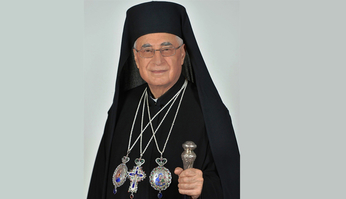
Patriarch Youssef
Christmas letter 2007
“The Word became Flesh”
Letter for the Birth in the Flesh
of Our Lord God and Saviour
Jesus Christ
25 December 2007
Given at the Patriarchal Residence,
Damascus
Gregorios, by the mercy of God,
Patriarch of Antioch and of All the East, of Alexandria and of Jerusalem:
May the grace of God and apostolic blessing
come upon our brother bishops, members of our Holy Synod
and all the members of our Melkite Greek Catholic Church,
clergy and laity, in Arab countries and countries of emigration,.
“The Word became flesh”
This is the expression, both old and ever-new, that I bring to my brothers and sisters in the Melkite Greek Catholic Church, to all Christians and indeed to every believing person, at this glorious Feast of Christmas and at the beginning of the New Year of the Lord, 2008.
We find this expression in the prologue of the Gospel according to Saint John, in which he speaks of the Word in the beginning, in eternity with God, in God, and of his very nature. Saint John, in this expression, goes from first things, from eternity, into time, summing up, in an extraordinarily succinct and almost astonishing way, the entry of eternal God into human time, into the history of all humanity. He does not limit himself to the history of the period in which the Word became flesh, but speaks in absolute terms, both with regard to time and to humanity. “The Word became flesh.” He became man, everyman, inclusive of every time, place, gender, ethnicity and colour.
In these few words, we find a unique passage about the relation of man with God and God with man. Though this phrase appears to refer essentially to an event in time, the relationship described is not limited to one historical episode. For the Word becomes flesh with all flesh, at every moment in the history of everyman. He both enters into absolute time and, at one and the same moment, into absolute man. He enters also into the limited time of each limited person. Thus the limitless becomes limited indeed.
This is the true miracle that is still happening: limitless God entering the limited predicate of a limited conception. That is the true mystery of the feast of the news that we are celebrating: the mystery of the new Child, God before the ages.
All that seems incomprehensible, and explains why this dogma is rejected by Islam and Judaism. However, we do find something similar, though in a primitive, almost physical way in paganism, where gods take bodily form to communicate with people. These deities have human passions, inclinations and sorrows.
In Christianity, the incarnation is tremendous, extraordinary, surpassing all human understanding, an act simultaneously both human and divine. The Word remains divine though he becomes incarnate. His body is really the body of the Son of Man, but through this, man is called to go beyond himself, in fact, to divinisation.
“The Word became Flesh”
Through the incarnation, the body of each person becomes sacred and holy, whether he be Indian, Chinese, Native American, African, Arab or European, from East, West, North or South.
Through the incarnation, my body is sanctified in all its limbs and senses: my feet, hands, eyes, heart...
Through the incarnation, Jesus entered the situations of all kinds of people: sick, healthy, sufferers, the tempted, despairing, sinners, criminals, great, small, kings, rich, poor...
Thus is fulfilled what is written in Scripture, “Eye hath not seen, nor ear heard, neither have entered into the heart of man the things God hath prepared for them that love him.” (I Corinthians 2:9) This means that although man is always looking for the happiness that is his heart’s desire, he can never discover that happiness prepared for him. As Saint Augustine says, so splendidly, “The happy life exists, when that which is man's chief good is both loved and possessed. ”
God would not be God if he tempered his revelation to our passions, and did not wish to raise us up to himself. Since man always longs for whatever is more perfect, beautiful and strong, God must be above and beyond all his desires and longings. So man continues to be filled with yearning and hope.
That is the meaning of Jesus’ saying, “Be perfect, as your heavenly Father is perfect.”(Matthew 5:48) God comes down to our level. (“The Word became flesh.”) But he takes our flesh as his own, as we say in the Liturgy of Saint John Chrysostom, “Thou didst not cease to do all things until Thou hadst brought us up to heaven, and hadst endowed us with Thy Kingdom which is to come.”
The one who came down is himself the one who ascended. He who became body, matter, is the one who raises us to the height of the beatific vision and. to the level of his divine stature.
“And the Word became flesh.” That means he became civilization, language, culture and knowledge in order to change everything earthly into something heavenly, or rather, to give to terrestrial things a spiritual meaning and to reunite earthly things with those of heaven.
Holy Scripture says, “It is not good that the man should be alone; I will make him an help meet for him. ” This “help meet” seems indeed at first sight to be Eve, but the true helper like himself is the new Adam, Jesus, the incarnate Word, as is echoed in our prayers, “And having made man in his image and likeness, he destroyed the pangs of death.” (Liturgy of Saint Basil)
The Word of God in Holy Scripture
Let us take a journey through the paradise of Holy Scripture in order to discover the different dimensions, attributes, strengths and effects of the Word of God in divine revelation, whilst realising that the word written in the books of the Old and New Testaments, though conveying revelation to man, is not itself that divine revelation of God. God is not limited to this divine revelation, but continually speaks with people through Holy Scripture. So he is in dialogue with human beings, with everyone, through the Word, and that is the meaning of the verse which we have chosen as the title of our Christmas Letter, “The Word became flesh.” That means that the revelation of God has come to us, not only by his becoming incarnate and taking flesh as the Word of God, Jesus Christ himself, but also through the Word of God, that is, the teachings of Jesus Christ, the divine Word, as recounted by the holy apostles writing the holy Gospels with human words, but under the inspiration of the Holy Spirit. They also wrote the beautiful epistles, in order to show us the revelation of the Word, the teaching of God for mankind.
With this object in view, I have gone through Holy Scripture and am passing on to you what I have discovered about the holy and sanctifying Word of God, who became incarnate in the only Son and Word of God.
The Effects of the Word
In the Holy Gospel, as written by Saint John the Evangelist and Theologian, there is a very beautiful expression about the Word that we find in the Prologue, “In the beginning was the Word, and the Word was with God, and the Word was God…All things were made by him (the Word); and without him was not any thing made that was made…And the Word (Jesus Christ, Son of God) was made flesh (man.) And we beheld his glory (the incarnate Word), the glory as of the only begotten of the Father (as we find in the Divine Liturgy, O only-begotten Son and Word of God,) full of grace and truth.” (John 1: 1,3,14)
The word is compared to seed being sown: it is the word of paradise, of the kingdom that is sown in the heart of all people. Some receive it and by it the Word, Jesus, and his words and teachings. Others refuse it, that is, refuse Jesus, the Word, his words and teachings. (cf. The Parable of the Sower - Matthew 13; Mark 4; Luke 8) And for those who receive the Word of God, it yields fruit in their lives, fruit of holiness and purity and good works, “thirtyfold, sixtyfold and an hundredfold.” (Matthew 13:23)
The word of Jesus feeds man. “Man shall not live by bread alone, but by every word that proceedeth out of the mouth of God.” (Matthew 4:4)
The word of Jesus heals. “Speak the word only, and my servant shall be healed.”(Matthew 8:8) And his word casts out the evil spirits from people and heals all that are sick. (Matthew 8:16)
Jesus, the incarnate Word of God, speaks the word of God through himself. He discloses his nature and his teaching by the Word, by preaching the Gospel (the good news.) So the word becomes a proclamation, a message. Jesus Christ is the Word, he himself is this message, or announcement, and is himself its bearer, bringing it to the ears of those who hear it. (Mark 2:2) But “the care of this world and the deceitfulness of riches choke the word and (the hearer) becometh unfruitful.” (Matthew 13:22)
By hearing the Word of God, man becomes close to God, close to the word of the incarnate Word: he becomes close to Jesus. “My mother and brethren are these which hear the Word of God and do it.” (Luke 8:21)
The Relationship of the Word with the Apostle
The word is the instrument by which faith reaches people. (Acts 4:4) The apostle must be free to announce the Word of God, for the service of the Word of God. He must not be preoccupied by serving tables. (Acts 6:2, 4) Through the apostle and through every believing person, the Word of God must grow in society and the community. (Acts 6:7, 10:44, 12: 24, 19:20)
Furthermore, it is not permitted for the apostle to go and preach the word, without having first received the Holy Spirit and being filled by him. “Tarry ye in the city of Jerusalem, until ye be endued with power from on high.” (Luke 24:49 cf. Acts 1:8)
And if the apostle or believer distances himself from Jesus, he is likely to tarnish and corrupt the word of Jesus. “For we are not as many, which corrupt the Word of God: but as of sincerity, as of God, in the sight of God speak we in Christ.”(II Corinthians 2:17, 4:2)
So the Word of God becomes the apostle’s word. He announces, pronounces and glorifies it, explaining and proclaiming it to the world. The Word is always in relation to Jesus. Moreover, the subject of the word and proclamation is Jesus himself. Indeed the apostle becomes one with Jesus, his word and message.
“Receiving the word” is an expression which means receiving holy faith. (Acts 8:14) The basis for every announcement is the Word of God, the Word of Jesus. Indeed Jesus himself is the Word, who proclaimed the Word of God. (Acts 10:36)
So the word is transformed into faith among those who hear it, through the descent of the Holy Spirit. “And while Peter yet spake these words, the Holy Ghost fell on all them which heard the word.” (Acts 10:44)
Moreover, the Word becomes the expression of all the commandments, summing up their content, for if the commandments are not in relation to Jesus, his teachings and words, they become empty commandments, a kind of slavery. “The word is nigh thee, even in thy mouth, and in thy heart: that is, the word of faith, which we preach.” (Romans 10:8 cf. 13:9)
The Word of God: Schoolmaster to Mankind
Moreover the Word of God received by the believer keeps him away from all unworthy speech. The Word of God makes the word of man wholesome, purifying and educating it. “Let no unwholesome word come out of your mouth, but rather, everything that is good, for edification, according to need, in order to give a grace to him who hears it.” (Ephesians 4:22) “Let the word of Jesus dwell among you and converse with each other in psalms and hymns and spiritual songs, singing in your hearts to the Lord.”(Colossians 2:16)
So the Word of God really becomes incarnate in the faithful believer and is stronger than people’s malign, insipid, corrupt words. “When ye received the word of God which ye heard of us, ye received it not as the word of men, but as it is in truth, the word of God, which effectually worketh also in you that believe.” (I Thessalonians 2:13) So the faithful person is strengthened by the word of God and distances himself from vain-speaking, ugly, fraudulent, bad and unworthy speech.
The Attributes of the Word of God
The attributes of the Word of God are many and they express its strength and the influence it has over the faithful in society. “The word of God is not bound.” (II Timothy 2:9) It is “profitable for doctrine…and instruction in righteousness.” (II Timothy 3:15) It is “faithful.” (Titus 1:9) “For the Word of God is quick, and powerful, and sharper than any two-edged sword, piercing even to the dividing asunder of soul and spirit, and of the joints and marrow, and is a discerner of the thoughts and intents of the heart.” (Hebrews 4:12) The faithful must work according to the word and not just listen to it, as we read in the Parable of the Sower, “Be doers of the Word and not just hearers, deceiving your souls.” (James 1:22) So it is a living Word and a Word of life. “To whom shall we go, for thou hast the words of eternal life?” (John 6:68) Saint John the Apostle says in his First Epistle, “That which was from the beginning (the Word), which we have heard (the Gospel), which we have seen with our eyes (in the body) which we have looked upon, and our hands have handled, of the Word of Life; … that we declare unto you.” (I John 1:1, 3) This verse expresses in a very beautiful way the title of our Letter, “the Word became flesh and dwelt among us.” We have experienced him, so to speak, through all our bodily senses, hearing, sight and touch.
The Word Became Flesh
We are going to make a trip through the paradise of Holy Scripture in order to discover the meanings of this expression, “the body.” Our body is Jesus’ body; our body is the creation of God in all its limbs and poor, weak nature. This very body was taken by the Word of God when he became flesh in Mary’s womb. Through this same body the Word of God was united to human nature in order to sanctify the body, raise it, divinise it and make it the temple of the Holy Spirit. Hence we can discover the theology of the body, its dignity, value, vocation, holiness and spirituality. All this the Lord restored to man by his incarnation, when he became united through his body to the body of mankind.
.
So God wished in his providence (his economy), for his loving relationship with people to be through the body, for he sanctifies them and works their redemption by means of his bodily sufferings, enabling them to participate in his divine life communicated through the body.
As Saint Paul says, speaking of the Father’s initiative in sending his Son into the world (at the beginning of the divine economy for the world), “Sacrifice and offering thou wouldest not, but a body hast thou prepared for me…Then said I, Lo, I come to do thy will, O God (to accomplish all the divine economy.)” (Hebrews 10:5, 7)
Thus begins the unique story of the body, from the beginning of its creation in Genesis, passing through the history of humanity up to the moment when its final chapter is realised. “Male and female created he them” and “they [were made to] be one flesh.” (Genesis 1:26, 2:24) “And the Word became flesh and dwelt among us,” so that man is no longer born by the will of a man and a woman, but becomes a new creature, “… born, not of blood, nor the will of the flesh, nor of the will of man, but of God.” (John 1:14, 13) Therein lies the dignity and vocation of man: to be united to and in communication with the vocation of the Word of God incarnate. So the love of man and woman becomes a bonding of their souls and the will of man and woman expressed in their sexual relationship becomes a way of participating in the work of God the creator, a noble project and plan within God’s saving economy for mankind. So man’s body is united to that of the divine Son and incarnate Word. Thus everybody born of woman may cry, “Abba, father,” for he is “no more a servant” in the body, but has become “a son [and]… heir of God through Christ,” the incarnate Word. (Galatians 4:6, 7)
The Word became Bread
After declaring at the beginning of his Gospel that the Word became flesh, John continues the explanation of the divine revelation in the incarnation of the Word, affirming in chapter six that the Word became “bread of life.” Moreover, Jesus himself, the incarnate Word declares, “I am the living bread which came down from heaven: if any man eat of this bread, he shall live for ever: and the bread that I will give is my flesh, which I will give for the life of the world.” (John 6:51)
Jesus adds in his discourse in the synagogue at Capernaum words on the body and bread that no ear has heard . “Verily, verily, I say unto you, except ye eat the flesh of the Son of Man and drink his blood, ye have no life in you. Whoso eateth my flesh and drinketh my blood hath eternal life; and I will raise him up at the last day. For my flesh is meat indeed and my blood is drink indeed. He that eateth my flesh and drinketh my blood, dwelleth in me, and I in him.” (John 6:53-55) The Jews, including even the apostles, disputed amongst themselves about the validity of these assertions, saying, “How can this man give us his flesh to eat?” (John 6:52)
Jesus’ explanation was given to assure us of the real meaning of “the body” and “the spiritual” in his teaching about the body and the life-giving spirit. “It is the spirit that quickeneth: the flesh profiteth nothing: the words that I speak unto you, they are spirit and they are life.” (John 6:63) Later he confirmed this, “Ye judge after the flesh.” (John 8:15) Before his Passion, he prayed to his Father, saying, “..Thou hast given him power over all flesh, that he should give eternal life to as many as thou hast given him.” (John 17:2)
The Word of God became flesh, connecting the human body which he took from Mary’s womb to his holy body, and making from his body real food. “This is my body which is given for you: this do in remembrance of me.” (Luke 22:19) In this way the Word of God connects with the weak human body, empowering it with his Spirit. “Watch and pray, lest ye enter into temptation. The spirit truly is ready, but the flesh is weak.” (Mark 14:38)
The Relationship between Humanity and the Body
Jesus explains the relationship between humanity and the body, giving rules for working with the body as a spiritual instrument and raising it to the level of God’s Word that became flesh. Thus he connects the earthly with the heavenly: not only connecting his holy life with human life, his creature, but also showing humans by his supernatural wisdom the true way of regulating the relationship of the body with the spirit, and earthly life with the glorious life of heaven. He tells us, “The light of the body is the eye: therefore when thine eye is single, thy whole body also is full of light, but when thine eye is evil, the whole body is full of darkness. Take heed therefore the light which is in thee be not darkness. If thy whole body therefore be full of light, having no part dark, the whole shall be full of light, as when the bright shining of a candle doth give thee light.” (Luke 11:34-36) And later he assures us, “And I say unto you my friends, Be not afraid of them that kill the body, and after that have no more that they can do. But I forewarn you whom ye shall fear: Fear him, which after he hath killed hath power to cast into hell; yea, I say unto you, Fear him.” (Luke 12:4)
Christ also assures us of the Father’s care for the human body. “Even the very hairs of your head are all numbered.” (Luke 12:7) He then adds, “The life is more than meat, and the body is more than raiment.” (Luke 12:23), yet today we prefer food to life and clothing to the body: that means we are inverting the value of life.
Through these holy verses we understand the depth of Jesus Christ’s teaching when he took our body (“the Word became flesh”) to teach us about life in the body and the connection between the things of earth and those of heaven, the connection between life and food, the body and clothing, and the relative importance of each to the other. Moreover, we can see the link between our bodily life here and the life of his body through the mystery of the Holy Eucharist (Holy Communion) since without Christ’s body, there can be no life in our present body. Without Christ’s bread (his body) and his resurrection in the body, there is no resurrection for us and no life to come for us. From this, we understand the eucharistic mystery which we celebrate in the Divine Liturgy and through which we encounter two food-tables: that of the Word, centred around the Liturgy of the Word, (Psalms, hymns and readings from the Epistle and Gospel) and that of the body of the Lord Jesus Christ, (of communion) in which we share after sharing at the table of the Word! In this way, Christ really appears in the body every time that we celebrate the Divine Liturgy: he is incarnate first in his Word (as we sing in the hymn, “O only-begotten Son and Word of God”), then again in the holy bread, and we share in this incarnation through Holy Communion.
Paul the Apostle of the Theology of the Body
The Apostle Paul comes to explain the different kinds of teaching that Jesus gave about the body, which allows us to call him the real “theologian of the body” or “philosopher of the body” or “master of the body.”
The basis of Paul’s teaching about the body is his assurance that “… ye are the body of Christ, and members in particular.” (I Corinthians 12:27) “Always bearing about in the body the dying of the Lord Jesus, that the life also of Jesus might be made manifest in our body.” (II Corinthians 4:10-11) In the Epistle to the Galatians, he says, “I am crucified with Christ: nevertheless I live; yet not I, but Christ liveth in me; and the life which I now live in the flesh I live by the faith of the Son of God, who loved me and gave himself for me.” (Galatians 2:20) “From henceforth let no man trouble me: for I bear in my body the marks of the Lord Jesus.” (Galatians 6:17) “..Christ shall be magnified in my body, whether it be by life, or by death.” (Philippians 1:20) Again, Christ “shall change our vile body, that it may be fashioned like unto his glorious body...” (Philippians 3:21) Since at the incarnation, he became the head of all, as head of the Church’s body, “Who is the image of the invisible God, the firstborn of every creature…and is the head of the body, the church.” (Colossians 1:14, 18) Paul was content to suffer, as his suffering is that of the body of Christ. “Who now rejoice in my sufferings for you, and fill up that which is behind of the afflictions of Christ in my flesh for his body’s sake, which is the church.” (Colossians 1:24) And again, Christ is “the head over all things to the church, which is his body, the fullness of him that filleth all in all.” (Ephesians 1:22-23)
As Jesus had explained these truths or basic parameters of the relationship between our body and Jesus’ body and that of his with ours, we discover and understand the spirituality and morality of the body and the believer’s code of conduct while one lives in the body. We know that Saint Paul ranges from the body as instrument of sin to the body as instrument of grace. Here are some beautiful verses that lay down basic morality for Christians baptised into the body of Jesus. The Church with Saint Paul, addresses them, saying, “As many as have been baptised into Christ (the body of Christ) have put on Christ.” (Galatians 3:27) We say in our Paschal Liturgy, “Take the body of Christ, drink from the fount that is inexhaustible.”
Saint Paul tells us, “Brethren, we are debtors, not to the flesh, to live after the flesh, for if ye live after the flesh, ye shall die: but if ye through the Spirit do mortify the deeds of the body, ye shall live.” (Romans 8:12-13)
And he addresses us, saying, “Put on Christ Jesus [his body] and do not do the work of the body, according to its passions.” (Romans 13:14) And he says again, “For, brethren, ye have been called unto liberty; only use not liberty for an occasion to the flesh, but by love serve one another…. This I say then, Walk in the Spirit, and ye shall not fulfil the lust of the flesh. For the flesh lusteth against the Spirit, and the Spirit against the flesh: and these are contrary the one to the other…Now the works of the flesh are manifest …fornication, impurity …And they that are Christ’s have crucified the flesh with the affections and lusts.” (Galatians 5:13-24) “For he that sows to his flesh shall of the flesh reap corruption; but he that soweth to the Spirit shall of the Spirit reap life everlasting.” (Galatians 6:8) “…everyone may receive the things done in his body, according to that he hath done, whether it be good or bad.”
(II Corinthians 5:10) “Having therefore these promises, dearly beloved, let us cleanse ourselves from all filthiness of the flesh and spirit, perfecting holiness in the fear of God.” (II Corinthians 7:1)
So the body may become perhaps an instrument of sin, but it is called to be an instrument of salvation. “What? Know ye not that your body is the temple of the Holy Ghost which is in you, which ye have of God, and ye are not your own?” (I Corinthians 6:19) “And I, brethren, could not speak unto you as unto spiritual, but as carnal, even as unto babes in Christ….For ye are yet carnal: for whereas there is among you envying, and strife, and division, are ye not carnal and walk as men?”
(I Corinthians 3:1, 3)
Saint Paul continues by speaking of fellowship and mutual help among people, taking as an example the relationship of the members of the body and its senses among themselves. And he links the body of mankind with the body of Christ which is the link of love among mankind. And he says, “For as the body is one, having several members, and all the members of that one body, being many, are one body, so also is Christ. For by one Spirit, we are all baptised into one body, whether we be Jews or Gentiles, whether we be bond or free; and have been all made to drink into one Spirit. For the body is not one member, but many.” (I Corinthians 12:12-14)
He takes up this comparison again in the Epistle to the Romans, “For as we have many members in one body, and all the members have not the same office; So we, being many, are one body in Christ, and everyone members one of another.” (Romans 12:4-5)
The Dignity of the Body
From these verses we understand the dignity of the body that Jesus took and purified by his teachings and sacraments (mysteries). Moreover the body is itself the subject of special dignity in the Christian faith. “I have called thee by name, thou art mine….thou art precious in my sight and honourable and I have loved thee.” (Isaiah 43: 1, 4) The body is indeed an instrument of sanctification and a way to holiness. So each one has his dignity before God and nobody is despised in his eyes. That is why any offence to man is an offence to God his creator and to Jesus Christ who took our body, human nature, giving it dignity by making it his own. When the bishop puts on the omophorion, he says, “When thou hadst taken upon thy shoulders human nature which had gone astray, O Christ, thou didst bear it to heaven, unto thy God and Father.” That is similar to what we read in our prayers for the Feast of the Divine Ascension, “O God, thou hast renewed in thyself Adam’s nature, fallen into the depths of the earth, and thou hast raised it up today above every principality and authority. For having loved it, thou hast seated it beside thee and taking compassion on it, thou didst unite it to thyself; by enduring the Passion, thou who art without suffering, thou hast glorified it with thee.” (Great Vespers of the Ascension of our Lord Jesus Christ)
All this explains the harshness of the words of Jesus when confronted with any offence given by man to his fellow-man, “Whosoever is angry with his brother without a cause shall be in danger of the judgment: and whosoever shall say to his brother, Raca, shall be in danger of the council: but whoever shall say, Thou fool, shall be in danger of hell-fire.” (Matthew 5: 22) “Whoso shall offend one of these little ones …it were better for him that a millstone were hanged about this neck…” (Matthew 18:6)
From these sayings, we can understand the concern of Jesus for the integrity of the body, lest it become a scandal for man himself, or for his neighbour. We all know these more radical verses, “And if thy right eye offend thee, pluck it out and cast it from thee: …and if thy right hand offend thee, cut it off and cast it from thee...” (Matthew 5: 29-30)
This also explains the doctrine about the veneration of icons and relics of the saints. Indeed, we venerate the relics, that is, the remains of the bodies of the saints, for the saints gave glory to God through their bodies serving their neighbours by their works and by the ascesis of their lives. We must imitate them, remembering the teachings of Saint Paul, “Know ye not that your bodies are the members of Christ?...What? know ye not that your body is the temple of the Holy Ghost which is in you… Therefore, glorify God in your body.” (I Corinthians 6: 15, 19, 20)
Practical Applications
After the above theological and spiritual explanation of the incarnate Word, we would like to give some practical applications:
Learning Verses from the Word of God
We would like to make here some remarks on the importance of learning by heart verses of Holy Scripture, especially from the Holy Gospel and the New Testament in general, because these verses relate to our concerns, problems and difficulties in life and help us understand their meaning. In that respect, I would like us to learn from our Muslim brothers, who have the custom of learning the Qur’an by heart. It is noticeable that they often refer to verses of the Qur’an in their preaching and conversation and they write these verses in different places in their homes and workplaces. Similarly, Protestants are an example for us in this way. It is a pity that there is a tendency in catechetical teaching that says learning passages from Scripture is old-fashioned and no longer suitable to a modern education. Yet how much effort we expend on learning rules for using computers, mobile phones, the Internet and so forth! I am sure that learning by heart verses of Holy Scripture helps us very much to make our own the experience of Saint Peter, when he replied to Jesus Christ, saying, “Lord, to whom shall we go? thou hast the words of eternal life.” (John 6: 68)
Incarnating the Word of God
It is also vital to insist on the importance of incarnating the Word of God, so that it becomes near to people, beautiful, attractive, luminous and illuminating, lovely and pleasant and so that we bring to people’s hearts the beauty of the Word, its fascination, radiance, dazzling beauty and the strength of conviction that lies within it. So we can show how important preaching, spiritual direction, meetings with youth groups, women’s groups and families are in enabling them to discover together the Word of God for themselves, through continual reading and meditation. Here we see the importance of the priest becoming a companion, brother and friend, a director and spiritual father for the faithful, as if he were taking them by the hand to guide them to those paradisal places of the Word. The Word of God becomes truly incarnate through priests, religious men and women, teachers, Christian catechists and directors and animators of gospel missions and different, variously-named parish fraternities.
Word of God: Word of Life
It is also important to experience by ourselves and in our daily lives how much the words of Holy Scripture are addressed to me personally and that I shall really find the answer there to all my questions, suitable to all conditions and circumstances of my personal, family, professional, social, scientific and existential life and in my relations with other people of my religion or of other confessions, concerning different problems, moral and behavioural matters, dialogue and other issues.
Indeed, that is what we find in the Sermon on the Mount and in the parables and miracles of Jesus: we see how he behaved with other people, sinners, outcasts, sick, doubters, women, the proud, isolated and remote, the handicapped, the paralysed, the Pharisees, Sadducees, pagans, Greeks, Romans, governors, evil-doers, poor, rich, merchants, bankers, businessmen and tax-collectors. We see also how we should behave with regard to values, opportunities for prayer, fasting, alms-giving, faith, trust, love, charity, hope, service, self-giving, co-operation, fellowship, excellence, perfection, food, drink, marriage, virginity, suffering, illness, death, hatred, calumny, divine providence, brotherly love, disputes, tribunals, parents, relatives, vengeance, tolerance, forgiveness and love of enemies. We also learn about behaviour towards nature: flowers, fruit, harvest, sowing, trees, the fruitfulness of Paradise, grapes, olives, water, fire, light, figs, wine and oil. There is also teaching about personal meditation, behaviour towards others, with adversaries, the righteous and with those in government: the list is long, exhaustive and really complete. We have a verse from the Word of God for all occasions.
The Experience of the Word of God
The experience of the Word of God should enable us to make these discoveries for ourselves through continual reading of Holy Scripture and commentaries, always returning to them in a continuous way. We should meditate on the Scriptures, to discover how the Word became flesh, a real body. The Word is for me, as he took a body like my body, becoming incarnate, in the flesh. He knows what is in man, in his thought, in his heart. He knows his concerns, preoccupations, needs, weaknesses, longings, hopes, visions and feelings. He loves mankind, venerates and respects us, esteems and understands us, wants our good, freedom, progress, success, perfection, happiness and joy. As we say in our Corpus Christi readings that are peculiar to the Melkite Church, “Jesus, having loved his own, loved them unto the end.” (John 13:1)We repeat in our prayers that God is good, merciful, the Father of mercies and lover of mankind. Christ is our brother, friend, saviour, healer who raises us from the dead. So there will come a time for each of us to cry, with personal conviction, repeating with Saint Peter, “Where shall we go, for thou hast the words of eternal life?” (John 6:68)
Neither should we minimise the importance of parents and the household in that regard. The parents are the first educators, especially through teaching about prayer, religious symbols and gestures, veneration of icons in the home, going with the children to church and spiritual gatherings and participating in religious meetings.
Yes, since we have received the Word of God through faith in holy baptism and all the other mysteries or sacraments, we have become responsible for the Word of God, for spreading it and taking it to others, beginning with our home, neighbourhood, our neighbours, relatives, acquaintances, friends and all those who are not yet of our religion.
Word of God: Words of Mankind
Pentecost was a prodigious event: the Holy Spirit descended upon the apostles and many of the Jewish pilgrims who had gone up to Jerusalem for the Feast of Pentecost, who, when they realised what had happened, ran up towards the upper room at Sion, where the apostles had been gathered after the ascension of Jesus Christ whilst awaiting the Father’s promise, that is, the descent of the Holy Spirit. And the tongue or language of the apostles was empowered after the Holy Spirit had descended on them in the form of tongues of fire to indicate the importance of speech, pronunciation, language and words in bearing the message of Jesus. “Their voice is gone out into all the earth and their words to the ends of the world.” (Psalm 18 (19): 4, LXX)
The apostles addressed the crowds around them, announcing the Word of God, but in just one language. However, though those present were of different nationalities and countries, speaking different languages, as Saint Luke tells us, yet they heard the apostles speak, each one in his own native language. So the Word of God is one, though for all people, reaching all, each in his own civilisation, with its language, culture and characteristics.
It is truly the Word of God, because it really can reach all mankind and become a Word for people. That is the great challenge for preaching with conviction, for pastoral writing and in all documents issued by church authorities. The challenge is how to make the Word of God understood and bring it to people in such a way that it remains really his Word (without trickery, confusion or alteration) while meeting with people’s words and with their understanding, mindset and way of thinking. Yet it must elevate their thoughts and change their mentality, so that their own words really enter into harmony and contact with the Word of God. Then may be realised what Saint Paul said, “We have the mind of Christ.” (I Corinthians 2:16)
So the Word is not for me, but belongs to him that sent me. It is not my property, but it is the Word that has come to me. So it must be pronounced and preached, not as if it came from me, but as Jesus said, “The Word that I give you is a word of truth. Go and preach the Word.” (cf. John 14:24 and II Timothy 4:2)
The Word of God is directed towards and addressed to us all. It has however need of an epiclesis, so that it may become the Word for others, for society and for the world. The Holy Spirit changes everything. The epiclesis is truly the mystery of Christianity.
Moreover, the Word of God unifies, creating unity between people and that is the meaning of the verse, “The Word became flesh.” Our poor, bleeding, scattered body has different tendencies and inner rendings and contradictions. That is why Saint Paul writes, “Who shall deliver me from the body of this death?” (Romans 7:24) The Word became flesh in order to “gather together in one the children of God that were scattered abroad.” (John 11:52) That means that he came to reunite the members of the body, to reunify the body. The body has need of the Word of God, to enable it to gather its strength and direct it towards God. So the Word here means unity: the unifying force is eternity, whose principle is the Word. So the Word means both what is here and what is yet to come after the here-and-now, and the body means what is here. That is why the incarnation of the Word is a work of reunion between what is here and what lies beyond.
The Liturgy: Celebration of the Word of God Incarnate
It is important to notice the relationship of the Word and of the body with the Divine Liturgy and with all the other liturgical prayers, for prayer, whatever else it is, is always in relation with the Word of God. In fact the prayers of the first Christians were concentrated above all on the Psalms and readings of Holy Scriptures. Later the Holy Gospel, Acts of the Apostles and Epistles were read and the priest explained and commented on the Word of God, during prayers, especially the Divine Liturgy. With time, hymnographers composed other hymns, which are a sung meditation on the Word of God.
This continued as the Fathers of the Church read and meditated on the Word of God, feeding on it, commenting on it and preaching it to the people in their sermons and compositions. Then the monks, especially, who came after them, took the Word of God and passages from some of these well-known homilies and transformed them into different hymns for feasts of the Lord and the Virgin Mary, celebrating the events of salvation and for the feasts of saints and for their praises. It is possible to show this important relationship by putting cross-references beside all our prayers indicating the relevant Biblical passages. That is what we have done recently in the new edition of the Divine Liturgy of Saint John Chrysostom, which demonstrate splendidly the relationship between the prayers of the faithful and the Holy Word of God.
Hence we see the importance of celebrating all liturgical prayers beautifully, worthily, clearly, in a lively, moving and attractive way, so as to provide truly spiritual and substantial nourishment for priests and people in their different roles.
Hence we see the importance of clear diction and eloquent reading with well-executed chant of the Epistle and Gospel. In our rite, the singing is even more important than just reading aloud, as for us “reading,” means a kind of music, or harmonisation of the words, so that the Word of God may be better understood and its beauty meditated upon.
From that we see the importance of the liturgical animation that we have proposed and frequently insisted upon after being designated president of the liturgical commission in 1986 and then elected Patriarch, since we have published the new liturgical books in a beautiful presentation and also annotated the different liturgical feasts. So we really have a Melkite Greek Catholic liturgical encyclopaedia. It is truly a heritage of which to be proud and thankful to God, allowing it to become real spiritual and substantial nourishment for all the faithful clergy and people.
The Word of God: Dialogue of Religions and Faiths
The Council of Vatican II gave us the golden rule for religious dialogue, by showing us the importance of discovering the good things or the wealth of others. Here is what the Second Vatican Council said in Nostra Aetate (1965):
Relationship with pagan religions
1. The Catholic Church rejects nothing that is true and holy in these religions. She regards with sincere reverence those ways of conduct and of life, those precepts and teachings which, though differing in many aspects from the ones she holds and sets forth, nonetheless often reflect a ray of that Truth which enlightens all men. Indeed, she proclaims, and ever must proclaim Christ "the way, the truth, and the life" (John 14: 6), in whom men may find the fullness of religious life, in whom God has reconciled all things to Himself…The Church, therefore, exhorts her sons, that through dialogue and collaboration with the followers of other religions, carried out with prudence and love and in witness to the Christian faith and life, they recognize, preserve and promote the good things, spiritual and moral, as well as the socio-cultural values found among these men.
Relationship with Islam
2. The Church regards with esteem also the Muslims. They adore the one God, living and subsisting in Himself; merciful and all- powerful, the Creator of heaven and earth, who has spoken to men; they take pains to submit wholeheartedly to even His inscrutable decrees, just as Abraham, with whom the faith of Islam takes pleasure in linking itself, submitted to God. Though they do not acknowledge Jesus as God, they revere Him as a prophet. They also honour Mary, His virgin Mother; at times they even call on her with devotion. In addition, they await the Day of Judgment when God will render their deserts to all those who have been raised up from the dead. Finally, they value the moral life and worship God especially through prayer, almsgiving and fasting…Since in the course of centuries not a few quarrels and hostilities have arisen between Christians and Muslims, this sacred synod urges all to forget the past and to work sincerely for mutual understanding and to preserve as well as to promote together for the benefit of all mankind social justice and moral welfare, as well as peace and freedom.
Relationship with Judaism
3. As the sacred synod searches into the mystery of the Church, it remembers the bond that spiritually ties the people of the New Covenant to Abraham's stock…. Since the spiritual patrimony common to Christians and Jews is thus so great, this sacred synod wants to foster and recommend that mutual understanding and respect which is the fruit, above all, of biblical and theological studies as well as of fraternal dialogues.
Dialogue between Christians and Muslims
There is the Word that we have in common, it is clear: let us maintain a dialogue of our beautiful faith, for the word that was given to me by God in my Christian faith is truly mine, but not only for me; it is for my society, for my fellow-men and I must bring it to them as a light of love and as a call to love, a sign of hope for the other person, that he may grow in his religion and beliefs and deepen them, not so that I may despise him or he may despise his own religion.
It is of very great importance for people to love their religion and the Word of God for mankind, and know it in ever greater depth, preserving and defending it. But one must be open to the other person, to his convictions and faith. If not, we fall into relativism, which is the greatest enemy of faith.
Jesus calls us to preach that faith, saying, “Go ye into all the world ” and “teach all nations .” And Saint Paul exhorts us, speaking to his disciple Timothy, saying, “Preach the word…in season, out of season.” (II Timothy 4:2)
There is no monopoly on the Word of God. It is just as much the other person’s as it is mine. Our Muslim world is afraid of our preaching, but does not cease preaching Islam. That is an unreasonable position. We require our Muslim fellow-citizens to acknowledge our freedom to bring the good news to others, with love and respect for their faith, but we do not require anyone else to embrace our faith. It is enough if people can find out about it and come to esteem and love it. Conversion is the work of God. Do not attempt to convert a friend, or loved one. God converts whom he will.
The Word of God is for me and its revelation is to me, but not to me alone. I must allow others to share in it. We must have, as we say in the Arabic proverb, bread and salt.
But it is not bread or salt that enables us to live together. What matters is rather how we can share together in the Word of God in Christianity, Islam and Judaism. How can we feed each other by the Word of God? How can the Word of God become an essential food? As we say in the Our Father, “Give us this day our daily (epiousion) bread.” The Our Father is really a call to share together in the Word of God.
We thank God for the many, beautiful relationships between Christians and Muslims that occur especially in everyday living. However, I would like us to share together in the Word of God, since that is what unites us, draws us together and gives us strength, reinforcing our faith. Let us not be afraid to love the Word of God in our brothers and sisters. Let us not be afraid of verses from the Qur’an and let them not be afraid of verses from the Gospel or from the Torah. These are the Word of God for us all, every one according to his own calling. I would like to tell our Muslim brethren not to fear our faith. Let us all rather be afraid of using words of vengeance, criticism, pride and haughtiness. The Word of God does not despise anyone. It is not proud, boastful or puffed up. It does not engage in bad behaviour or enjoy retaliation. It does not rejoice in evil, but in good. It rejoices in love and believes all things. (cf. I Corinthians 13)
Words of God and Words of Men
Let us love the Word of God, for the Word of God is for us all. Let us share these words, proclaiming them in song and loving them. Let these words of God be for our friendship, living together and mutual relationship. Instead of using empty, lying flatteries, let us nourish ourselves with earth’s most beautiful words and feed each other with these same heavenly words that God addresses to the children of men, for God is bountiful and bestows his life-giving words on us all. Let us not be afraid of the words of God, but rather let us fear the words of men. Let us so act that our human words be changed into words divine.
I propose founding a forum to be called “The Forum of the Word of God,” so that Christians and Muslims can meet together and together discuss and meditate upon the Word of God.
Our zeal for the Word of God should be a means of sanctification for us and for deepening our faith. We must not allow our zeal for the Word to become a weapon to exploit others, judging, persecuting and compelling them to embrace our faith, any more than we can allow the Word of God to become the cause of conflicts, disputes and confrontations between our faithful and those holding different religious convictions. Nor should it become an instrument of terrorism and a pretext for one group to claim superiority over another. The Word of God (not we ourselves) is the true judge between us and those who are not of our faith.
And why be afraid of having churches and mosques? If they were symbols of defiance, we would have cause to fear, but as signs of faith they may stimulate instead our hopes and expectations.
Why, in Saudi Arabia, are they afraid of allowing churches to be built and the Gospel to be preached? Why are they even afraid of Christians praying as a community? Surely those who are in the light need be afraid of nothing!
Let us not be afraid. The Prophet Muhammad was not afraid of a Christian or Jewish presence, but combated paganism. Today all of us Christians and Muslims are called to fight against today’s new paganisms: incredulity and unbelief.
I say to my Muslim brethren: don’t be afraid of our faith, but rather be afraid if we neglect our faith and indulge in unpleasant habits. To my fellow-Christians I say: don’t be afraid of the words of those Muslims who keep and preserve the Word of God.
Feast of Christmas: Feast of the Incarnate Word
It is not enough for us to sing at our festivals and take pride in the rites of our feasts and faith - even in the Feast of Christmas and the beautiful verse of our letter, “The Word became flesh.”
The Feast of Christmas is the Feast of the Word, Jesus, who became flesh. The challenge to us all is, how can Christmas become a feast for me, a reality in my life? How can the Word of God become incarnate in my soul, my understanding, my consciousness and thought, in my manners and life? That is, how can the Word of God be realised and embodied in my life, becoming flesh of my flesh, bone of my bones? How can the incarnate Word of God become part of my personal, existential convictions? Similarly: how can I become an incarnate word in my society, a spiritual word for other people, a word of salvation, consolation, friendship, love, redemption, bread, food? How can I become a cause of salvation for my brother or sister?
How can we make incarnate for other people the words of God in our holy books, theology, dogmas, Creed and popular devotions, so that they are not misunderstood or misrepresented by others?
It is a big effort for each believer to explain his faith and present it to others, to Jews, Muslims, Buddhists, agnostics, atheists, those on the fringes of the Church, who criticise it and criticise its teachings, sacraments and symbols.
How can we express the hope that is in us (cf. I Peter 3:15), so that it becomes a hope for others and not a scandal (as the cross was for non-believers “a stumbling-block, but unto them that are called …the power of God and the wisdom of God”)? (I Corinthians 1:23-24) We can however avoid that catastrophe, knowing that communicating our faith to others strengthens our faith, bringing security and serenity.
To that our prayers invite us, where we read, “Let him who has faith share it with the one who does not know the Word.” Thus we become true stewards, faithful to grace. (Great and Holy Tuesday, Matins) That is true charity or love to the other person: that we love his spiritual welfare and want him to progress in the love of God, in faith, hope and charity, in spiritual life and virtue.
So it is that our relations with others may be given new life, strengthened, deepened and that they be truly for their edification, as Saint Paul says, “.. the Lord hath given us for edification.” (II Corinthians 10:8)
Christmas in the World
How can I myself enter into the deep meaning of Christmas? How can I become an agent of Christmas, of this new way of being in my society, in my family, neighbourhood and place of my profession, my workplace? How can I become a real feast for the other person, for everyone around me? How can the Word become flesh? This sign is presented to our society in which there are so many longings, hopes, desires, wishes, plans, international, national and local decisions, on the level of the world, nations and our Arab society, in the Church and its associations and above all, among young people. How can all that take flesh? How can peace take flesh? How can justice become flesh? How can reconciliation between peoples become flesh? How can peace between Jews and Palestinian Arabs become flesh? How can the aspirations of our young people take flesh?
We cannot reply to these questions. Nevertheless, we have laid the foundations for finding the answers for each one in his surroundings. At the end of this letter, we express them all as prayers, wishes for them to become a programme of life and work. And we raise them all to the Child of the Cave of Bethlehem, for him to bless them and himself transform them into real bodily existence.
We raise all the above-mentioned intentions to the leaders of Arab countries, so that they may become for them a programme of life, an agenda for 2008, especially a programme for peace in Palestine and Iraq, and we all know that the peace of Jerusalem, the peace of the Holy Land, is the key to war and peace in the region and in the whole world.
All our peoples, especially the young, have need of the incarnation of their hopes of justice, peace, security and safety, for them to be made a living reality. If not, there will be more violence and terrorism, negative fundamentalism, killings, destruction and conspiracies. All that will become on a global scale the cause of calamities, wars, disputes, hatred and crises.
We ask Jesus Christ, the divine Child of the Cave, incarnate for us and for the salvation of the world, who is himself the Prince of Peace, to grant peace and realise all our hopes and the hopes of those who read our message and of all our faithful, and to grant us all to sing with joy, hope and faith, the holy hymn of Christmas, “Glory to God in the highest and on earth peace, to men of good will.”
Gregorios III
Translation from the French: V. Chamberlain
Translation from the Arabic: Maher Labbad