

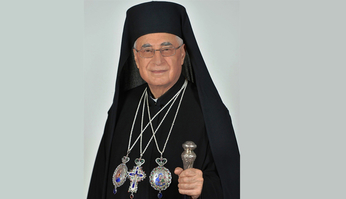
Patriarch Youssef
Paschal Letter 2012
Paschal Letter 2012
Love is stronger than death: whosoever loves does not die
Love is stronger than death. Whosoever loves does not die!
That is the cry of the feast of the glorious Resurrection! That is the real meaning of the immortal Resurrection hymn,“Christ is risen!” Christ whose glorious Resurrection we are celebrating and who is the object of our faith. “And if Christ be not raised, your faith is vain; ye are yet in your sins.” (1Corinthians 15: 17) He it is of whom John the Evangelist, the beloved, said,“God so loved the world, that he gave his only-begotten Son, that whosoever believeth in him should not perish, but have everlasting life.” (John 3: 16)It is he who said: “He who believeth in me, though he were dead, yet shall he live.” (John 11: 25)He it is who said: “He that believeth on me, as the Scripture hath said, out of his belly shall flow rivers of living water.” (John 7 : 38)
The Resurrection of Jesus Christ is the signof the victoryof his love, the triumph of life over death. That is whatSaint John Chrysostom saidin hisPaschal Sermon, that we read aloud: “Let no one fear death, for the Saviour's death has set us free.O death, where is thy sting? O Hell, where is thy victory? Christ is risenand thou art overthrown! Christ is risenand life reigns.”
That is our faith, despite the painful reality of our life, and despite our weakness. We are all weak when confronted by pain, illness, doubt, frustration, solitude, disappointment, failure, domination by the wicked, the noise anddin ofarms, the sightsof warand violence, massacres, destruction, explosions, criminal acts, plots, intrigues andall the forces of evilthat surround uson all sides…
Unfortunately, this has been the reality in regions of the Arab world, especially in Syria for more than a year now.
Jesus’ disciples were afraid when he foretold his passion and death: “Ought not Christ to have suffered these things, and to enter into his glory?” (Luke 24: 26)Then Peter said to him: “Be it far from thee, Lord.” (Matthew 16: 22)
Christ himself was in agony, to the point of sweating blood in the Garden of Gethsemane at the approach of his passion and death. He prayed: “O my Father, if this cup may not pass away from me, except I drink it, thy will be done.” (Matthew 26: 42)
The apostles were all weak in the face of the passion and death of their Master Jesus. But their love for Christ and Jesus’ love for themgave them new hope, since he told them,“Lo, I am with you alway, even unto the end of the world.” (Matthew 28: 20)
He strengthened them through his love that he declared before his passion, saying, “I will not leave you comfortless, I will come to you.” (John 14: 18)He said to them,“The Father himself loveth you, because ye have loved me.” (John 16: 27)
By this love, Jesus raised his friend Lazarus. He reassured Mary,“Thy brother shall rise again.” (John 11: 23). Saint John expressed this love that is stronger than death, saying,“Jesus wept.” (John 11: 35)Those present who witnessed that said,“Behold how he loved him.” (John 11: 36)
The Feast of the Resurrection calls us to faith, hope and love. Moreover, every Sunday, in the Eastern tradition, is Resurrection Sunday, and is a call to faith, hope and love.
The encounter with Jesusrisen from the deadawakens in usthat lovewhich is stronger than death.
Such considerations are not a kind of aspirin or sedative, or refusal to face up to the reality of our world, especially in the Middle East and above all in Syria. They will rather help us to draw strength and hope even from weakness.
H.H. PopeBenedict XVI put it this way when faced with the sufferings of the African continent, during his visit to Africa in November 2011:
The Church does not propose any technical solution and does not impose any political solution. She repeats: do not be afraid! Humanity is not alone before the challenges of the world. God is present. There is a message of hope, hope which generates energy, which stimulates the intellect and gives the will all its dynamism. A former Archbishop of Toulouse, Cardinal Saliège, once said: "To hope is never to abandon; it is to redouble one's activity." The Church accompanies the State and its mission; she wishes to be like the soul of our body untiringly pointing to what is essential: God and man. She wishes to accomplish, openly and without fear, the immense task of one who educates and cares, but above all who prays without ceasing (cf. Lk 18:1), who points to God (cf. Mt 6:21) and to where the authentic man is to be found (cf. Mt 20:26, Jn 19:5). Despair is individualistic. Hope is communion. Is not this a wonderful path that is placed before us? I ask all political and economic leaders, as well those of the university and cultural realms to join it. May you also be sowers of hope!
Love is stronger than death!
One of the signs of love is communion or fellowship. This is how Saint Paul puts it: “Whether one member suffer, all the members suffer with it.” (1 Corinthians 12: 26). Communion means solidarity, especially in times of trial, distress, pain andillness.
In this regardI cite here a passage from the ecumenical letter for theFeast of the Nativity 2011that I received fromHis Grace,the Anglican Archbishop of Canterbury, Rowan Williams:
Over the past twelve months, many will have sensed that this is indeed a time of the ‘shaking of nations.’ The tumultuous events in the Middle East and North Africa, the economic crisis in Europe and indeed in North America too – all this has reminded us of how fragile are some of the structures we take for granted. Our political identities and our financial security alike are vulnerable. We have no choice but to ask what it is that cannot be shaken. But as we do, we should reflect on a phrase that has been used by some writers and thinkers in recent years: we are called to experience ‘the solidarity of the shaken’ – that is, we are called to recognize the kinship between all who have come to know how vulnerable they are and how insecure their world is. To recognize the same vulnerability in each other is a very profound solidarity, one that overcomes much of our suspicion and fear.
The expression of solidarity with our fragility, weakness, and vulnerability is love. As Saint Matthew tells us: “Himself took our infirmities.” (Matthew 8: 17)Love covers a multitude of sins (1 Peter 4: 8), and where sin has multiplied, grace has abounded.(Romans 5: 20)
Before the Resurrection, there was a great earthquake, as the Evangelist Matthew tells us: “And, behold, there was a great earthquake: for the angel of the Lord descended from heaven, and came and rolled back the stone from the door, and sat upon it.” (Matthew 28: 2)
In view of this, we understand that love is stronger than death!
In the face of the Arab world’s crises (an earthquake), the shaking of loveand trust among the nations of the Arab world, the financial and economic crises, the crises of moral and faith values…we have recourse to love,which is really stronger than death, violence, destruction, egoism, murders, exploitation, economic, political and social dislocation.
It is then that we discoverthe value of the teaching about loveoffered in the Gospel,the lettersof Paul and the other apostles. Love is the world’s salvation! Loss of love is the world’s perdition and ruin.
The fears, obsessions andrevolutions that pervade our Arab worldare perhaps more particularly felt by Christians than others, although we see that all are similarly exposed to weakness, fragility and vulnerability.
Faced withand in all these situations and states of affairs, we Christians have to find our place, discover our vocation, and what God’s plan (or economy) of salvation is for us. We have to be especially in solidarity with this Arab world of ours, in which we are rooted. We have achieved so much, in the fields of its history, literature andcivilisation.Furthermore, we arethe builders and initiators of Arabism, or Arabness, and of Arab thought, as we are its architects, thinkers, pioneers, theorists, and propagators.
This is the time whenChristiansmustas ever,and even more than ever,discover“the love of God … shed abroad in our hearts by the Holy Ghost which is given unto us,” (Romans 5: 5)and through thatdiscover the power of the Gospeland the truth and veracityof Jesus Christ’s teachings! Yes! They must discover that they are the children of the Resurrection. Furthermore, they have to discover that their resurrection is their obligation to show solidaritywith these realities, the problems of theircountries, lands, nationsand fellow-citizens!They have to contribute to the resurrection of their society, although they represent the little flock, to which the Lord entrusted thatgreat, immortal, strong, unalterablemission and vocation: that of being light, salt and leaven in our society.
Thus we participate in and sharewith our countries, their weakness, fragility and vulnerabilityin order to discover together the power and hopes of the Resurrection. Saint Paul expressed that when recounting his experience with Jesus: “My grace is sufficient for thee: for my strength is made perfect in weakness.” (2Corinthians 12: 9). “For which cause we faint not; but though our outward man perish, yet the inward man is renewed day by day.”(2 Corinthians 4: 16)
In these difficult circumstances that our Arab world is experiencing, here and there, Christians are wondering about their future and fate. I find it apposite and relevantto mentiona second-century document, a letter written by a pious Christian to defend Christianity and the power of Christian faith, especially in view ofsociety’s developments and changes, convulsions, vulnerability and fragility.
The author wrotein the form of a letter addressed to a most eminent pagan Greek fellow-citizencalledDiognetus. The document is called“Epistle to Diognetus. ”
In this document, there are many features of the contemporarystate of affairs in our society, and also plenty of guidance, lessons or useful tips to guide Christian behaviour and reaction in view of that state of affairs.
“Chapter 5. The manners of the Christians
For the Christians are distinguished from other men neither by country, nor language, nor the customs which they observe. For they neither inhabit cities of their own, nor employ a peculiar form of speech, nor lead a life which is marked out by any singularity. The course of conduct which they follow has not been devised by any speculation or deliberation of inquisitive men; nor do they, like some, proclaim themselves the advocates of any merely human doctrines. But, inhabiting Greek as well as barbarian cities, according as the lot of each of them has determined, and following the customs of the natives in respect to clothing, food, and the rest of their ordinary conduct, they display to us their wonderful and confessedly striking method of life. They dwell in their own countries, but simply as sojourners. As citizens, they share in all things with others, and yet endure all things as if foreigners. Every foreign land is to them as their native country, and every land of their birth as a land of strangers. They marry, as do all [others]; they beget children; but they do not destroy their offspring. They have a common table, but not a common bed. They are in the flesh, but they do not live after the flesh. They pass their days on earth, but they are citizens of heaven. They obey the prescribed laws, and at the same time surpass the laws by their lives. They love all men, and are persecuted by all. They are unknown and condemned; they are put to death, and restored to life. They are poor, yet make many rich; they are in lack of all things, and yet abound in all; they are dishonoured, and yet in their very dishonour are glorified. They are evil spoken of, and yet are justified; they are reviled, and bless; they are insulted, and repay the insult with honour; they do good, yet are punished as evil-doers. When punished, they rejoice as if quickened into life; they are assailed by the Jews as foreigners, and are persecuted by the Greeks; yet those who hate them are unable to assign any reason for their hatred.
Chapter 6. The relation of Christians to the world
To sum up all in one word— what the soul is in the body, Christians are in the world. The soul is dispersed through all the members of the body, and Christians are scattered through all the cities of the world. The soul dwells in the body, yet is not of the body; and Christians dwell in the world, yet are not of the world. The invisible soul is guarded by the visible body, and Christians are known indeed to be in the world, but their godliness remains invisible. The flesh hates the soul, and wars against it, though itself suffering no injury, because it is prevented from enjoying pleasures; the world also hates the Christians, though in nowise injured, because they abjure pleasures. The soul loves the flesh that hates it, and [loves also] the members; Christians likewise love those that hate them. The soul is imprisoned in the body, yet preserves that very body; and Christians are confined in the world as in a prison, and yet they are the preservers of the world. The immortal soul dwells in a mortal tabernacle; and Christians dwell as sojourners in corruptible [bodies], looking for an incorruptible dwelling in the heavens. The soul, when but ill-provided with food and drink, becomes better; in like manner, the Christians, though subjected day by day to punishment, increase the more in number. God has assigned them this illustrious position, which it were unlawful for them to forsake.”
In this splendid letterwe discover the power of the Christian faith. This faith is the basis of the behaviour of Christians towards society, developments, changes, laws, constitutions and ordinances, which could form or represent an obstacle to the exercise of their holy faith. That is the case with Sharia, for example, or Islamic law, withFiqhor Islamic jurisprudence, more especially in Muslim-majority Arab society. They should know how to behave with regard to those laws orconstitutions; how to find, within the context of those laws, and with non-Christian Sharia and jurisprudence, room to live and practise their Christian faith and values.Furthermore, they should discover how to be interactive with these laws, and even enrich and develop them, and graft them onto thevalues of their faithand the teachings of their Master, Jesus Christ in the Holy Gospel, and the principles of their Church and the convictionsof their national, humane faith. And in that way they will be able to meet their fellow-citizens of another religion, faith and culture. Further, through that, they will be able to arrive at outcomes that protect their faith, customs, values and Church laws. That will be possible through the personal statute, conferences about developing principles of civil society and faithful secularism.
Fear not: Christ is risen!
Fear not! That is the comforting, consoling, life-giving and loving saying that Jesus repeated to his disciplesduring his life with them. On the day of his birth the angels proclaimed it! We hear it during the storm onTiberias, and elsewhere in the Gospel, in the stories of Jesus after his Resurrection.
The angel said to the women, fearful at the sight of the empty tomb: “Fear not ye: for I know that ye seek Jesus, which was crucified. He is not here: for he is risen, as he said. Come, see the place where the Lord lay.” (Matthew 28: 5-6). We don’t have a crucified Christ! We have a risen Christ!
Jesus himself meets the frightened womenand says to them: “All hail… Be not afraid.” (Matthew 28: 9, 10)And in place of fear, and at the moment of theparoxysmof fear, Jesus gives his disciples their mission and asks themto discover theirnew vocation: “Go ye therefore, and teach all nations, baptizing them in the name of the Father, and of the Son, and of the Holy Ghost.” (Matthew 28: 19)The same verse can be found in Mark: “Be not affrighted! Jesus…is risen!” (Mark 16: 6)
So, amidst the most difficult and painful moments, Jesus gave his disciples the highest, most tricky and boldest mission,“Go ye into all the world, and preach the gospel to every creature.” (Mark 16: 15)
To the faithless, fearful and penitentPeter, chief of the apostles, Jesus entrustedthe most delicate and sublime mission, saying,“Feed my sheep!”since Peter loved him. (John 21: 15-17)
Saint Augustinesaid: “Love and do what you want.”I would say: love and you will be able to do what you want.
Little flock! Bigmission!
Love is stronger than death. Love is resurrection. It is really interesting to note the link between two aspects;namely, the way in which Tertullian describes the first Christian community,especially in Antioch, where the disciples were first called Christians (Acts 11: 26) , saying,“See how they love one another. ”In this expression wecan seethe practical application of what Jesus told his disciples: “By this shall all men know that ye are my disciples, if ye have love one to another.” (John 13: 35)The other aspect is the name given to Christians in Syria: children of the Resurrection.
It is very important to discover the link between these two beautifuldimensions: loving and being children of the Resurrection. This link shows us that we are responsible for love and resurrection in the Arab world, its participation in the joy of the Resurrection andthe joy of the birth of a new and better world.
Yes! We belong to the little flock that is so effective, the little flock that is there for the big flock. Jesus protects the little flock for the good of the big flock, that all “might have life, and might have it more abundantly.” (John 10: 10)
That is the meaning of the Resurrection. That is the meaning of the popular expression, that the Resurrection is the great feast. It is in part the meaning of our demanding that all Christians celebrate this Feast of Pascha together. It is just most important to give witness all together to the risen Christ, who is stronger than death, fear, suffering, problems, poverty, discrimination… and everything that can make people’s lives wretched, since love is stronger than death.
Happy Feast!
We address these cordial good wishes for the feastto our brother bishops, members of ourHoly Synod, our sons and beloved brothers, the religious priests, the consecrated men and women of our religious congregations, all our sons and daughters of our Melkite Greek Catholic Church, in Arab countries and throughout the world.
We are praying for you all, especially those who are suffering, doubting, frightened, fragile, fallen, especially among our Christians,during these painful and tragic eventsin our countries, Palestine, Iraq, Egypt, and especially Syria.
We sing from the bottom of our heart, despite the pain choking our throat, the hymn of Christ’s victory over death! May it always be the hymn of our faith, hope and love!
Christ is risen! We shall rise with him! Our world will share in the joy of the Resurrection.
Christ is risen!
He is risen indeed!
Gregorios IIII
Patriarchof Antiochand All the East,
Of Alexandriaand Jerusalem