

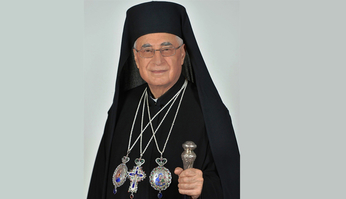
Patriarch Youssef
Patriarchal Christmas Message, 2003
Poverty and Development
Gregorios, by the grace and mercy of God,
Patriarch of Antioch and of all the East, of Alexandria and of Jerusalem:
May divine grace and apostolic blessing be on all our brother bishops, members of the Holy Synod
and on all the faithful clergy and people laity that make up our Melkite Greek Catholic Church.
Poverty and Development
Poverty and development are among the deepest realities of the Gospel: the Gospel, this fine, beautiful, pleasant, beloved, kind, divine, confidence-giving, benevolent, merciful message; this message which Jesus has been bringing to our world for the last two thousand years, as he preached it on the hills and plains of Palestine, in its houses, towns and villages. The message begins with this very beautiful hymn which has given so much inspiration to singers, poets and hymnographers, those who composed prayers, preachers, orators, Church Fathers: a hymn which always remains the focal point and object of our annual holy festival, the Birth of our Lord and Saviour, Jesus Christ - that is the hymn of the angels, singing in harmony with the musical instruments of the shepherds of Beit Sahour: to the accents of these hymns and melodies, the shepherds left quickly for Bethlehem, where the Lord of Glory was born, King of Kings and God before the ages. The shepherds sang this hymn with ecstasy, piety, joy and that happiness which surpasses all joy, in the presence of Jesus, in the most beautiful royal room, that palace before which all our kings’ and emperors’ palaces are but naught, the animals’ manger, in which the divine Child was laid in the presence of the admiring Mary and meditative Joseph. This hymn is ceaselessly repeated, without coldness, boredom or tiredness by the angels in heaven and by human beings on earth, singing, praying, giving thanks to God, glorifying him and saying, “Glory to God in highest heaven and peace on earth to men of good will.”
This Christmas hymn sums up the message of our Lord God and Saviour, Jesus Christ. This hymn is the object of our festal joy, the ornament of this glorious feast, despite our sorrows, illnesses and tribulations, despite the situations by which our world, especially the East, is buffeted. We hear every day the clamour and news of war, fury, killing, violence, terror, hatred and aggression.
The more then, do we have need of this hymn; precisely in these circumstances of ours, so that we can draw from it strength and hope. So we rejoice each and every day, even from the depths of our misfortune, despair, doubt, poverty and feeling of perdition. We call upon each person reading this letter to rejoice because of the New-born, who is our God before the ages, coming to console us, dissipate our sufferings and call us to life, faith, hope and charity.
I Of the Substance of the Gospel
In last year’s Christmas letter, we meditated on the expression which was, so to speak, the guiding star of the past year, “Jesus Is Growing.” This year, we pause, with our beloved brother bishops, priests, monks and nuns, the beloved faithful of our parishes in our holy, beloved Arab countries and in all the lands where our beloved pastors and beloved, faithful people are spread, to reflect on the different meanings of last year’s letter and on the expression which sums up all the concern of Jesus, incarnate for us and for our salvation: the expression, “poverty and development.” Poverty and development are correlative, linked together in the lives of individuals, societies and human groups. We all try to brush away the dust of our poverty and vilification and aspire towards progress and development with all our strength.
Our Lord and Saviour, Jesus Christ, the great Master himself, wished to put as a goal of his Gospel message both love of man and help for the poor and downcast, who are ignorant of everything that would enable them to extricate themselves from their poverty. He wanted to develop the situations of the earth’s people, whom he had created after his image and likeness and he wanted them all to be happy; to be happy and make others happy and build a better world. Jesus said he “came in order that people might have life and have it in abundance.” (John 10:10) And he said, “The Son of Man came not to be served, but to serve and to give his life as a ransom (for those he loves) for many.” (Matthew 20:28) And he said, “Greater love hath no man than this, that a man lay down his life for his friends.” (John 15:13) He pronounced the Beatitude to the poor, “Blessed are the poor in spirit, for theirs is the Kingdom of Heaven.” (Matthew 3:5)
He called his disciples and addressed them, seeing the crowds who were pressing around him by the Lake of Tiberias, saying, “Give them something to eat yourselves.” (Matthew 14:16) And he declared his love for these people surrounding him, people who were hungry, thirsty, with empty stomachs and who had much hope, saying, “I feel compassion for this people.” (“Misereor…”) And furthermore, he blessed the five loaves and two fish and satisfied with these loaves and fish all the crowd whom he loved, he, the “good shepherd, who gives his life for the sheep” (John 10:11) and who seeks the lost lamb and “will seek that which was lost and bring again that which was driven away and .. will bind up that which was broken and will strengthen that which was sick: but... will destroy the fat and the strong: (and) will feed them with judgment.” (Ezekiel 34:16)
II Message and Involvement
These Gospel verses which I have just quoted have always left a profound impression on my life and that is why my patriarchal motto is, “Watch... (and walk) in love.” This expresses nothing other than my great desire to realize this great goal, through my patriarchal service and in my Church. I have repeated very often since my election as Patriarch in the year 2000, expressions, thoughts, wishes and guidelines which all tend to throw greater light on the two aspects of this appeal: to lessen suffering and poverty in our Church and to promote new horizons for development through our services, especially in the private sector, to those groups that have the greatest need of love and care.
Besides, I consider that the realization of this goal is the proper medicine to fight confessionalism and fundamentalism, (that religious impatience which hides behind the cloak of religion in the assemblies of Arab nations) and to staunch the flow of emigration which makes our church communities bleed.
I know very well that this business is also the preoccupation of my beloved brother bishops, the Mothers and Fathers General, and of our Church’s very numerous charitable institutions. Each one of us can tell stories of love, devotion, giving and service and that is the fundamental reason why I founded in 1966 Dar al-Inaya, the Providence Centre, east of Sayda, with my two brother bishops, Georges Kwaiter and Salim Ghazal, putting together a basic project for this institution: to help poor orphans and give to the children of South Lebanon a job, a way for them to live and develop, thus spreading the mentality of this Providence Centre among all the inhabitants of the surrounding region.
That is why I would like this year’s Christmas letter to become a sign of personal involvement for the Patriarch and also for our Church’s pastors and parishes. That is why I tried to find out the opinion of many, both clergy and laity, on this subject and why our Synod studied this theme in June 2003. My desire is that the message of this letter be the expression of all the aspirations of all the members of our Holy Synod and that it may also represent the way of thinking of our Superiors General and our Mothers General who have a great role in enabling it to be realized.
III Concerning Convictions and Solidarity
We should see this solidarity being realized between the Patriarch, the pastors and those responsible in the Church for the laity in the parishes and we consider it the basic condition for guaranteeing the realization of this noble goal, the warranty of our Church’s unity and strength of witness and service in our society.
This letter is not just a dream and the aim is not to put about beautiful slogans, boastful and sweeping. Moreover, we do not pretend that we will find basic, definitive solutions for the thorny critical situation in which we find ourselves, a problem which really goes beyond even the world’s governments and monetary institutions.
IV The Experience of Giving
This letter has as its starting point my conviction and the convictions of us all that the hearts of the sons and daughters of our Church in the whole world are full of a very powerful, prodigious capacity for love, generosity, giving, service, solidarity, mutual compassion and zeal. The history of our Eastern Church is enlightening in the sector of struggle against poverty and fostering development: who are those who have built our churches and monasteries and institutions? They are the men and women of great generosity among our parishioners, who have been and still are creative, always working and giving help for realizing our projects and dreams as pastors for the service of our Church. I may affirm without rashness that there is no eparchy or religious community, dedicated group, institution, service, or welfare society that does not belong to this category and let us not forget the help that we have received and are still receiving from our sister Churches throughout the world.
This letter expresses our determination to walk in the steps of our parents and grandparents, profiting from the experience of the past, but placing before our eyes a new strategy, suited to the situation of our Church, where from day to day our numbers are diminishing in our Arab countries, our strength is being reduced and many of the intelligentsia among our faithful have left and are leaving us for the countries of emigration.
V Perspectives for the Future
This letter is a meditation on the reality of our Church and at the same time an outlook towards a better future for it in this, the third millennium of the incarnation, by putting into place a strategy common both to pastors and parishioners, using suitable modern methods, so that what today is already happening in different stages, in the various eparchies, parishes and religious congregations, may be transformed into a common program. That way, our Church may be transformed into a big workshop for realizing the double goal declared in the title of this letter by the two terms “poverty” and “development.” That means: fighting poverty and putting into action the politics of development.
VI Poverty: “The Poor are Always with You”
Jesus Christ reminds us of our duty to the poor, saying, “The poor are always with you.” (John 12:8) He gave us the parable of the rich man and poor Lazarus, to assure us that the two can be found always in the same society: the rich man at one extreme and the poor man who is longing to eat even the little crumbs, which fall from the rich man’s table. Jesus recalls also the hardness of heart of the “poor” servant who asked for the compassion of his lord, (who took pity on him and pardoned him his debts that he owed him) but then went out from his lord’s to his brother in servitude and poverty, to demand of him the little money that he owed him and started to choke him, threatening to kill him if he did not immediately repay the debt. (Matthew 18: 23-35)
Jesus warns us all against hardness of heart, more than he warns us against wealth and reminds us that judgment for us all will be dependent on our way of practicing charity, helping the poor, sick, strangers, the hungry and thirsty, beggars and those in need. (Matthew 25:31-46)
VII The First Christian Community: “All Things Common”
St. Luke describes the experience of the first Christian community, with regard to development and poverty, in these words. “All that believed were together and had all things common... They sold their possessions… and parted them to all men, as every man had need.” (Acts 2:44) The Acts of the Apostles continues “and great grace was upon them all. Neither was there any among them that lacked: for as many as were possessed of lands or houses sold them and brought the prices of the things that were sold, and laid them down at the apostles’ feet: and distribution was made unto every man, according as he had need.” (Acts 4:33-35)
We do not contend that the early Christians always fulfilled this ideal, but we want to work in our Church to realize at least in part in our third millennium this experience of the early community.
VIII Saints in the Service of the Poor and of Development
The life of all the saints has been characterized by their love for the poor and by social work for development of their society. They lived through the experience of the Spirit that was amongst the early Christian community. We recall for you as an example St. Basil the Great, with whom are linked all our religious congregations. He instituted what has been called the Basileiad, or Basilian foundation, which included an orphanage, a technical school and a popular soup-kitchen. Let us note that St. Basil was a great theologian, bishop, monk and founder of a religious way of life. Let’s not forget St. Nicholas, the defender of the poor and stricken and St. John the Compassionate and St. John Chrysostom, who built six hospitals in his eparchy in Constantinople, St. Theodosius (†639) archimandrite of a monastery in the region of Bethlehem beside St. Saba’s, who founded a big monastery and hostelry for passing poor folk and old people and workshops for trade. Let us not forget the holy unmercenary doctors who healed and looked after the sick, or the great, virtually countless, number of monastics, both male and female, who dedicated their lives to the poor. Let us note in Damascus itself Georgy (George) Betar, who was called by the very beautiful name of Father of the Poor. Let us not forget Father Beshara AbuMurad of Saint Saviour, who was a servant of God. Let us not forget either St. Vincent de Paul, after whom are named many of our congregations and welfare associations, founded by Patriarchs preceding us. In very recent times, just in our time, we remember the Holy Mother, Teresa of Calcutta, beatified by John-Paul II on 19 October, 2003 on the twenty-fifth anniversary of his pontificate, which began on 22 October, 1987. This woman presented the true face of the compassionate Christ, healing and humble, who gives his whole soul for the poor, the needy, the sick, the suffering and the marginalized. This woman really raised the profile of the Church, the bride and body of Christ, as a Church witnessing to the teachings of Jesus and at the service of her poor and sick brethren in society.
IX Monasteries and Eparchies in the Service of the Poor and of Development
The poor have always been at the gates of our monasteries and eparchies, parishes and welfare associations. How much have those monasteries collaborated for the development of society, especially in the sectors of literacy, employment and in schools of arts and crafts! Surely in each religious congregation, association, eparchy, and even in each parish of our churches there is an activity or institution that cares for the poor and in all these institutions, which themselves have sometimes faced weakness and losses, are made very clear the face and ideal of the first Christian Community.
X Paul, the Apostle of Sharing: “Let Everyone Give”
In all that, the Church walks according to the hallowed modes of the holy Bible, which continually reminds believers and invites all the faithful to sharing and giving and helping. We know the saying of Jesus put forward by St. Paul, when he was going about collecting offerings for the holy brothers and sisters of Jerusalem: “It is more blessed to give than to receive.” (Acts 20:35) And he repeats and insists that each one covers the needs of the poor, from his abundance. These words are really a charter for sharing, solidarity and distribution of the goods of the earth to help the poor. And he says, “I mean not that other men be eased and ye burdened: but by an equality, that now, at this time, your abundance may be a supply for their want, that their abundance also may be a supply for your want: that there may be equality: as it is written, He that had gathered much, had nothing over and he that had gathered little had no lack.” (II Corinthians 8:13-15) “Know that he which soweth sparingly shall reap sparingly; and he which soweth bountifully shall reap also bountifully. Every man according as he purposeth in his heart, so let him give; not grudgingly, or of necessity: for God loveth a cheerful giver. And God is able to make all grace abound to every good work: (As it is written, He hath dispersed abroad; he hath given to the poor: his righteousness remaineth for ever. Now he that ministereth seed to the sower both minister bread for your food, and multiply your seed sown, and increase the fruits of your righteousness.)” (II Corinthians 9:6-10) And that is the meaning of a notice I read recently on the door of one of our churches in Cairo, “The poor man is not the one who has nothing, but the one who gives nothing.”
XI The Reality of our Church
As it was in the first Christian community and in the time of St. Paul, so it is still today with the situation in our world: among us there are poor and rich and this situation will not change. It has not changed either under Communism or Socialism whether of an Eastern or Western variety. This situation will not change through legislation or even through a very developed economic or social system. Of course these institutions and developed social norms will be able to change much in society, but the words of Jesus remain present and relevant still, “The poor are always with you.” (John 12:8) “…Whensoever ye will ye may do them good.” (Mark 14:7) This reality is also that of our Melkite Greek Catholic Church in Arab countries, Lebanon, Syria, Jordan, the Holy Land, Egypt, Sudan, Kuwait, Iraq and in the countries of emigration, Canada, United States of America, South America, Brazil, Mexico, Argentina, Venezuela, Australia, New Zealand etc. In all these regions there are poor people at the doors of our churches, our convents, our welfare and social associations and also at the doors of the wealthy among us and at the gates of our clinics, hospitals and even of our parishes, just as there are also rich people, very rich, rich saints, rich who are generous and like benefaction.
It is a reality everywhere and we need to bring a remedy for it, by all means possible, with persistence, planning and clear vision and the mustering of all our strength, as individuals, societies and religious and civil institutions. We ought to deploy all our forces, organizing them in a kind of general campaign, and putting into effect a well studied plan of action, so placing all the means at our disposal for realizing this work. Our goal is clear and urgent, to fight poverty and assure the means for development and prosperity and to arrive at a state of self-sufficiency in our eparchies and religious communities, our monasteries of men and women, so that all these institutions may be capable of assuring more social services for our society in general, especially for the people of our Melkite Greek Catholic Church.
XII The Aim of this Letter
So we may consider four sectors:
1. Fighting poverty and helping the poor in different ways.
2. Finding ways of development, especially in outlying, under-developed areas.
3. Finding ways of developing our properties and buildings and lands, which are in fact generally very numerous and rich, especially in our eparchies and religious congregations.
4. Assuring opportunities for work, especially for young people and young families.
These four sectors should become the preoccupation of Patriarch, bishops, fathers general and mothers general, welfare societies and also the different councils that exist in our eparchies and parishes, as well as the pastoral councils, the millets, the Haut Conseil of the Lebanon, the Association (Rabitah) of Greek Catholics in the Lebanon, and other associations, work teams and welfare societies in our eparchies and parishes.
We should profit from experience of the past and that of others and let us be creative, not afraid of thinking of new, courageous initiatives for realizing this noble goal, even if some people think that these means are useless or unimportant.
There then is, frankly, the aim of this letter. We are faced with the reality, as I have just said, that the poor are always with us. So before me is a very clear goal: there will be no poor people after today in our Church! Of course, it is an ideal, too high and noble and not capable of being realized one hundred per cent. But we should however, make every effort to bring it about, even partially. Of course, I don’t have ready-made solutions, all prepared and effective, but I am putting forward ideas for my brothers, my children, for my brother bishops all, the fathers general, the mothers general, the rich among us, business-people, economists, people who have social, international and local relations and all Melkites throughout the whole world. Besides, we need to develop these ideas in our meetings everywhere in our Church.
XIII Initiatives and Proposals
In what follows, I should like to put forward some practical proposals towards realizing the aim of this letter. Of course, not all these initiatives and proposals can be realized, but we have thought about and tried out different initiatives, in order to see what are the best suited to our purpose.
Here are some initiatives:
1. To call together a preparatory meeting consisting of bishops and businesspeople, to study further the ideas proposed in this letter and put into place a kind of policy or plan of action in broad terms to see how they could be realized either locally or internationally.
2. To hold a special congress in our Church, which would bring together all the welfare and social work institutions in order to see how to co-ordinate the efforts made in social work; to modernize the work and give it a new and more effective thrust, based on the Church’s social teaching, especially insofar as it is concerned with social justice and its practice and application in our Church in general and in each of our eparchies, monasteries and institutions.
3. To relaunch the UMCI Foundation, (The International Melkite Greek Catholic Union) so that it becomes once more a departure point for finding ways of funding big projects in our Church.
4. To require a monthly or annual donation, freely given but insisted upon, from each family or each Greek Catholic wage-earner. This monthly or annual gift will form the basic revenue for supporting all our projects. This proposal must spread and be applied everywhere, amongst all our faithful.
5. To increase the capital and effectiveness of the development team AlRabweh (in the Lebanon).
6. To increase the capital of the community’s funds for the support of poor eparchies’ development projects and welfare.
7. To found a job centre in every country or eparchy, according to need.
8. To found a student fund, according to the needs of each country and region.
9. To found a Greek Catholic business people’s association in every Arab country and in all the countries of emigration, the network of which would be coordinated through a central association.
10. To found an office for the study of different projects proposed by our parishes, in our eparchies and religious communities of men and women and in welfare associations. This office would study projects in a scientific way and propose ways of financing them through the donation, (mentioned in number 4) of one dollar either monthly or annually. These funds would be directed by a special commission, under the presidency of the Patriarch.
XIV A Common Mission
Dear brothers and sisters, dear sons and daughters,
this then is my letter: it is a kind of summary of my dreams, my vision and perspectives. The aim is very dear to us all. The Patriarch is the one who co-ordinates the efforts and strengthens our courage, always seeking the good: he watches over those who do not, in order to bring about the common good, abundant for all.
That is dear to the heart of our Lord, Jesus Christ, who asked us to look after the poor, the orphan, the foreigner, the widow, the marginalized and those in need. It was also very dear to the hearts of the saints, who all loved the poor and served them. It is also dear to the heart of the Church, which has expressed this in her social teaching, repeated down the centuries, especially after Vatican II. It is also truly dear to the heart of each one, each monk or nun, each Christian, who is believing and sincere in his faith. For we all need the mercy of God and of our neighbour beside us. We are guests at the table of friendship and love, at the table of the kingdom. We are all children of Abraham, friend of God, who gave hospitality to God, through the hospitality he gave to strangers. We all know the great monastic tradition of philoxenia, of love and friendship to (poor) strangers, and of fraternal sharing with them.
I would like, through this letter, to make each faithful child of our Melkite Greek Catholic Church feel that he is responsible for the poor person at his door, whom he sees every day, accompanying him as he walks and talks with him, and whom he encounters every day. He is, each one of us is, responsible for developing his Church, for he is a member of this Church and together we all make up one single body, as St. Paul says, “Whether one member suffer, all the members suffer with it and if one member be honoured, all the members rejoice with it.” (I Corinthians 12:26)
XV A Common Responsibility
The realization of the goal of this letter is a common, shared responsibility: no-one is excluded. No-one can declare himself incapable of working for the realization of this goal. No-one is dispensed from his obligation to realize this goal. It is a real common responsibility, personal and universal, springing from our faith and from our consecration to God and to the service of others, from our baptism, from our priestly ordination and from our religious and ecclesial dedication.
I, as Patriarch, declare my involvement in and my entire responsibility towards this letter.
I would like us all to declare together that we are involved and responsible for it too, both as individual members and as communities: bishops, members of the Holy Synod, fathers general, mothers general, religious communities of dedicated men and women.
Besides, I would like us to declare, as a whole Church, pastors and parishes, our obligation and involvement in the plan for “Poverty and Development,” and that we affirm our responsibility towards the realization of the goals of this letter.
Through this letter, I call upon our sons, especially, in the Melkite Greek Catholic Church throughout the world and address this appeal especially to welfare societies, to the different councils that are to be found in our eparchies and parishes and I say to them all: you are all responsible and involved with this letter.
I appeal especially to the wealthy, to very successful businesspeople, those who have a lot of money or influence in social and economic life and in local, national and international politics: you are all responsible and you should all be involved.
I am speaking also to all our sons and daughters, brothers and sisters, wherever they are and saying to them all: you are responsible; you are involved in the realization of the content of this letter.
I even address the poor themselves, each and every individual among our children in the Church: you are all responsible and involved.
XVI An Historic, Common Involvement
This letter represents an historic moment in the history of our Church. It must be a prophetic letter at the beginning of the third millennium, drawing together, simultaneously, our experience of the history of our Church and our perspectives and those of the new generation looking towards a better future.
We declare before all our historic involvement: let all be witnesses to our involvement, both I and all of us, trusting in God and his providence. Also, we have confidence in you all, so that we may realize together this dream and noble goal. It is a dream of love, and love and charity are never-failing and never abandon in the face of difficulties the fight for the beautiful ideals of spiritual perfection and Christian heroism. It is a dream of active charity; it is a dream of common charity, to which Jesus has invited us, by making it into his New Testament for each one of us; charity that knows no limits; as he said, “This is my commandment: that ye love one another as I have loved you. Greater love hath no man than this, that a man lay down his life for his friends.” (John 15:12-13) “I am come that they might have life, and that they might have it more abundantly.” (John 10:10) Well, this letter is a dream of love: it is also the dream of God for his children, because God is Love. And when a man loves God and the poor and his neighbour, the Lord gives him still more in sharing his own strength and love.
I am waiting for your proposals, comments and opinions and I hope that this letter will not remain without an echo in your heart and thought. I hope that there will be study circles at different levels to look together at how to bring about the goals of this letter. I propose that it be studied in different circles and gatherings, including gatherings of businesspeople and wealthy folk. Write to me; enter into a dialogue with me. Our Church has need of all its children and I make this appeal especially to my brother bishops, and the superiors general and mothers general: don’t leave me alone in my dreams and projects and plans!
We ought to mobilize all our resources to realize this plan of action, which I think important for the future of our Church, on the spiritual and material, political, social, moral and national levels in our Arab countries and in the countries of emigration.
It is a plan which is capable of realizing what the Holy Father, John Paul II said to us during his first visit to us after my election as Patriarch and which has become a sort of slogan and aim for all our faithful, known to them all, “You Greek Catholics are a strong, coherent, united Church.” I add to the Holy Father’s words, my own motto that you know, “Watch …and walk in love.”
This plan, which will be implemented by us all, should be common to all Greek Catholics, to each and everyone. It is not simply concerned with material progress and collecting plenty of money for the service of the poor and setting up a workshop for development. There is besides a social and spiritual dimension to our Church and we believe in and aim at realizing thereby progressive involvement in and attachment to the Church, in Melkite Greek Catholic solidarity and in the feeling that we are one body, one Church, a united community, so that each individual Greek Catholic throughout the world should feel linked to his Greek Catholic brother throughout the world. We have had enough of living here and there in the diaspora, in isolation and in the feeling that we are lost, in our egotism. We have had in the past, more than enough of weeping over our Church’s woes, our poverty and our fears.
We are convinced that the realization of the aims and proposals of this letter are guaranteed, by the grace of our Lord Jesus Christ, to rally and raise our Church and develop it, creating a strong bond between all its faithful. No-one should feel a stranger in our Melkite Greek Catholic Church. No-one should feel helpless, without support, without a reference point in his Church. And no-one should feel that he is at all dispensed from helping his brother. No-one is dispensed from his responsibility for realizing even a jot of the Patriarch’s big project. I shall knock at the door of each one of you. I shall allow no-one to rest satisfied with his wealth, closing his eyes to his brother’s need.
I want, as Patriarch, to bring about these projects decisively and consistently, even obstinately, with my eyes on a specific target. I shall go from country to country, to every country where there are Greek Catholics telling them all, “I love you: love each other and help each other, especially in life’s difficulties. You, Greek Catholics around the world, unite; be a single body, a single community, a single society and a single heart. Watch and walk in love.”
XVII First Step: Melkite Solidarity
We shall continue to ask for advice here and there about the principal sectors of this letter, but we wish to take the first practical step. We shall throw ourselves into the venture and we shall succeed. That’s why I am declaring straightaway the founding of the Melkite Solidarity Fund. It will be at the service of the projects of our eparchies and religious and monastic congregations and we shall open the door for everyone to subscribe to it. We hope to collect, in the course of this year, two thousand addresses from our faithful and we shall found a commission to direct the Solidarity Fund, under the supervision of our patriarchal Ekonomos General. There will be laypeople too on the commission, which will decide on ways and means of collecting and distributing the funds among the different projects. So, again, we shall soon be opening an account under the name of “Melkite Solidarity.” We consider that each little realization, even a partial one, is a small step along the road to the realization of our project and of our great aspirations. Help us; align yourselves with the Patriarch’s dreams. Send us your offering, whether small or large, to the “Solidarity” account.
XVIII A Common Dream of Love under the Protection of the Virgin Mary
We place this letter and our involvement in realizing these goals, we place this dream in the heart of Our All Pure and Holy Lady, pitiful, merciful and full of love, the Virgin Mary, who has filled all her children with her love, as appeared during the marriage at Cana when she asked of Jesus the first miracle, to get the young household out of its first difficulty, on the very day of the wedding. It is Mary whom St. Luke described as hastening to Zechariah’s house to serve her relative, Elizabeth. It is she who heard the voice of her son, Jesus, as he was about to die on the cross, recommending St. John to her care and saying, “There is your son.” She bends her gaze on all her children and blesses them and blesses us and blesses our proposals and goals, so that this letter may bear good fruit. Jesus did the first miracle to honour his pure mother and from love for that new family at Cana. He himself is the guarantee also for doing miracles with us in our Church and for blessing our involvement and the declaration of our common ecclesial responsibility, so that that these should become the source of spiritual and social prosperity and so that this letter should yield fruit, thirtyfold, sixtyfold and a hundredfold of goodness, love, solidarity, brotherliness, prosperity, animation and development.
A Merry Christmas and a Happy New Year and may the blessing of God, Father, Son and Holy Spirit be with you all. Amen.
Gregorios III
Translated from the French by V. Chamberlain