

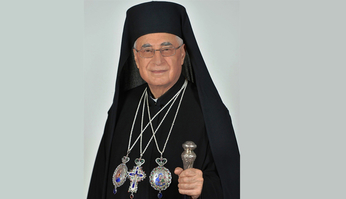
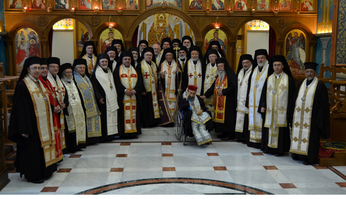
Patriarch Youssef
Middle East Synod 2010
Communiqué of 12 October 2010
Speech of His Beatitude Gregorios III
Patriarch of Antioch and All the East
of Alexandria and of Jerusalem
On this second day of the Synod for the Middle East, His Beatitude Gregorios III, Patriarch of Antioch and All the East, of Alexandria and of Jerusalem, gave a speech on the theme of Peace, Living Together and the Christian Presence in the Middle East.
His Beatitude summarised the main theme of his Christmas Letter of 2006 by emphasising what was at stake and the dramatic consequences of Christian emigration, “Christian emigration represents a continual haemorrhage, causing Arab society to become monochrome, an entirely Muslim Middle East, over against a European society called Christian, although Europe and America are rather secularized than believing. If it were to happen… it would mean that any occasion would be propitious for a new clash of cultures, civilizations and even of religions, culminating in a destructive confrontation between the Arab and Muslim East and the Christian West, a conflict between Islam and Christianity.”
Third Reunion of the Presynodal Council for the Middle East
Rome 23-24 April 2010
Report by Patriarch Gregorios III
of the Melkite Greek Catholic Church
The work of preparation for the Synod for the Middle East has made progress in this third reunion of the members of the Presynodal Council, who are the seven Patriarchs of the Middle East, the President of the Episcopal Conference in Iran and the President of the Episcopal Conference in Turkey. The work was led by Archbishop Nikola Eterovi?, Secretary General of the Synod of Bishops, Rome.
The members studied in a plenary session and in three groups the vast amount of material made up of answers from eparchies, institutions and religious to the questions of the Lineamenta, sent to all Churches in January 2010.
The next step will be for the Office of the Synod of Bishops to produce a document about this recent meeting of the Presynodal Council to be sent in a few days’ time to Council members, who are asked to reply with comments as soon as possible to the Synodal Office.
Then it will be the work of the Synodal Office to produce the final version of the document for the Synod for the Middle East, which will be proposed to Pope Benedict XVI, for his approval. This final document is called the Instrumentum Laboris and will be translated into Arabic and other languages and presented by His Holiness to the members of the Presynodal Council during the papal visit to Cyprus from 4 to 6 June.
The General Secretariat of the Synod will send further information about their eventual participation to all members of the coming Synod for the Middle East to be held in Rome between 10 and 24 of October. The General Secretariat of the Synod will send invitations to observe to Orthodox Churches, to Muslims and to Jews.
The Synod was prepared by the Presynodal Council in September 2009 and in November of the same year. This was the third and final meeting of the Presynodal Council.
All members of our Church are asked to pray for the success of this unique and very important event in the life of the Catholic Churches of the Middle East.