

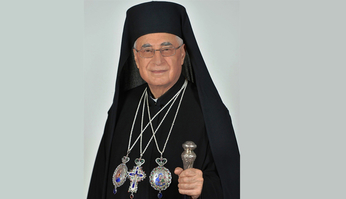
Patriarch Youssef
Visit to Turkey 2004
Liturgy the basis of Christian Unity
Conference of H.B. Gregorios III
for Orientale Lumen 10-13 May 2004
Marmara Hotel, Istanbul - Turkey
Introduction
Jerusalem is the mother of all churches: thus sang St. John Damascene (8th. century) monk at St. Saba’s Lavra, near Jerusalem, 'Rejoice, O Jerusalem, mother of churches, dwelling place of God, because you have received first the remission of sins, through the resurrection.'
Jerusalem is the capital of our faith; the source of all liturgy and celebration; the guarantor of the integrity of our faith, the unity of the Christian cult and of their agreement with the Christian mystery and with the divine economy. Jerusalem is the guarantor of the unity of humanity; all people shall call Jerusalem ‘mother’ (Ps. 87:5, 6). Pope John Paul II said in his encyclical Redemptoris Mater, ‘Palestine is the spiritual homeland of all Christians, because she is the homeland of Jesus and Mary.’
I have experienced these spiritual, liturgical and ecclesiological riches of Jerusalem and in Jerusalem, where I have been able to participate in so many liturgical services according to the rites of different churches, I have observed and analysed much and been able to note how many common elements there are between the rites. Once again the words of Blessed Pope John XXIII are true, ‘What unites us is much more than what separates us.’ I have lived an intense spiritual unity with all the heads of Churches, especially through the liturgy. To live the liturgy of others, with others, is already a very intense movement towards unity: to appreciate the rite of another, to taste and discover the affinities and resemblances between the rites, is deeply appreciated and most enriching. Hearts are always won through the liturgy. When understanding joins with the emotions, in the heart, there the bonds are tightly forged. This is the experience I had during my time in Jerusalem!
The liturgy is not the only basis of Christian unity, however; the liturgy is itself is one of its sources (not withstanding the diversity of languages, traditions, expressions, of the spiritual and literary genius of each liturgy or rite) because the object of the liturgy, its substance and content is the mystery of Christ, as St. Paul says, in ‘its breadth and length and depth and height’ (Eph. 3:18); in all its dimensions, aspects, epiphanies and transfigurations, in all its extent and horizons. This is what the Fathers of the Church have so well expressed by the typically Eastern phrase ‘economy of salvation.’
In this Christological, cosmic and ecumenical sense, the liturgy is at the same time one and unifying and the factor of unity; the liturgy is the fabric of unity, in all its threads and colours. The liturgy is the most eloquent expression of the unity of the Church and of Christians. This is the meaning of the Latin adage, ‘Lex orandi, lex credendi.’ Our Fathers, especially the Eastern Fathers, made a unity of the Word of God in the Old and New Testaments, through the liturgy, the offices and the hymns. This remark is very important in the present situation of hypersensibility on the subject of anti-semitism, because some people are keen to discover evidence of it in the New Testament and in works of the Church Fathers. The liturgy is the gateway to this unity; it carries the interior harmony of Christian prayer. The Greek biblical language is a striking example of this Christian unity, and especially so is the Antiochian unity of the Patriarchate of Antioch, which is the goal of this study.
We Melkite Greek Catholics have a profound sense of the search for unity and the preservation of this unity, especially with our Greek Orthodox brothers and sisters. We have edited all our liturgical books according to a new method, grouping together in a single book, for a period of three or four months, the six books used throughout the whole year. Alongside our liturgical and pastoral concerns, our concern for unity with the Orthodox Church remains alive. We do everything we can to conserve, through the liturgy, the strongest bond of unity with our Orthodox brothers and sisters. Thus, in the latest official edition of the Divine Liturgy, we preserve the Greek language side by side with the Arabic. In the same way, we have conserved the official Typikon while giving a broad range of liturgical options, with a view to liturgical animation.
Therefore, in spite of our communion with Rome, our fidelity to Orthodox liturgy, which is our own, is the expression of our fidelity to unity with our sister Orthodox Church. In short, we have a concern for preserving the sense of the Orthodox liturgy, the yphos (fabric) of the Orthodox liturgy.
The effect is truly excellent. We feel that there is osmosis: our Melkite liturgical reforms are passing slowly into Orthodox circles. Once again the liturgy unites us. In the same way we keep an eye on all liturgical movement in Orthodoxy. This lecture represents a thesis of my liturgical, historical, ecumenical (in the current meaning of the word), ecclesiological and above all Antiochian vision. This lecture springs from my spiritual, liturgical, and yet again, my ecumenical experience. I hope that this conference may lay the foundation of a more profound work for Antiochian unity and for the unity of Christians in the Middle East.
The Greek Antiochian Liturgy and the Greek Language
The Greek language was at one time a world language, the language of the Oikumene, the ecumenical language in the true sense of the word: that is to say, the language of the civilised, inhabited world in antiquity. The ancient civilised world was the Greek or Hellenic world. Rome had triumphed over the Greeks, but had adopted the language of the vanquished and this despite the world expansion of the Roman Empire. The Roman world was much later divided by Emperor Theodosius I ‘the Great’ into the Eastern and Western Empires. This is why I am still called today in Arabic 'Roum' Melkite Catholic and in the languages of Europe, ‘Greek' Catholic.
It is very well known that Greek was the liturgical language of the primitive church, even in Rome, capital of the Roman world and of the Roman Empire, whence we derive the term Roman Church. The Greek language remained the language of the Roman Church for two centuries. Little by little Latin was introduced into Rome and its neighbouring region, Latium. St. Polycarp of Smyrna, visiting Rome in 156, surely concelebrated the liturgy with Pope Anicetus in Greek.
We know too that the Greek language remained in use in the Latin or Roman rite, in the Kyrie Eleison, Christe Eleison, and the Agios O Theos and the Reproaches of Good Friday: moreover, there is an ancient and venerable tradition which imposes on the Roman ritual of the Papal Pontifical Mass, that the epistle and Gospel be proclaimed in Latin and Greek. I used to do this during my years of study in Rome (1958-1961). We know too that there are still troparia common to Latin and Greek in the Greek and Roman liturgy. Thus the Sub tuum praesidium is used in the Latin, Greek and Syriac traditions. Or again, for the Feast of the Nativity of the Virgin (8 September) and the Hypapante (2 February), there are common troparia.
The Cycle of Greek Civilisation
To illustrate my point, I would like to dwell a little on a theme which I call: the cultural cycle of the Greek Mediterranean. This is a world axis which profoundly marked human history, its civilisation and its ancient and modern culture and will always mark it in spite of the influence of globalisation in our time. The cycle has as its point of departure, Greece, with the Greeks. This Greek cycle embraces all aspects of Hellenic culture and civilisation, such as philosophy, medicine, architecture, algebra, astronomy, theology and sophiology.
The Greek language was soon to submerge the entire Mediterranean basin, from east to west, from north to south, both during the centuries before and after the first Christian era. The celebrated city of Alexandria, constructed by Alexander the Great in 332 B.C., is an eloquent witness. It became, along with Athens, the capital of Hellenic and Roman culture.
We can see the importance of the Greek language in the famous translation of the Bible from Hebrew into Greek, in the third century B.C., called the Septuagint and reputedly realised by seventy Jewish scholars, well versed in Hebrew and Greek. This was necessary since the Jews, dispersed in the countries of the Mediterranean basin and in all the Roman Empire as far as the Yemen and the Persian Gulf, no longer knew much Hebrew and apparently spoke in Greek. Thus the Greek language became the language of culture, eloquence, rhetoric, law, philosophy, history, science, for scholars and for city dwellers, while the inhabitants of the villages spoke a Semitic language: Aramaic, eastern or western Syriac. Jesus himself did not speak Greek; he preached the gospel in Aramaic. Amongst the apostles, not one spoke either Syriac or Greek. The Gospels however were written in Aramaic and Greek. On the cross, the writing placed above the head of Jesus was in Greek, Latin and Hebrew.
In fact throughout the whole Church up to the seventh century, in all regions of the East, there was spoken the kind of Greek language that was studied and practised by the majority of fathers, scholars and doctors of the early Church. When the Roman Empire became Christian under Constantine, the church adopted the Greek language; councils were held in Greek and Greek became the language of theology, liturgy and ritual. This also applied to the church fathers and scholars of antiquity, whether called Greek or Syrian, who lived in Asia Minor (today called Turkey), or in Syria and Palestine, that is to say, the territories of the ancient Diocese of the East.
A profound knowledge of the Greek language permitted eastern scholars, such as the Fathers of the Church, to be able to translate into Arabic the Greek intellectual heritage after the Arab conquest. This massive task of translation took off in an extraordinary way in the cities of Antioch, Damascus and Baghdad. It may be affirmed without fear of exaggeration, that Arabic culture and civilisation owe much, if not all, to Christianity and Christian writers, translating from Greek and Syriac. One could argue that there is a Christian influence on Islamic civilisation; in the same way that Christian civilisation in the East has been influenced by Islam.
Let us return to the concept of a ring or circle of Greek or Hellenic civilisation which encircles the Mediterranean basin and even beyond. Effectively the Muslim Arabs who conquered Spain, via Egypt and North Africa, carried with them Greek culture in the Arab language. Through Arab contacts with Europeans of the Middle Ages, and through the Arabic language, the West discovered Greek Hellenic culture and civilisation. After that the Latin culture of the middle ages began to develop, drawing on Greek culture for its literature, philosophy and theology.
This cultural circuit is arguably the greatest and richest in human history: it is a cultural axis of pagan-Greek-Christian-Arab-Muslim; western-eastern; Middle Eastern-European! Subsequently, the circle widened into the whole of Europe, the Slav world and the entire ancient world. The whole world is truly indebted to Greek culture and language.
Liturgical literary genres
The number of Eastern liturgies has always been an enigma for me. How many times have I asked myself the question: why all these eastern rites when the faith is one, with its geographical starting point, Jerusalem, its capital?
However I know these rites closely and in depth, because of my long stay in Jerusalem as Patriarchal Vicar (1974-2000). During that time I discovered numerous, profound affinities between a great number of liturgical texts. I also discovered that what distinguishes them is the language and other characteristics which I shall call ‘cultural’ and which form a kind of ‘literary genre’. It is because of this that I like to apply to the liturgy the theory of ‘literary genres’ used and applied in the study of sacred scripture. Effectively, these rites express Christian dogma which is one in substance, spread across their literary, linguistic and cultural genres.
The application of this literary genre theory to the liturgy is of major importance for reconnecting the diverse rites of East and West, and discovering that which unites and distinguishes them. One can apply in this regard the affirmation (cited above) of Blessed Pope John XXIII on the subject of the Christian churches, ‘What unites us is much more than what separates us.’ The same applies very well to the different rites and liturgies. They are differentiated in literary art, cultural genius, civilising aspects, which are different from one rite to another. On the other hand, they are in accord and harmony with their principal aspects, in number and in kind.
This will help us in our study of the Antiochian liturgy in its numerous modes across history. Although the uninformed observer believes that the liturgies are from different families or denominations, so to speak, in fact, they are all from the same source, and are one in their substance and across their ‘transfigurations’ or diverse ‘epiphanies.’
In order to demonstrate the unity of the Antiochian Rite, (Greek, Syrian, Maronite) and the profound resemblances across all the Eastern rites, I wish to refer to the book of Fr. Alfonse Raes S.J. entitled ‘Introductio ad Liturgiam Orientalem.’ (He was my professor of liturgy at the Pontifical Oriental Institute.)
In his book, Fr. Raes established synoptic tables for different parts of the eastern sacraments and liturgies. These tables demonstrate the profound kinship between the rites, not to say their unity. This study provides evidence for our theory about the literary genres of liturgies. All our liturgies are indeed cultural ‘epiphanies’ of the same Christian dogma: they proceed directly or indirectly, in one manner or another, from one unique liturgical source, Jerusalem. All express in different ways (chants, melodies, poems, icons, symbols, ceremonies, rites, processions, gestures, liturgical instruments and ornaments..) that which St. Paul calls the ‘great mystery of faith’ and which the Fathers, especially the Greek Fathers, have put so well in their expression dear to the Eastern Christian, ‘the divine economy of salvation.’
This appears especially in the anaphora of the Divine Liturgy, which is the great prayer of thanksgiving and which is the central part of the Divine Liturgy or Mass. One finds there very clear common elements, especially in the anamnesis and epiclesis. This is obvious in the different eastern anaphora: they are so similar, not to say ‘one’ and share a basic content and central core founded on the Trinitarian economy of salvation.
There is no time to discuss in detail other common elements, such as the Psalms, (which are the same, of course) which are very similar in their selection and deployment among the different Eastern feasts and offices, being distributed among the events of salvation in the holy places of Jerusalem and the rest of the Holy Land. Then there are the saints common to all churches and rites and in the same manner, the liturgical cycle; Easter, all the Feasts of the Lord Jesus and of Mary (Our Lady); and of course the sacraments too: Fr. Raes gives the synoptic tables of the sacraments in all the eastern rites in his work already cited.
Jerusalem: The Origin
All rites were born and developed in the Middle East. They are eastern constructs and not imports. The East (from Jerusalem) is the point of departure for all the rites, including the Roman and other Latin rites. This is what the famous theologian and hymn writer St. John Damascene sang, ‘Rejoice, Zion, Jerusalem, Holy One, mother of churches, dwelling-place of God, because you have received first the remission of sins, through the resurrection.’ And the Psalmist says, “And of Zion it shall be said, ‘This and that man was born in her’ and ‘all my springs are in thee’” (Ps.87:5, 7).
One knows very well that the Spanish pilgrim Egeria (or Eheria) and other western pilgrims transported to the West the prayers and customs, processions and rites which they had experienced around the holy places, especially in Bethlehem and Jerusalem. Thus Jerusalem is truly not only the mother of churches, but also the mother of all rites. We can justifiably call all the rites ‘Hierosolymitan,’ because the liturgy of the mass and all the prayers are the celebration of the mystery of Christ, the mystery of the divine economy of salvation, accomplished in Jerusalem.
It is interesting to raise the point that the majority of hymns are the work of hymnographers, of saints, holy Melkite monks, in the Orthodox and Catholic meaning both Chalcedonian and Syrian, of the eighth and ninth centuries. The majority of them were monks of the monastery of St. Saba in Palestine, the most renowned being St. John Damascene (+749), Andrew of Crete (+767), Cosmas Damascene the Hymn Writer (+749), Joseph the Hymn Writer (+ 883), Theophanos the Hymnographer of Jordan (+845), and their master Romanos the Melode, son of Homs, deacon and cantor at Beirut, Tyre, Baalbek.
Antioch: One Church in two languages, Greek and Syriac
Antioch is the first heir of the Jerusalem tradition. The second is Alexandria, the third Asia Minor with Constantinople: hence the importance of the study of the history of Antioch in the first millennium. The geographical, historical, theological, national, ethnic and linguistic structures of this church are the reason and cause of the diversity of these rites. From a misunderstanding of this reality, there is born a feeling of confusion at the diversity of rites and it is believed that the rites are different and strangers one to another. We lose the universal character of Antioch! In fact, it is in this ancient Eastern Diocese of the Roman Empire, in Syria of Greek tradition, that we find the most beautiful marriage between Roman and Greek cultures. We may say without boasting that the Melkite tradition, both Orthodox and Catholic, is the most successful example of such a marriage in the history of the whole Roman Empire and in the civilization of the Middle East. It is through this universal character that we can discover the unity between the Antiochian rites and their Antiochian origins and in the same way discover the unity of the Church of Antioch itself.
Indeed, we, the Greek Catholics and Greek Orthodox of Antioch (and of Jerusalem and Alexandria) are called by two names: Greeks in the West, and Roum or Roman in Arabic and in Muslim and Arab literature up to the present! Thus we carry the double character of Roman and Greek. Through our double name, we discover the history and civilization of the Middle East, which formed part of the immense Roman Empire, Western and Eastern, including Europe, North Africa, the Middle East, as far as the Arabian Peninsula, Mesopotamia up to its frontier with Persia (Iran) and this is where Greek language and culture reigned, side by side with Syriac. We are indeed both Greek and Roman!
We rediscover this historical, cultural and geographic reality in the titles of the diptychs of the Orthodox Patriarchs of Antioch, Jerusalem and of Alexandria. These are to be found all together in the Phymie (praise) of the Melkite Greek Catholic Patriarch who carries the triple title of Antioch, Alexandria and Jerusalem and where we read, ‘the Patriarch (so and so), our Lord and Pastor(shepherd) Patriarch of the Great Cities of Antioch, Alexandria and Jerusalem, of Cilicia, Syria, Lebanon, Jordan, Palestine, Georgia, Arabia, Mesopotamia, Libya, Pentapolis, Ethiopia, Egypt, Father of Fathers, chief of chiefs, shepherd of shepherds, the thirteenth apostle, may he live many years! Eis polla eti...’ These titles show the vastness of the territory of the patriarchates of Antioch and of Alexandria and of Jerusalem, where the eastern rites of which we speak are to be found. One discovers through this the geographical, cultural, ecclesiastical, spiritual, monastic, theological and liturgical bonds which unite them.
The expansion of the Greek language in all these regions created between them common denominators and a very rich and diverse facility for theological, intellectual and ecclesial osmosis. It is this richness which characterises Antioch from the point of view of historical culture and civilization.
At Constantinople there is a certain monolithism, or monism, because one finds there a sole culture, a sole language, a sole people. The same is true of Alexandria, where the Greek language reigned supreme in its Coptic form (the characters of the Coptic alphabet are Greek). Perhaps this is one of the reasons why so many Coptic prayers are found in the Greek rite. We must not forget though, that nine Syrian monks preached the gospel in Ethiopia, of whom St. Frumentios of Tyre was the first bishop of Aksum (Eritrea).
Antioch is very different: there one finds Greek language and culture developed to its highest level. At the same time, the Syrian, and even the Aramean and Arab language and civilization, were splendidly and richly developed. Antioch is truly the homeland of pluralism in all its aspects; ecclesiastical, civil and cultural. It should be noted that Syriac is very different from Greek and although these two languages developed harmoniously, they remained independent in all their aspects.
This is a single and unique fact in the history of cultures and civilizations: this harmonious diversity remains in place up to our time. Indeed Syrians remain faithful to Syriac in spite of the fact that they use Arabic in their liturgy; the same is true of the Maronites. In the same way, we, the Greeks, are called Greeks in spite of the fact that we have translated all our liturgy and offices into Arabic. Since the 11th. century we have been praying in Arabic, while still using Greek to this day.
This means that the Syrian Fathers were Antiochian Syrians, in spite of the fact that they wrote in Greek and most likely did not celebrate in Syriac. In the same way the Greek Fathers were Syrian and Antiochian in spite of the fact that they wrote in Greek and did not understand Syriac. This was because the Greek language was common to all cities, while the rural population spoke Syriac or Aramaic, but the inhabitants of the cities and villages came from the same ethnic stock.
Saint John Chrysostom, the Antiochian genius (before he became Archbishop of Constantinople), was Syrian Antiochian and did not know Syriac. He used to preach in the cathedral of Antioch. During the great feasts there came from the town and villages the faithful, of whom one group spoke Greek (the town) and the other group Syriac (the villages). However, all belonged to the same diocese and Church. On the occasion of a great feast, he (St. John) had around him a large congregation, but had to apologise for not preaching in Syriac, the language of the greater part of the faithful attending the liturgy. That is to say, the two languages of Greek and Syriac were the languages of the faithful of the same diocese of the Church of Antioch; the same people had two languages. One can draw an initial conclusion from this: we, called Greeks and Syrians, that is to say the Greek Orthodox, the Greek Catholics, the Syrian Orthodox, the Syrian Catholics and the Maronites are a single people, even if, nowadays, we belong to different rites.
We all know that St. John Chrysostom was the author (in a general sense) of the liturgy attributed to him, which he took with him to Constantinople and which is now celebrated in different forms in the Syrian, Armenian and Coptic rites. The liturgy gained several new, but rather minor, elements in Constantinople: the proskomedia; the procession of gifts and the chant ‘O only begotten son’; otherwise it is an Antiochian liturgy.
Similar to the instance of St. John Chrysostom is that of St. Cyril of Jerusalem, when he was given the task of preparing catechumens: for them, he preached his famous Catecheses, during Lent and the Paschal season of 348, in the Basilica of the Holy Sepulchre, (all except the last five, which he gave in the rotunda of the Resurrection) standing on the hill of Golgotha, on top of the stone of Unction, where the catechumens had gathered, of whom one part spoke Greek and the other Syriac. However, St. Cyril only knew Greek and had recourse to a Syriac interpreter. All the catechumens were members of the same Church of Jerusalem. Much later St. Cyril became bishop of Jerusalem. We must not forget that the monks of St. Saba belonged to different countries and spoke different languages, but belonged to the same Church and gathered together to celebrate the liturgy in the Greek language. Similarly, St. Jerome reports that at the funeral of Saint Paola psalms were sung in Greek, Latin and Syriac. A little-known sermon of St. Gregory of Nyssa shows that the province of Pontus (present day northern Turkey) and Cappadocia were following the Syriac rite at the end of the fourth century. The osmosis effective in Antioch and at Jerusalem was also effective in the region of Constantinople.
When picturing Antiochian culture, it is impossible to exclude other languages: Syriac, Greek and Arabic are endemic in the geographical area with which we are concerned here. So, one of those icons of the kind that best demonstrates the universality of that same Syrian-Antiochian culture across time and space, is the double-sided icon of Kaftoun. It has on the back a magnificent depiction of the baptism of Christ, with inscriptions in three languages, Syriac, Greek and Arabic.
Now a word on the subject of the term Byzantium: this town was named after its founder Byzas, in 658BC. It was later called Constantinople, the name of its founder the Emperor Constantine, who inaugurated it in 330, when the name Byzantium disappeared. In spite of this, the name (Byzantium) became more renowned than Constantinople and it remained that way until the name of Byzantium gave way to that of Istanbul. The term Byzantium became widely known in culture, architecture, thought and theology and this under the influence of Byzantinologists. Remember that Byzantium was dependent on Antioch. The term Byzantine, applied to the liturgy appears much later.
Greek: the Common Denominator
Thus the Greek language becomes a common denominator for the eastern rites, which all conserve Greek terms. I shall give some examples of numerous common hymns between the Greek rite (called Byzantine) and the Syrian (Maronite), Coptic, and also between the Armenian and Ethiopian rites. The eight tones of the Resurrection are for the main part the same or very similar in Greek, Coptic and Syriac, as are the prayers and hymns of the little hours. So are the prayer which closes the little hours; the beautiful hymn ‘O Gladdening Light’ in the Greek, Armenian, Coptic and Syrian rites; the hymn of the Bridegroom; the hymns of Christmas and of Easter; the chants to the Theotokos; the anaphora of the liturgy of St. John Chrysostom and other prayers of that liturgy (the Armenian liturgy contains twenty-one prayers from that liturgy).
The Council of Chalcedon (451) and the Antiochian Rites
The eastern rites diversified and were fixed between the sixth or seventh centuries, around the Council of Chalcedon. This Council, where the theme of Christology occupied the place of honour, did not influence the liturgical texts or rites. The texts in which one finds traces of the Christological dispute did not appear until later. The main parts of the liturgical texts were composed before the Council when there was only one bishop and two languages in Antioch as also in Alexandria. We must not forget that Severus of Antioch and Dioscoros of Alexandria and numerous others, who are pillars of the Syrian and Coptic tradition, wrote in Greek, and lived before the (time of the) schism of Chalcedon. Hymns slowly replaced the psalms and were composed between the fourth and eighth centuries. In the same way the principal structures of the liturgical prayers (the hours) were being formed around the council of Chalcedon, but were not influenced by the conciliar disputes, in spite of the fact that these disputes were the reason for the diversification of the rites and the divisions of the churches.
This is to say that the majority of these hymns were written in the one church, where there was still one bishop, before the divisions between patriarchates and bishops into Chalcedonians, Greek Byzantine Melkites and non-Chalcedonians, Syrians and Copts. All these elements (a single bishop, the hymns, the hymnographers) are important factors for demonstrating that the Antiochian rite (in the two languages of Greek and Syriac) was formed and constituted before the Council of Chalcedon or a little after, and in any case before the foundation of the Syriac non-Chalcedonian jurisdiction of the time of Jacob Baradi (+578), denounced as a Monophysite. This is a proof of the unity of the Antiochian rite in both languages and in both traditions. That is to say that the Syriac rite is Antiochian and the Greek rite is also Antiochian; the same rite in two languages. The Melkite rite is also Antiochian and is the origin of the rite now called Byzantine. That is to say that our rite, like that of the other Greeks and the Syrians is the unique rite of a single Church which had two liturgical languages, going back to one origin. It is the Council of Chalcedon which has separated us and not our rite. We all have one sole Antiochian rite in two languages (and one can say the same thing about the Maronites.)
Influence between Antioch and Constantinople
We can affirm with scientific certitude, that the rite called Constantinopolitan was able to develop because of and after the Council of Chalcedon and that this is where the Greek Antiochian rite acquired several elements from Constantinople. But, to tell the truth, these are secondary elements and of lesser importance: the procession, ritual movements, directives of the Typikon; these elements developed much later between the thirteenth and seventeenth centuries. This Constantinopolitan influence became marked after the Crusades (which in our Arab and Muslim literature are called the Frankish War) and again, because of the aggrandising influence of the Patriarch of Constantinople, it became the point of reference for its Christian citizens, later the inhabitants of the Ottoman Empire. We must not forget either the Byzantine reconquest of the tenth century or the fact that the Patriarchs of Jerusalem and Antioch were refugees in Constantinople. It must be stated that both then and later it is Antioch which influenced Constantinople, especially in the liturgy.
On the other hand, everywhere, in all Churches and rites, there were different local traditions, so the Syrians conserved seventy-two anaphoras. It is possible that under the influence of Constantinople a good number of these anaphoras disappeared. The Antiochian Typikon and that of Jerusalem were also partly influenced by that of Constantinople. If we read the Typikon of Constantinople and that of St. Saba (and not that of Antioch), we see the relationships between the Antiochians and the Byzantine Greeks, which prove that the original rite is Jerusalem-Antiochian. It is interesting to note that the texts of the Greek rite (Byzantine) of the Greek Orthodox and the Melkite Greek Catholics, written in Greek, were translated entirely into Syriac, after the Byzantine reconquest of Syria in the ninth and tenth centuries. It was Syriac that was in vogue, Greek diminished and Arabic was not yet in liturgical use. Later, at the end of the eleventh century, there began the enterprise of translating the same texts into Arabic. Thus one notes the unique strength of enculturation in the Patriarchate of Antioch and in particular the Greek rite.
The Greek Antiochian Rite was not an Import
There is a widespread theory, hard for us to accept, that affirms that the Melkite Greek Orthodox Catholic Church abandoned its Antiochian rite to adopt the Byzantine or Constantinopolitan rite in the twelfth and thirteenth centuries. This theory was adopted by the celebrated Metropolitan Neophyte Edelby (of Aleppo) in his famous Liturgikon, in Arabic, French and German. The same theory has been presented and defended by Fr. Robert Taft S.J. in his work: The Byzantine Rite: historical précis (1992). Our opinion is different: it is that our Greek Orthodox (and Greek Catholic) rite is an Antiochian rite in the Greek language. The Syriac rite of the Maronites is also the same Antiochian rite in the Syriac language. The Antiochian rite in the Greek language emigrated with St. John Chrysostom to Constantinople and much later into Eastern Europe (the Slav tradition). At Constantinople it acquired several new elements, for different reasons, as we have already said. In the sixteenth century the expression ‘Byzantine rite’ began to spread. One must note that the division of the rites into Constantinopolitan, Antiochian and Alexandrian is of rather recent, especially twentieth century use. The traditional usage is to say: Greek rite, Syriac rite, Coptic rite, Slav rite in reference to the liturgical language of the rite and not in reference to the geography or locality. Recently (January 2004) I was visiting His Beatitude Petros VII of Alexandria, who assured me that he never employed the term Byzantine rite, but only the term Greek rite.
Analysis of Fr. Taft’s Theory
In spite of the great esteem I have for Fr. Robert Taft, I must state that his theory is refuted by the same profound analysis which he made in his work earlier cited. Thus he demonstrates clearly that the origin of the rite called Byzantine or Constantinopolitan is the Greek rite. This is what the Slav ambassadors discovered when they came to Constantinople (987) to find out about the true Orthodox faith and saw in the liturgy, ‘heaven on earth.’
Fr. Taft strongly demonstrates historical evidence for all stages of the so-called Byzantine rite being closely bound up with the tradition of Jerusalem and Antioch, also called Sabaite . Effectively the Byzantine rite developed under the influence of the Antiochian tradition, as we see from the synods held at Antioch. (Not one synod was held in Byzantium.) Antioch gave plenty of bishops and patriarchs to Constantinople, the most famous being St John Chrysostom, who brought the liturgy which is attributed to him.
The rite of Constantinople proceeded from Antioch. We find the Greek rite in the famous Barberini manuscript (n 338), which was put together halfway through the eighth century, and which is of Antiochian and Syrian origin. All subsequent editions are based on this manuscript. This evidence presented by Fr. Taft contradicts his own theory. Taft also speaks of the reform done by the monks of Studion (the monastery founded halfway through the fifth century) with their head Theodore the Studite (+826). He states that this reform has its origin in the influence of the tradition of St. Saba’s and that of Antioch. Effectively St. Theodore sent for the monks of St. Saba’s to help realise this reform. Many of the prayers and hymns of this monastery and in the capital were written, with several variants, according to the tradition of St. Saba’s. Patriarch Methodios of Constantinople (843-847) came from southern Italy and was of Syrian or Melkite Greek origin. It was he who developed the prayers of the Evlogitaria in the Euchologion. At the beginning of the second millennium the book of the Typikon appeared and in it one reads prayers according to the tradition of the monastery of St. Saba, which were in use in the Christian East. These books clearly carry the imprints of St. Saba’s, traces of Jerusalem, of Antioch and of Constantinople. I believe the same thing can be said about the Typikon of Mt Athos.
In the 12th. century a profound osmosis was realised between Constantinople and the East and the Greek rite took on a more Byzantine and cathedral-like colour, where the chants play a greater role. Much later Taft says, ‘In the 12th. century the influence of the Sabaite (of the monastery of St Saba) tradition was augmented and introduced in the Studite monasteries of Constantinople; this is perhaps the last determining element in the formation of the Byzantine rite of today’. At the same time he affirms that the monks carried out the offices of the Church of the Resurrection in Jerusalem (destroyed in 1009 by the Caliph Al-Hakim, and rebuilt by him) and borrowed liturgical elements from the Studite monks. We find an interesting description of this osmosis between Jerusalem, Constantinople, the Monastery of St. Saba and the Studite monasteries in an important liturgical document, the Tachtikon of the monk Nikon of the Black Mountain, in the region north of Antioch in Syria (1025-1088). In this document one sees clearly the influence of Jerusalem on Constantinople and the Studite monasteries and on the Byzantine tradition in the south of Italy (where in some regions, people spoke Greek as late as the sixteenth or seventeenth century and where there are still two eparchies of Italo-Greeks, who are Greek Catholics) and on the Slav countries of Eastern Europe.
These documents produced in the Tachtikon refer to the Typikon of the Great Church, that is to say Constantinople, or more precisely the church of Agia Sophia. In the same way these documents refer to Mount Athos, to the Studion, to the Typikon of St. Saba which relates to the tradition of the monastery of St. Saba and the Church of the Resurrection and the monasteries of Palestine. There is no mention of the term ‘Byzantine’ in any of these documents. In spite of this, Fr. Taft applies the name Byzantine to all stages of development of the Greek liturgy and the influence between Antioch and Constantinople, though we do not find any trace of this attribute in any of the documents already cited by Taft. This would confirm my theory that the usage of this attribute is modern and we owe it to western authors, the Byzantinologists or Byzantinophiles!
We wonder and ask these questions of the Byzantinologists: what is the Byzantine rite? Wouldn’t it be more adequate and scientific to speak of a Constantinopolitan rite? What is the Melkite rite abandoned by the Melkites in order to adopt the Byzantine rite? What are the specific traditions of each one of the two rites? What are the hymns proper to them?
On the contrary we find that our theory is the one that gives the true answer. In the beginning there was the rite of Jerusalem (in its original form) which developed specifically in Antioch, the whole of Syria and in Egypt. It was celebrated in the Greek language in the cities and at Constantinople. Much later, using different languages, it spread throughout the Slav countries and those of Eastern Europe and southern Italy. Thanks to the influence of the Imperial city and several other factors, much later secondary Constantinopolitan elements entered into the already well organised and established Greek rite. The expressions, Antiochian rite, Byzantine rite are very late terms. This is because the word rite relates to the language and not to the city, as we have repeated more than once. Following the resumption of communion with Rome in 1724, our Melkite Church continued to call itself the Greek Church practising the Greek rite. Our patriarch, though Arab, is called Greek. Our synods speak of Greek traditions, Greek canons and Greek theology. Our correspondence with Rome and other places uses the term ‘Greek’ up to today. At the entrance to our Patriarchate in Alexandria one reads: Katholikos Ellenikon Patriarchion. The rubrics called of the ‘Great Church’ and systematised by the Patriarch Philotheos of Constantinople in the fourteenth century never mention the attribution ‘Byzantine.’
How can one say that these rubrics were components of the Byzantine rite, which supposedly replaced the Antiochian Melkite rite deemed to have been abandoned by our ancestors for it? Furthermore, the influence of Constantinople grew only when this city was called Istanbul, at the dawn of the Ottoman Empire, thanks to the Caliphs and not the Byzantine Emperor! This was to maintain the identity of the Orthodox Church and the spirit of ‘Byzantium after Byzantium’. There appeared in the sixteenth century printed editions of the Greek rite: they followed the order of the Constantinopolitan tradition of St. Saba’s, known from that time as the Typikon of the Great Church. Once again, it was a Patriarch of Antioch, Macarios III in the seventeenth century, who introduced the usage of this Typikon, originating from Jerusalem, into Russia, making a uniform liturgical practice in the Orthodox world.
Common research on the subject of the Greek Antiochian, Syriac and Maronite rites
The Maronite Church developed as a church independent of the Greek Chalcedonian Church, in the seventh century, under obscure conditions, in the time of monothelitism. It constituted itself in the first half of the eighth century, the time when the Maronite Patriarchate was founded, because of the vacancy of the Melkite see of Antioch (between 700 and 742). This is why we find three Antiochian rites in the same region: Greek, Syriac and Maronite. There is a vast field for research into the historical, ecclesial, liturgical and ecumenical character of Antioch. Such research would help us overcome our differences, not to say our disputes! Such research would be able to revive the spirit of harmony (concord) between the faithful and extinguish the spirit of fanaticism, which is at the origins of difference between the rites. This would have a beneficial influence on pastoral work, especially amongst the young who cannot bear the East to be so divided. It is our mission to demonstrate our common origin, complementarity and the osmosis between the rites, to help collaboration between our eparchies and parishes, in Arab countries and in the countries of emigration. I am convinced that such research would give much help towards deepening Christian unity, even amongst eastern Catholics. Once again the adage remains true, ‘Lex orandi, lex credendi.’
I am sure that the work of academic liturgical research is a very important factor for contributing positively towards the unity of the Patriarchate of Antioch, which has five title holders: Greek Orthodox and Greek Catholic (the Greek tradition), Syrian Orthodox and Syrian Catholic and Maronite (the Syrian tradition), not one of whom resides in Antioch.
This work for unity in the Patriarchate of Antioch may seem utopian, but it is very important for the Christian presence in the Middle East and in the countries of emigration and for liturgical research. Once again the liturgy can and must be a basis of unity among Christians. This work is the responsibility of patriarchs, bishops, universities and centres of research in the Middle East and in Europe. It seems illusory, but I think that the Church in the Middle East, where Christians are a minority, needs this effort.
Once again we can see the importance of the Patriarchate of Antioch, its unique role in geographical and historical realities, difficult and tragic, its pluralism, complexity, complementarity and wealth of traditions. This Patriarchate represents the reality of the Christian presence in the Arab world. All initiatives coming from this Patriarchate, whether theological, liturgical, ecclesiastical, ecumenical or social, have an immense local impact and an international echo.
Conclusion
1. The use of the term ‘Byzantine rite’ is inexact. It is a late term. It applies to cultural realities rather than liturgies.
2. The rite is related to the liturgical language which characterises it. That is why we say, Greek, Latin, Syrian, Coptic, Armenian, Slav, Ethiopian, Georgian rite.
3. The name of Constantinopolitan, Antiochian or Byzantine rite is very recent and not exact.
4. The original rite is that of Jerusalem; its first heir is Antioch where the heritage is expressed in Greek and Syriac; Alexandria is another heir, in Greek and Coptic; Constantinople is an heir in Greek; Rome is an heir in Latin: so one encounters real liturgical unity.
5. The diversity of rites is best illustrated by the expression, ‘liturgical literary genres:’ all the Christian rites are the expression of the economy of salvation, one in substance and content, but diverse in form, expression and formulation.
6. Antioch has, in this respect, major importance. The Church of Antioch, presided over by five patriarchs, has a unique role. Its leaders must work for great unity, solidarity and coordination, both inside Arab countries and in the countries of emigration.
Antioch, where the disciples were first called Christians
For Antioch this title has the greatest honour: there, the disciples were first called Christians. It is the see of Peter and Paul, Ignatius of Antioch and John Chrysostom. At Antioch Christians were called Christians, and not Greeks or Syrians, Byzantines or Orthodox, Maronites or Catholics, simply Christians!
Here is the future and role of the rites: they are to be forms, rich liturgical literary Christian genres, to celebrate the mysteries, one in Christ, one in the economy of salvation. Our future is that we should be Christians. That is the future of Antioch, Constantinople, Alexandria and Jerusalem. It is the future of the Greek Orthodox, Greek Catholics, Syrian Orthodox and Syrian Catholics, Maronites, Copts both Orthodox and Catholic, Armenians, Chaldeans, Assyrians and all Christians, who form in the Middle East the Church of the Arabs, and of which the greatest number are today in the countries of emigration. This Church, I dare to call the Church of Islam.
This study, if it does not aim to realise the great goal of unity, through serious, conscientious, and urgent work, is not worth being written or read.
This is a question of life or death, as J.-P. Valognes has written in a huge work: ‘Life or Death for Eastern Christians.’ It is Antioch which must answer the challenge. The Church of Antioch (with its five branches) has to be the church of the future, not only the church of history. We are, with our Antiochian pluralism, the heirs of history and guarantors of the future.
Antioch! Lift up your head! Your sons and daughters are proud of you. Christian Antioch, great city of God, cradle of Christianity, heir of Jerusalem, holy city and capital of our salvation, from you spread throughout the world “the great mystery of godliness: God was manifest in the flesh, justified in the Spirit, seen of angels, preached unto the nations, believed on in the world, received up into glory’ (1 Tim 3:16).
May this name and mystery be glorified in all languages, all cultures and all rites. May Antioch always remain the symbol of Christian unity!
Gregorios III
Patriarch of Antioch and all the East,
of Alexandria and Jerusalem
English language editor and translator from the French V. Chamberlain