

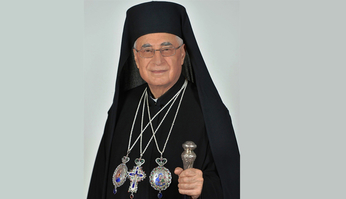
Patriarch Youssef
Message on the occasion of the Eucharistic Year 2005
The Year of the Eucharist
Feast of St. Gregory Nazianzus the Theologian Cairo, 25/01/2005
May divine grace and Apostolic blessing rest on us all. We address this letter especially to the parishes of our Patriarchal Eparchy in Damascus, Syria and to the Patriarchate of Alexandria, Egypt and to the Patriarchate of Jerusalem, Palestine and we leave to our venerable brothers the care of putting into practice whatever seems good to them in their eparchies according to their needs and if they so wish.
The Holy Father, John Paul II wanted this year to be the Year of the Eucharist, from October 2004 to October, 2005 and His Holiness has already published a magnificent letter entitled “The Church Lives by the Eucharist” on 17 April, 2004. An international eucharistic congress was celebrated about the Eucharist in Mexico in October, 2004.
The Eucharist will also be the principal theme of the Synod of Catholic Bishops in October, 2005 entitled, “The Eucharist, Source and Summit of the Life and Mission of the Church.”
The title of the Pope’s letter proclaiming the Year of the Eucharist is the request to Jesus of the two disciples on the road to Emmaus, “Stay with us, Lord. Be with us. Be Emmanuel, Jesus with us.” Jesus himself reassures us that his name is Emmanuel and before leaving us on the day of his Ascension to heaven, he says to his disciples, “I am with you always… Nobody can be against you.” (Matt. 28:20 and cf. Romans 8:31) We in our turn say to Jesus, “Stay with us. Be present with us in the mystery of thy love, in holy communion and above all in this Year of the Eucharist.”
Spirituality of the Year of the Eucharist
The Eucharist is the summit of Christian spiritual life throughout the whole Church and at all levels of the Church, individuals and communities as well. The Eucharist is God with us and we with God, through the celebration of the Divine Liturgy and Holy Communion. But the Eucharist is also the mystery of the whole Church: it is the sacrament of the community. This sacrament has as its starting point the community which gathers on the Lord’s Day to live the mystery of the risen Christ in an atmosphere of prayer, brotherhood, love and joy. It is at the same time also the mystery of the community outside the church, the mystery of brethren that we meet on Sunday at the mass and that we meet in house, street, school, workplace and job. The Eucharist is the mystery of Christian brotherhood, the mystery of brethren, the mystery of the other and it is to that that the greeting that we exchange during the Divine Liturgy refers, “‘Christ is among us and with us.’ ‘He is and will be always.’”
That is what we read in chapters 2 and 4 of the Acts of the Apostles which unite together the celebration of the Eucharist and the agape and help to the poor in the first Christian community as follows: “And they had all things common; and sold their possessions and goods and parted them to all men, as every man had need. And they, continuing daily with one accord in the Temple and breaking bread (the Eucharist) …did eat their meat with gladness and singleness of heart.” (Acts 2:44-46) “And the multitude of them that believed were of one heart and of one soul.” (Acts 4:32)
The Eucharist is a call to unity within the Church and with the faithful members of other Churches with whom we also have the possibility of participating in the holy Eucharist and for us Greek Catholics the Eucharist is the realisation of the wish of the Holy Father John Paul II to us, when he said to us, “You are a strong and united Church.”
So we wish that the Eucharist be in our whole Church, with its three patriarchal eparchies, a year of love, collaboration, solidarity and brotherhood, pastoral co-ordination and strengthening of our common faith with regard to the mystery and sacrament of the Eucharist. We would like to quote here a reference to a passage from His Holiness’ letter declaring this year the Year of the Eucharist, where he says, “I do not ask, however, for anything extraordinary, but rather that every initiative be marked by a profound interiority.” (Paragraph 29 of the Apostolic Letter “Mane Nobiscum, Domine.”)
The principal features of the Year of the Eucharist
The principal features of this blessed year are:
I. Celebration of Sunday with great care and reverence, with beauty and spiritedness of the Divine Liturgy and liturgical prayers celebrated in parishes and the participation of the people in these prayers, according to the guidance issued by the Patriarchal Liturgical Commission so that the Year of the Eucharist may be considered as the Year of the Liturgy, as the Holy Father was saying.
II. Very serious preparation for Holy Communion, especially through the sacrament of repentance, reconciliation and confession and works of penitence and encouragement of acts of faith, hope and charity.
III. Strengthening of the community spirit in our parishes
IV. Declaration of our faith in the sacraments and the mystery of the presence of Christ in our midst in the Eucharist through different initiatives.
V. Care for the poor among us by means of collections on Sundays especially for their needs from benefactors whom God has blessed.
Initiatives and Proposals: general guidance
We outline some initiatives and practical proposals to bring to life this Year of the Eucharist and we leave to each eparchy and parish to choose from among them those that are most suitable for them and their conditions.
1. The official proclamation of the Year of the Eucharist in our Cathedral in Damascus and in each parish on the same day, which is the 30th. January, 2005.
2. Churches will be open on Fridays or another day until 9p.m. at the latest and there will be a spiritual vigil there during which chapters of Holy Scripture will be read on the subject of the Eucharist and prayers will be recited from our Church’s Services of Corpus Christi and of Metaleipsis and some time can be left for Gospel participation, moments of silence, listening, meditation, adoration and personal devotion.
3. Choirs will learn the chants for Corpus Christi and will present them in special recitals.
4. Publication of a small leaflet which would help the faithful practise penitence and confession for preparation for Holy Communion.
5. On Great and Holy Thursday, there will be a great, central celebration with all the clergy and parishes gathered around the Bishop and there will also be the ceremony of washing the feet with the Divine Liturgy and priests will renew their sacerdotal and Eucharistic vows in the presence of the Bishop and the people for whom they are responsible.
6. There will be taken each month, let us say, on the second Sunday of the month a collection, set aside especially for needy brethren.
7. Make a video-recording of a model liturgy, with special explanations for presentation at meetings of fraternities, youth clubs and other pastoral activities.
8. Print and disseminate a little booklet explaining the different parts of the Liturgy and other things, such as entering a church, making the sign of the cross, venerating icons and symbols in church.
9. Record cassettes of all the liturgical prayers said other than the Divine Liturgy, so that they may be in the hands of the faithful, to be the means of practising prayers in the home and to guide the faithful to rediscover the beauties of our liturgical prayers composed by our holy Fathers.
10. Direct the faithful to practise the ancient practices of Eastern devotion so that they may slowly spread in our parishes, especially that of the Jesus Prayer. One can consider it as an Eastern corollary to Eucharistic devotion. Moreover it may help the devout faithful to engage in a dialogue with Jesus, as if he were present at every minute in all the details of their life. That is why we have placed an explanation of this prayer in the booklet on the Eucharist that we have published this year.
11. The importance of celebrating in a devout and distinguished way all the sacraments this year, for they are all linked to the Eucharist: as we know, in the past, every sacrament was celebrated from within a eucharistic context.
12. We recommend that the icon called Platytera should be printed and disseminated, as it represents the Holy Virgin Mother carrying in her bosom our Lord Jesus Christ. This icon is like a monstrance of the holy Sacrament, in which we are able to see the Virgin Mary, showing Christ, lover of mankind.
13. Revive and strengthen the ancient custom that the faithful had of regularly presenting to the church everything necessary for the celebration of the Eucharist. The Eucharistic bread, wine, oil, candles, flowers, liturgical instruments, altar cloths, vestments for priests and deacons and for the thurifers and those who carry cross and candles and other offerings according to the needs of the church.
14. We appeal to all our faithful in all parishes to participate in this Year of the Eucharist and to discover above all the beauty of silence, of quietness, meditation and compunction in church and during celebrations of the Divine Liturgy and liturgical prayers in order to participate in them with warmth.
15. We appeal especially to the young to discover the importance of silence and listening in such a noisy world as this and they are called upon to participate in all the initiatives mentioned above in this letter.
16. We appeal also to our brother priests to ensure the participation of children in this Year of the Eucharist and to help them discover the meaning of liturgical prayer, adoration, devotion and recollection.
17. We have been celebrating in our Patriarchate in Damascus the Year of the Sacrament of Marriage in the framework of different activities of our Pastoral Eparchial Assembly in 2003 and that is why we are calling on families to participate in the different activities of the Year of the Eucharist. Above all, we call upon them to come as often as possible to the Liturgy on Sundays and Festivals, father, mother and children together. We also call upon them to dedicate more time to devotion, silence, listening and meditation in the home. So the home will really become a church, through the presence of Jesus there, as Jesus was present in the house of the disciples at Emmaus, when they recognised him by the breaking of bread.
18. We wish that the Year of the Eucharist may really activate the EparchialAssembly that we celebrated in 2003 in our parishes in Damascus, Egypt and Jerusalem.
The Divine Liturgy
19. Participation in the Divine Liturgy on Sundays very frequently and if possible, every Sunday, although in our countries, Sunday is not a holiday. The faithful have to be encouraged to the eucharistic fast before communion for at least an hour or even two before the beginning of the Liturgy.
20. Presentation of the explanation of the Divine Liturgy in sermons and Gospel vigils.
21. The priests are asked to please apply the rule of carrying out the Divine Liturgy with exactness to help the faithful participate in it, according to what has been presented in the liturgical books by the Patriarchal Liturgical Commission.
22. Priests are asked please to pay close attention to the parts of the Divine Liturgy which prepare especially for Holy Communion, including, for example:
i. the procession with the gifts, with participation by the people, young people and children,
ii. praying the prayers of preparation for the reception of communion with the people,
iii. pronouncing the person’s name before his reception of Holy Communion,
iv. insisting on the importance of the thanksgiving prayers after receiving communion,
v. possibly consecrating two minutes’ silence for personal thanks after communion. That can be done before or after the prayers of thanksgiving after the communion of the faithful.
vi. singing hymns from the Feast of Corpus Christi, after the prayer said “Thou hast counted us worthy to participate in thy holy …mysteries” or at the end.
vii. playing special recordings of the Service of Corpus Christi before theLiturgy and at the end of the Divine Liturgy.
23. Celebration of the Divine Liturgy with designated groups. There would be more time to explain and animate them suitably for these specified groups, such as, for example, young people separately or little children and so forth.
24. The celebration of the Divine Liturgy on Sundays and Festivals and the celebration of liturgical services should be done suitably to express our eucharistic adoration during this year. I call upon everyone not to look at their watch when they attend and participate in the Divine Liturgy. If they look at their watch it means they are not happy with the Lord, but let us say rather what is said at the beginning of the Liturgy, “It is time to act for the Lord. And let us set aside all earthly care, for we are going to receive the Lord God and we are in company with Jesus Emmanuel our God, our friend, our Saviour.”
25. Let us not forget either the teachings of the Holy Fathers about the Liturgy, that it is heaven on earth and let us learn how to be in admiration before the love of God, the holy icons and let our prayers have a very special character of celebration and beauty. Let our prayer be made in veneration, slowly, gently, with compunction and in a meditative and respectful tone, with a beautiful, eloquent pronunciation.
26. We recommend to the faithful to keep silence after the end of the Liturgy and that the choir sing some suitable eucharistic, liturgical hymns and that all leave church quietly and joyfully. Greetings and good wishes should be left until after the Liturgy.
Liturgical Prayer in the Parishes
27. We exhort priests to celebrate, alongside the Liturgy, Vespers and Matins and one of the hours, perhaps at midday with the faithful in parish churches. Let churches remain open and let a programme of prayer be put in place in church porches and on the Internet and especially, prayers must be intensified during the Great and Holy Fast. In fact, these prayers are an insistent appeal to repentance, to holiness of life and this is the best preparation for Holy Communion during Great Lent.
28. We remind all that the Presanctified Liturgy and the procession with the gifts during this liturgy are really our Eastern way of doing the Procession of the Blessed Sacrament.
Exhortation to priests, deacons, male and female religious and all consecrated people
29. We call upon all, especially priests, monks and nuns to discover the spirituality of the prayers of the Divine Liturgy and liturgical prayers, especially feelings of devotion, prosternation, compunction, admiration and penitence which are expressed repeatedly in these prayers.
30. We exhort seminarists, all clergy, priests, deacons, male and female religious to be faithful with great exactness to the requirements of canon law about the frequent, indeed, daily celebration of the Divine Liturgy and also the celebration of prayers that are obligatory every day: Matins and one of the Hours, Vespers and Little Compline. We also recommend setting aside time for silence, meditation, adoration, devotion and praying these prayers, for these celebrations are the most important works of our sacred vocation.
31. We exhort all those who serve in church and pass, in the course of their service, in front of the sanctuary, that they make signs of reverence and especially priests, monks, nuns, deacons, readers and sacristans, those who serve inside the sanctuary and those who are responsible for what happens in church.
32. We exhort seminarists to participate in the Divine Liturgy every day, despite doing their studies and that they make the effort to celebrate liturgical prayers with great care, with respect for the Typikon and tradition, with great exactness, especially in singing, which must be beautiful. We exhort them to practise personal meditation, solitude and adoration in church, in order to discover their vocation and deepen their conviction through their meeting with the Lord.
33. We make this appeal especially to the consecrated men and women in the congregations who work in our Church.
The Feast of Corpus Christi and the veneration of the Holy Sacrament
34. It should be mentioned that Corpus Christi, although of Western, Latin origin was adopted by our Church and given a true Eastern colour, after the Feast of Pentecost. It is an extraordinarily beautiful service which has been written by our Fathers.
35. We exhort our parishes to prepare themselves for Corpus Christi and celebrate it with great beauty. We shall be able to publish the service for Corpus Christi in a separate booklet on the occasion of the Holy Year.
36. Let us not forget the habit that has grown up amongst us of making the procession with the Holy Sacrament. It is a practice that is foreign to our Liturgy, to our spirituality and Eastern devotion, but our Melkite Greek Catholic genius has really created a very beautiful service of Benediction of the Blessed Sacrament in the framework of our Eastern way of devotion and which is without equal even in the Latin liturgy. That is why we recommend that the procession of the Blessed Sacrament should continue in those places where its usage is still current, and that we also celebrate the procession of the Blessed Sacrament on the days when the church is open for prayer and devotion by the faithful, so that the Holy Sacrament may appear at the end of the spiritual vigil.
37. We shall publish the booklet of the service of Corpus Christi and the Canon of the Metaleipsis or preparation for Holy Communion so may they be the companions for the faithful this year.
Conclusion
The Holy Father, John Paul II, who is the initiator of this year, says as follows: “The Year of the Eucharist takes place against a background which has been enriched by the passage of the years, while remaining ever rooted in the theme of Christ and the contemplation of his face..(whose model is) Mary, the woman of the Eucharist.” (Paragraph 10 of the letter.) We would like and we wish for our Melkite Greek Catholic Church, in our parishes and in our eparchies of Damascus, Alexandria and Jerusalem and in all our eparchies in Arab countries and countries of emigration, what the Holy Father himself wished, that the Church may find beside Mary and under her protection a new élan to be able to fulfil its mission and discover more and more that the Eucharist is the source, origin and summit of the different aspects of life. We end with a very beautiful hymn of the Corpus Christ service unique to the Melkite Church: “It is indeed a tremendous miracle to see God incarnate and become man, and more wonderful still to see him hanging on the cross, but the sum of all wonders, O Christ our God, is thine ineffable presence in the mystic species. Thou hast truly instituted in this mystery a remembrance of all thy wonders. Thou art a God compassionate and full of mercy, who hast given thyself as food to thy faithful that they may always remember thy covenant and recall thy passion and death until thy second coming. Come, all we faithful, let us all receive our food and our life, our King and Saviour, saying, “Save, O Lord, those who worship with faith thy glorious, venerable presence.”
Patriarch Gregorios III
Translated from the French by V. Chamberlain