

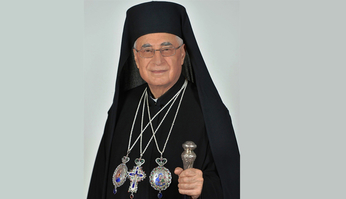
Patriarch Youssef
Sermon on Mark 16:9-20, preached in Cologne at Matins 2007
Sermon on Mark 16:9-20,
preached in Cologne at Matins
on the 14th Sunday after Pentecost, 2 September 2007,
The Gospel reading today emphasises the role of those who have witnessed the risen Jesus, to go and “preach the Gospel to every creature” for the salvation of those that believe and are baptized. Every Sunday it is appropriate to remember the good news of Pascha, of Jesus’ Passover from death to life and our own calling to accomplish this Passover in our own lives, through living our baptism.
Paschal Saturday was in the early Church the traditional time for baptism. This was no accident, but designed to show that baptism was a personal Passover. The Liturgy was also celebrated on the occasion of baptism, not only as the best way of recording and commemorating the death and resurrection of Jesus, but also as an acknowledgment that our life is a daily Pascha, a passage from death to life, from our old life to new life.
When the adult candidate for baptism makes his profession of faith, he (or she) is asked if he has renounced the devil and has turned to Christ. When he (or she) affirms that he has indeed turned to Christ, he goes down into the water and passes through, emerging from it and going up the steps on the other side of the pool. He is dressed all in white as a symbol of that new life.
Merely pouring water over the head of a person being baptized does not clearly show this personal Passover. The significance is best seen in those churches that have retained a baptistery for adults. For example, the Coptic Church has a baptistery in every purpose-built church. This is because the Coptic Church is a dynamic, growing Church that takes seriously its Christian mission to preach the Gospel to every creature.
So Passover is the meaning of baptism. Baptism is administered once for all, so it is a sacramental act that should not be repeated, but it has a daily effect. When baptism was administered in the early centuries, its importance was emphasised by being given together with the Eucharist.
The importance of the Eucharist itself is explained in the beautiful Melkite Greek Catholic service for Corpus Domini: “It is indeed a tremendous miracle to see God incarnate and become man, and more wonderful still to see him hanging on the cross, but the sum of all wonders, O Christ our God, is thine ineffable presence in the mystic species. Thou hast truly instituted in this mystery a remembrance of all thy wonders.”
It is food for our Orthodox faith and it brings life and renewal to us all.
Eucharist is the food for our daily Passover, our life’s pilgrimage. In our Greek Catholic Patriarchate in Jerusalem we prepare food for the pilgrims staying with us. (I saw this every day over the twenty-six years I was there.) Pilgrims go out for the day with their packed lunch in backpacks. As they walk through the streets, they are carrying this food they have received for their journey. So the Eucharist is our bread for the way, the bread of life, as the disciples travelling to Emmaus discovered when Christ broke bread before their eyes.
This Christian faith of ours is not a matter of academic discussion. That is why I like to celebrate the Eucharist as often as possible and take every opportunity to preach during the Liturgy, even if there are only two or three people present. Receiving the Eucharist strengthens us, so that we can live the Gospel message, helping people in need, visiting the sick, educating the young.
When we accept Jesus into our life, we must go straight on, go ahead and live the new life that we have been given, as Metropolitan Anthony of Sourozh once counselled a newly baptized person who asked what then must be done.
Like the Ethiopian eunuch, who after his baptism “went on his way rejoicing,” (Acts 8:37) we must see that our baptism be never repeated, but always lived, lived daily in its essence. We are to go through our life with the Lord, God with us (Emmanuel), having eaten and drunk of the life that he has given us and endeavouring to follow in his steps, until for every creature there is but one life in Christ.
H.B. Gregorios III,
Patriarch of Antioch and all the East, of Alexandria and of Jerusalem
for the Melkite Greek Catholic Church
Translated by V.C.