

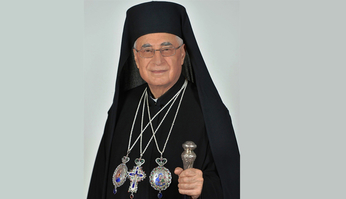
Patriarch Youssef
The Sixth Congress of the Bishops of Emigration In Acapulco & Mexico City 2008
The Sixth Congress of the Bishops of Emigration
In Acapulco & Mexico City
November 3-9, 2008
“Blessed are those who hear the Word of God and keep it”
(Luke 11:28)
RECOMMENDATIONS
The Melkite Greek Catholic Eparchy of Mexico hosted, this year, the Sixth Congress of the Bishops of Emigration, on November 3-9, 2008. The Congress was hosted in Acapulco by one generous member of the Church.
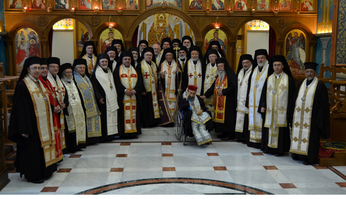
His Beatitude Patriarch Gregorios III concluded the Congress by the Divine Liturgy at the Cathedral of Our Lady of Perpetual Help, “Porta Coeli” in Mexico City. The following Bishops of the Melkite Church in the Emigration participated in the Congress:
John Adel Elya (United States),
Cyril Bustros (United States),
Nicholas Samra (United States),
Fares Maacarone (Brazil),
George Kahale Zuhairati (Venezuela),
Issam John Darwish (Australia & New Zealand),
Ibrahim Ibrahim (Canada),
Patriarchal Administrator Gabriel Ghanoum (Mexico).
The following participated in the Divine Liturgy:
Exarch Nicholas Antiba (France),
Archimandrite Robert Rabbat (Boston)
During the Divine Liturgy, was inaugurated the altar of the Cathedral which had been renovated from outside and inside and was decorated with holy Icons by the Patriarchal Administrator in Mexico.
At the end of the Divine Liturgy, Bishop Issam John Darwish, General Secretary, read the Recommendations of the Congress:
A – The Christians in the Middle East:
1 – The Fathers studied the situation of the Christians in the Middle East, especially in Iraq and Palestine. They were very alarmed about the killing and the displacement of the Christians. They decided to request from their respective governments and from the governments of the Arab countries to support the Christian presence in the Middle East in various manners and in all possible means and to preserve the rights of the minorities.
2 – The Fathers ask the Christians who are in the Arab countries to uphold their obligation as Christians and their right as citizens to carry the good news of the Gospel and to preserve the freedom of worship and of conscience, to be attached to their land and their country and to consider it as a permanent homeland.
3 – The Fathers asked all the Christians in the Diaspora to register their children in the Embassies, in order to enhance the Christian presence in the Middle East.
4 – The Fathers request from the Lebanese Government to allow the Emigrants to vote just as their bothers residing in the Country.
5 – The Father pleaded with the business people and to the holders of fortune in the Diaspora to create profitable projects in their mother countries in order to maintain the Christian presence.
6 – The Fathers request from their children scattered in the entire world to stay in touch with their Mother Country and to preserve their heritage and their sacred faith.
B – The Christians in the Countries of Emigration
1 – The Fathers entreat the Christian families in the Diaspora as well as in the Middle East to confirm their unity, to strengthen their faith in the Lord Jesus Christ and to witness in their lives to the Incarnate Word of God.
2 – The Fathers appreciate the work of the youth and their commitment to serve their Church. They ask them to carry the mission of Christ with courage and to be apostles to their peers in their families, in the school, in the university and in their place of work.
3 – The Fathers ask the faithful to be inspired by “the Word of God” in their daily work and in their religious, social, political, cultural and civil commitment in their societies.
C – “The Word of God in the Life of the Faithful.”
The Fathers insisted on the following points:
1 – Focusing on the importance of the Holy Scriptures in the Life of the family and in the life of each one of its members, so that the Holy Book may be a reference and a companion on which they rely to draw the living water.
2 – The necessity of having the Sacred Book in every house and even with every faithful.
3 – The request from the priests and from the men and women religious to give to the laymen a solid spiritual formation and to enable them to participate and direct Bible study sessions.
4 – The importance of preaching at the Divine Liturgy, so that each homily contains a teaching in the doctrine and in the Christian morals.
5 – The importance of the pastoral visits as opportunities to explain the Word of God and to relate it to the life and the different situations of the faithful.
D – The Role of the Woman in carrying the Word of God.
Bearing in mind the mission of the Lord Jesus Christ who took flesh from a woman, our Most Holy Lady the Virgin Mary Mother of God, and who supported women with an open spirit and a supreme respect, the Fathers focused on the following points:
1 - Assisting woman to understand her prominent role in the Church, the liturgical celebrations and society. This role is appropriate to her gifts, her vocation and her God given nature. Difference between man and woman does not in any way lessen their equality.
2 – Assisting woman to perform her role in building the family on the Gospel values, so that her house become a church in miniature in which the seeds of faith and virtue grow according to the Word of God.
3 – Giving to woman, after due training, an important role in pastoral work such as preparing the faithful for the Sacred Mysteries (Sacraments); teaching the children, the youth and the seniors; visiting the sick; comforting the dying, and consoling the afflicted.
4 – Giving to the consecrated women a special consideration and entrusting to them suitable pastoral tasks.
5 – Requesting from those in charge of priestly vocations to train the seminarians to respect woman and to work together with her for the good of the Church and society.
6 – Never to tolerate any priest or religious or employee or volunteer to harm the dignity of a woman or a minor. The Church should be a protection and a support to woman if, for any reason, she is weakened or persecuted.
7 – Making use of all occasions in which to honor woman and to manifest to her the respect and the esteem which she deserves, such as Mother’s Day, the World Day of Woman, the Feasts of the Virgin Mary, the Feasts of the great Women Saints and the Feasts of the Saint Families in our Liturgy.
E – The Divine Liturgy Book
The Fathers reviewed the unified translation in English of the Divine Liturgy. They made the necessary corrections and they agreed to the mandatory use of this approved text for two years, by all the English Speaking priests, and to revise the text after a two year experimentation. It is worth noting that this text is identical to the text prepared by the Patriarchal Liturgical Commission and approved by the Holy Synod,
At the end, His Beatitude the Patriarch blessed the works of the Sixth Congress of the Melkite Greek Catholic Bishops in the Countries of Emigration, taking into consideration its importance for the prosperity and progress of our Eparchies.
Mexico, November 10, 2008.
Translated from Arabic by Bishop John Adel Elya.
the Cathedral Anniversary at Boston
November 2008
Patriarca melquita reinaugura templo
Ruth Rodr?guez
El Universal
Lunes 10 de noviembre de 2008
Agradece l?der religioso apoyo de feligreces para remodelaci?n
ruth.rodriguez@eluniversal.com.mx
En su primera visita a México, Gregorio III Laham, patriarca de la Iglesia Greco Cat?lica Melquita, pidi? a su comunidad radicada en nuestro pa?s, a ser firmes en la esperanza, en el amor y en la tradici?n en todos sus aspectos, as? como los exhort? “a ser fieles en su fe oriental”.
A ustedes, les dijo a los feligreses que ayer se dieron cita en la consagraci?n del altar de la iglesia de Porta Coeli, o mejor conocida como la iglesia del Cristo del Veneno, son nuestra Iglesia en México. “En ustedes, la iglesia mexicana respira los dos pulmones”, sostuvo durante su mensaje.
El patriarca melquita de Antioquia, de todo el Oriente, de Alejandr?a y de Jerusalén agradeci? a todos los que contribuyeron en la remodelaci?n de esta Iglesia, y afirm? que Dios bendice al pueblo de México y de todo el mundo.
A esta misa de reinauguraci?n estuvo presente Antonio Chedraoui, arzobispo de la Iglesia ortodoxa en México y los embajadores del L?bano y del Palestina, as? como el c?nsul del L?bano.
Gregorios Laham record? que el trabajo de la Iglesia cat?lica melquita en México inici? en 1927 y fue en 1952 cuando se obtuvo el primer templo.
También, agradeci? la labor realizada por Gabriel Ghanoum, jerarca melquita del templo del Cristo del Veneno, porque ha logrado unir a todas las comunidades que viven en México.
A los asistentes, les pidi? a seguirle teniendo confianza.
En su oportunidad, Gabriel Ghanoum le dio la bienvenida a todas las visitas, a la vez que les record? a la comunidad que asiste a este templo, que por vez primera en la historia de esta iglesia “llega nuestro patriaca Gregorio Laham a México en una visita que realizar? a este pa?s y por América Latina”.
Entusiasmado por la consagraci?n del altar de este templo, Gabriel Ghanoum dijo a los feligreses que “esta comunidad es peque?a, pero es como el perfume”, as? es como los invit? a seguir trabajando unidos.
© Queda expresamente prohibida la republicaci?n o redistribuci?n, parcial o total, de todos los contenidos de EL UNIVERSAL