

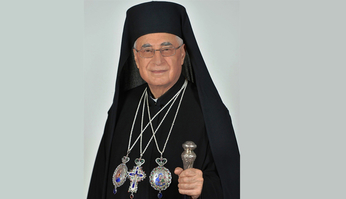
Patriarch Youssef
The quinquenial plan 2011
THE QUINQUENNIAL PLAN
Containing proposals inspired by the Elenchus Propositionum
of the Special Assembly for the Middle East of the Synod of Bishops
Communion and Witness
Re. Propositio 35 The Family
I propose to deal with The Family under the following headings:
Centres for preparation for marriage can be found in many eparchies. I expect that it will be obligatory in these centres to follow courses suitable to each eparchy’s characteristics and parish direction.
Found listening centres in each eparchy, especially for matters to do with marriage and the family.
Train young couples, married for between ten to fifteen years, to accompany families and prevent problems.
Celebrate silver, gold and diamond wedding anniversaries.
Celebrate family days each year.
Foster the habit of family prayers, comprising:
reading from Holy Scripture with commentary,
praying together,
liturgical service. (See the liturgical leaflets taken from the four volumes edited by Lutfi Laham, for Christmas, Lent, Paschaltide and the whole year.)
Found or develop already existing training centres for lay-persons.
Found a social resort for families where Christians can live their Christian life in our parishes in a social atmosphere of humane, holy faith.
Found family councils in every eparchy, with the aim of developing, as far as possible, pastoral care for the family.
When celebrating baptism, chrismation and the ensuing communion, bestow a Christian name that is clear and known to the relatives and that they try to use in the context of the family and in the family atmosphere. Put a list of male and female saints from which families may choose. Similarly when celebrating baptisms, allow the family to choose a verse from the Gospel, the Holy Bible or the Psalms which will be like a word of life for this new-born Christian. A list of such verses can be offered from which families can choose.
Re. Propositio 36 Youth
Here are some proposals on this topic:
Found a special office for youth, with the help of lay-persons.
Hold an annual youth conference in every eparchy, called Youth Day.
Prepare or facilitate work opportunities for young people, through an employment bureau.
Have one priest specialised and free to work with young people in each eparchy.
Found a central commission to be concerned especially with young people, particularly university students, to put into place joint programmes for everyone.
Launch a website especially for young people, in which they themselves can participate or which they can organise and provide material for and develop.
Found a listening centre especially for young people and their problems.
Practical projects: support students, by founding a student fund in each eparchy.
Re. Propositio 30 Formation
Religious formation.
Ecclesial formation.
Develop a sense of social responsibility in the Church.
Prepare lay-leaders to work in the Church.
Foster the sense of Christian membership and belonging to the Church. That can help considerably in creating a growing awareness of responsibility and of the meaning and goal of our Christian presence in Arab countries. It could also help to reduce increasing emigration.
Witness to our Christian faith and Christian identity in our society. How can we bring the Christian message into our society, to Christians and non-Christians?
Involve Christians in the issues and affairs of our society and homeland, in education, politics, in social work, health care and economics.
How can Christians respond to these pastoral needs and realise their mission in life?
Catechism and the new evangelization.
Christian faith education in our schools.
Emphasise Christian identity. What are the basic elements of this identity? How can we keep it and show it in our life and conduct? In this respect, we have in mind the words of Blessed John Paul II, who said that the meaning of being Christian, the meaning of being human, was being with and for.
Re. Propositio 31 Pastoral Work
Develop, organise and activate pastoral work by available means.
For our purpose, I suggest using the proposals of the First Eparchial Synod in Damascus in 2003:
The priest must be always present in his parish like a father to the parish, exercising his role of father and shepherd, and really available for his parish. So he must reduce his other roles a little, so that he can really put his pastoral obligations into practice as he should, insisting especially on pastoral visits, evangelical vigils and on care for each section of the parish.
It is important for the parish council in each parish to include representatives of the different religious groups and activities, and to enable everyone to participate in them, so giving the opportunity for plenty of parishioners to participate in parish life.
Put into action a structure and clear annual plan for pastoral work based on the pastoral structure, which must be accountable for its work to the ecclesiastical authorities.
Make an office and secretariat in each parish, with a secretary to help the priest in the administrative work and finances. Identity cards have to be organised and printed for the parish. The telephone has to be answered and parish archives kept using modern means, so that the priest can be liberated for pastoral work.
Train seminarians to be more open and welcoming, far from a domineering and selfish attitude and further their training through sessions at local level for a period of five years after their ordination as priests, thereby developing community life among the parish priests with the parish.
Prepare more lay-people for pastoral work with the priest according to their capacities.
Put a general pastoral system in the eparchy to be applied in each parish.
Have a member of the clergy or other person with a good formation ready to answer questions that parishioners may ask.
Launch the idea of district-based pastoral care, especially in large parishes, with a sub-committee for each district, to work with the priest to animate pastoral work in each district. This can be done in missions where there is no priest, especially in countries overseas, where there are small missions but not yet a priest.
(The above are the resolutions and proposals of the First Eparchial Synod at Damascus.)
Exercise and train people for working with apostolic movements, especially with children and young people.
Mount a special programme that really presents the history and identity of our Church, its heritage and mission.
Give a greater role to lay-people through their participation in church responsibilities, especially at the administrative and pastoral levels.
Give a greater role to women in church.
Give training to priests and lay-people as to how to be apostles in their work-place and profession.
Support Christian morale, based on the Word of God, our holy faith and on our responsibility and presence as Christian citizens alongside citizens who are not of our religion.
Emphasise identity and solidarity among the various parishes to strengthen the morale of the faithful and to encourage their identity to be lived in communion and witness.
Re. Propositio 39 Liturgy
Liturgical, spiritual and sacramental life:
Train priests for liturgical prayer, service and sacraments according to real, liturgical principles. Keep Church unity through its rites.
Implement the rules and proposals that were drawn up by the Patriarchal Liturgical Commission for liturgical animation.
Reflect and make a plan of how to make our rite, prayers and sacraments more popular, in the sense of allowing the people to participate in the Liturgy, and other sacraments, such as baptism and marriage, and in funerals.
Little spiritual, pastoral and liturgical booklets can be produced for each sacrament. (Such booklets have been written by Archbishop Lutfi Laham, with a preface about the symbols of each rite.)
Sessions of spiritual and liturgical teaching and guidance, especially on the occasion of meetings and celebration of sacraments, especially baptism, solemn communion and marriage, and marriage preparation studies too. The role of the god-parents and the relatives participating in these matters should be emphasised.
Through Sunday sermons make faithful Christians aware of and give them guidance about everything to do with Church sacraments.
Emphasise the explanation of the Divine Liturgy and other sacraments through courses given in catechism centres. To help with that, here are some books that may be of interest:
The Manual of Pastoral Sacraments by Fr. Joseph Lagine, (2007) after the Pastoral Synod at Damascus in 2003.
Introduction to Liturgical Services and their Symbolism in the Eastern Church, by Lutfi Laham (First published in Arabic in 1998 and subsequently in English by Eastern Christian Publications in 2009)
Prayer-books in the Church and the Community, by Patriarch Gregorios III (2005)
A booklet containing all the Introductions to the Liturgical Service-books (in Arabic)
Spiritual and communitarian life among the clergy
Animate communitarian spiritual life at parish priest level, especially in neighbouring districts or regions, whether in the same eparchy or in neighbouring eparchies. (For example, in Lebanon, the South and the Shouf, then Beirut and Tripoli, then Zahleh and the Beqaa together.)
Hold meetings for each region to implement the Synod for the Middle East, Communion and Witness.
Have a meeting for the priests of each country.
Hold at least an annual meeting, let us say, for all the priests of the different parishes and eparchies in a country.
Have an annual spiritual retreat for bishops of all the eparchies of the Middle East, or for the eparchies of each country (such as Lebanon) and so forth.
Hold a spiritual retreat for all monks and nuns, either separately or together, or according to region or country.
We propose holding a congress for clergy, as was done in the time of our predecessor, Maximos V.
Re. Propositio 33 Media
Information technology and social means of communication
Found a commission on information in each eparchy, whose task will be to check everything that goes into print, or that concerns us in a television or radio review on religion, morality or ethics, or that may have a harmful influence on young people or families and keep each other informed in our different eparchies.
Found a centre entitled Questions and Answers in each eparchy or group of eparchies.
Encourage exchange between websites of different eparchies.
Discover ways to reach young people through means of social communication.
Use social networking to ensure that our newsletters reach people who are not regular church-goers.
Activate our presence through different local and international social means of communication.
Activate the websites of our various eparchies.
Find different ways to present our heritage to our faithful, especially youth.
Use social means of communication to make our presence felt among young people.
The Synod of 2012 will have as its theme, The New Evangelization. (See my Christmas Letter 2010, New Creature.)
The Tithing Project
This has to do with starting a programme and community and pastoral rules in our Church to revitalise the Church’s commandment on tithing, especially in our various eparchies, taking as a basis my 2003 Christmas Letter, Poverty and Development, where a project for Melkite Solidarity is outlined, which may yet help in this matter of tithing.
Putting this commandment into action is one of the more significant means of giving a more practical sense to our ecclesial commitment. It is also a practical way of showing our Melkite collaboration and solidarity within the one Patriarchal Church. It is also a way of collecting the necessary money for realising the projects of the Quinquennial Plan in the various eparchies.
In fact it should not be forgotten that there have been efforts made in that direction in the Eparchy of Beirut, starting with Bishop Gregory Haddad, and later with Bishop Joseph Kallas. When I was Patriarchal Vicar in Jerusalem, I managed in part to put something into effect in the Dinar project.
Re. Propositio 42 Islam
Muslim-Christian Dialogue
The subject is very important, difficult and arduous, but we have to give it our greatest care. Our Christian presence and future, our Christian communion and witness are all linked to living together, collaboration and solidarity with Muslims. (See my 2006 Christmas Letter on Peace, Living Together and the Christian Presence in the Arab Middle East.) There are many proposals on the matter that have been put forward in books on dialogue, such as that of Rev Prof Theodore Adel Khoury, Professor Youssef Durrah al-Haddad and the basic principles that have appeared in Vatican documents. I would also like to emphasise the interventions made in the Synod for the Middle East, which addressed this problem.
Starting from all the above, I propose some ideas and stances:
Study the reality of the state of dialogue in each region, and on that basis, put into practice a plan for each region, eparchy or country. Then we can attempt to gain a global vision.
Write a paper, in which we outline some basic ideas for this dialogue, which could be prepared by specialists of our Church or elsewhere.
Undertake a study on the theme of how to present Christianity to Muslims, secure with regard to doctrine, morals, rites, devotions and customs.
By way of conclusion to the above, we can list as themes for joint study all the common values between Muslims and Christians. These can become lines of strength for common human, national progress together and can be also the subject of congresses, study circles or sessions and mentioned in educational catechism books.
Perhaps in this way we can manage to hold a Muslim-Christian congress or summit. We have had one in Lebanon and could have another such, at the level of each country and later at the level of Arab countries, as I proposed in the Synod for the Middle East.
Re. Propositiones 10-12 Christian presence and emigration
The relationship with the countries of the expansion
Make a study of the life of emigrants, and how to ensure an ongoing relationship between émigrés and those who remain in the country of origin. Study how to lessen emigration through different means. This could be done, with practical examples, at the level of every parish and eparchy. This topic has been studied by the Council of Eastern Catholic Patriarchs and their 1992 Paschal Letter was written on the topic, The Christian Presence in the East, Mission and Witness.
Form a Synodal Commission to work with the Conseil Supérieur in Lebanon to see how to develop relations between the different parishes of the expansion. (See Propositio 10 and Propositio 12 of the Synod for the Middle East.)
Re. Propositio 20 Vocations
Pastoral care for priestly vocations
Propositio 20 makes detailed mention of what must be done about this and I quote it in entirety:
“Vocations work requires:
prayers for vocations in the family, in the parish, etc.;
promoting Christian life in families so as to make possible the blossoming of vocations;
creating vocations committees in each diocese involving priests, consecrated men and women and lay people, to organize meetings for young people so as to present to them the various vocations in the Church and clarify their discernment;
devising a plan of substantial spiritual formation for young people involved in the ecclesial movements;
making parishes and schools more aware of the different kinds of vocations, priestly, consecrated and lay;
maintaining or setting up minor seminaries where feasible;
calling on priests and consecrated men and women to witness by the coherence between what they say and how they live;
intensifying the ecclesial communion among priests, which requires an openness to the
different pastoral needs of dioceses, in order to address the lack of priests; and
attracting young people to consecrated life by the example of a deep, radiant, happy spiritual life.”
Re. Propositio 26 The Consecrated Life
Religious vocations for men and women
To that end, we can see Propositio 26 of the Synod about consecrated life:
“At the heart of the Church is consecrated, apostolic, monastic and contemplative life. The Synod Fathers express deep gratitude to consecrated men and women for their evangelical witness.
They remember especially the martyrs of yesteryear and the present day. They ask that the
consecrated life, adequately renewed, be welcomed, encouraged, and integrated ever more closely into the life and mission of the Church in the Middle East.
Our Churches recognize the importance of the place of consecrated men and women religious in society, by virtue of their witness of faith, their disinterested service and their precious contribution to ‘the dialogue of life.’”
After this Propositio 26, we should like to add some proposals:
Emphasise the importance of languages other than Arabic in training centres for priests, especially French and English languages. It is absolutely indispensible that each priest should be able to express himself in either French or English, or both.
We should like to draw attention to the importance of the practical pastoral year before priestly ordination.
It is very important for seminarians to cultivate their spiritual life, as they prepare for priesthood.
I should like to draw attention to the need for excellent, cultural training for seminarians preparing for priesthood.
Re. Propositio 2 The Word of God
This proposal shows the importance of the Word of God, and the Fathers’ care for this subject. That is why we should like here to copy the two or three recommendations about the Word of God:
“The Word of God is the soul and foundation of Christian life and of all pastoral work; we hope that every family would own a Bible.
The Synod Fathers encourage daily reading of and meditation on the Word of God, especially ‘lectio divina,’ and the creation of a website about the Bible, including Catholic explanations and commentaries which are easily understood by the faithful. We would also like to see the preparation of an introductory booklet to the Bible, both Old and New Testaments, offering a simple way to read the Bible.
They also encourage eparchies / dioceses and parishes to introduce and promote Bible study sessions in which the Word of God is meditated upon and explained in a manner that answers the questions of the faithful, so as to help them to become more familiar with the Scriptures, deepening their spirituality and strengthen their apostolic and missionary commitment.”
Re. Proposito 7 Managing Goods
Financial Administration
This is a very sensitive topic, and that is why the Synod made a resolution on the matter, no. 7, calling for transparency and exactitude in everything to do with accounting, and dealing with material goods and money in the Church and directing different projects, as follows:
“For the sake of transparency, it is necessary to apply an audit system to the Church’s financial affairs that distinguishes clearly what belongs to the Church and what properly belongs to the Church’s personnel. At the same time, it is necessary to maintain the properties and goods of the Church and her institutions.
In any case, general and special Church laws are very clear in this regard. We think it would be very suitable to implement a joint system for finance, economy, management, and accounting in all eparchies, at least in outline. This programme would be practised and applied according to the needs and situation of each eparchy. Similarly, we should like, throughout the whole Patriarchate, to manage, in the coming years, to do all in our power for there to be local material self-sufficiency in our eparchies and religious congregations.”
Projects
Besides these papers concerning the Quinquennial Plan, we should like here to propose a collection of projects, which allow each eparchy or religious congregation to apply or implement according to its ability and need. Among these projects:
Housing; building houses. This is very costly, but every church could see how this might be realised, by some means or other. Especially, someone could offer land and groups of faithful could be constituted as housing unions or co-operatives.
The faithful could be encouraged to take advantage of local opportunities, wherever there are existing credit unions for houses, or companies building houses.
Encourage business-people of our Church to enter into collaboration with our Church, to realise such projects.
Present projects and proposals to the State for covering the needs of young people and newly-weds, in everything to do with housing.
Found, through parish benefactors, a student fund in every parish, to be topped up by the eparchy.
Develop welfare societies, which already exist in our many of our eparchies, so that they can help the prospects of poor people, by providing small loans, or jobs for the unemployed.
Collaborate between different welfare associations in neighbouring eparchies or regions, so that stronger associations can help the poorer or weaker parties.
Work to have church halls in each parish for weddings, funerals or other occasions. In this way there will be more communication between parishioners in each parish, where people can help each other and there is a healthy, Christian, pastoral, social atmosphere, which can help to further mutual solidarity, prosperity, involvement and identity in the Church. It can also prepare healthy marriages.
Similarly, it would be good to found social centres. These would be resorts for joyful occasions, a sort of club, especially for young people, with rooms, swimming-pools, popular restaurants where there would be a healthy Christian atmosphere for the family.
Be careful to apply social justice in our Church institutions.
Lobby Parliament to obtain sickness benefit and social insurance where at present there is none.
Try to find ways to found an association of business-people in each eparchy, so that they can support the eparchy’s projects.
The Future of the Quinquennial Plan
This five-year plan was formed on the basis of the resolutions of the Synod for the Middle East. I have also taken into account some proposals of the First Patriarchal Assembly of September, 2007, as I have the proposals of the First Eparchial Synod of Damascus of July, 2003. I have also adopted some propositions presented by certain bishops and profited from letters and papers presented by priests and lay-persons at various meetings I attended by way of preparation for the Synod. Practically, this Quinquennial Plan is an attempt to reply to Propositio 43 Follow-up to the Synod for the Middle East, which runs as follows:
“The Churches which have taken part in the Synod are called upon to ensure that it is properly followed up by working together with the Council of the Catholic Patriarchs of the Middle East and the official structures of the relevant Churches, with a greater involvement of priests and lay and religious experts.”
So this Quinquennial Plan is a collection of projects, proposals and ideas that can, I hope, form an interesting joint project for each eparchy, according to its possibilities and a document of guidance for our pastoral work and ecclesial service in different sectors of our pastoral service. We can draw inspiration, ideas and guidance from it according to the possibilities contained under one or other headings, and it can be a landmark in the life of our Church in the years to come. In any case, this Quinquennial Plan does not exempt us from returning continually to the Synod’s Resolutions and to the Nuntius and further to the Apostolic Exhortation given by the Pope.
I hope, at any rate, that this Quinquennial Plan will be well received by my brother bishops and the superiors general of the male and female religious congregations, and also by all the faithful. Of course, for this to happen, it will be most useful and even necessary, to put forward this Quinquennial Plan, or some aspects of it, to parish priests and discuss it with those responsible for different parish activities, monks and nuns, by means appropriate to each parish or congregation. So there will be interaction between eparchies and religious congregations to enable us to have a joint plan in the Church, to be realised according to the needs of each eparchy. Thank you in advance for the welcome you will give to this Five-year Plan.
With my good wishes for its success, according to the Saviour’s will and for the service of the Church and our society and the prosperity of our country, I place this plan under the protection of Our Lady, Mother of God, who was the subject of the final Propositio 44 of the Synod, “Holy Mary, the Virgin of Nazareth, who shows us how to listen to the Word of God, the Blessed Daughter of our land,”- under her protection I place this step along the new way of the Melkite Greek Catholic Church towards new Christian horizons in faith in Jesus Christ and the power of his word, which says, “Behold, I make all things new.” (Revelation 21: 5)
With my blessing and affection,
Gregorios III
Patriarch
Translation from French: V. Chamberlain