

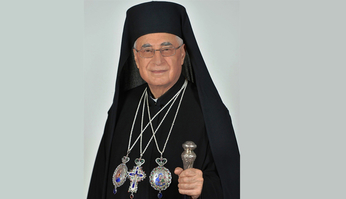
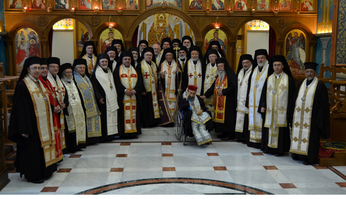
Patriarch Youssef
Church of the Arabs 2006
Digest of talks by His Beatitude, Gregorios III,
Patriarch of Antioch and All the East, of Alexandria, and of Jerusalem
given in Amman, Jordan (May 2005) and in the Sultanate of Oman (2006)
following the outline of that given at the opening of the Al-Liqa’ Centre
in Lebanon (2003)
Church of the Arabs
“God be with you”
This popular expression, so short and so rich, carries within it many meanings both divine and human and sums up splendidly whole lectures and books in philosophy, theology and the humanities.
Synonymous with the expression Allah maakum “God be with you” in the language of Islam is Assala’amu aleikum wa arrahmatullah wa barakatuhu - “Peace be upon you and the mercy of God and his blessings.” In any case, it was also the greeting of Jesus to his disciples, “Peace be with you all.” It is with these expressions, equally Christian and Muslim, that I greet you all, men and women. These expressions carry a wish from the speaker to the other party to the conversation and they also declare the speaker’s faith and religious convictions. The content of these expressions is one and the same: a profound awareness that God is with man and man’s conviction about the depth of God’s relationship with him and his with God. Such expressions, usually prefacing any kind of speech, talk or meeting with people, are really expressions of profound awareness and faith.
Jesus, by taking flesh and being born, laid down the basis for the meeting of God with mankind, for his name is Emmanuel, God with us.
Philosophy in every age and form always seeks a meeting point between the abstract idea and raw material and in the end it amounts to seeking how God can meet man.
Theology takes the same road in the light of faith. Theology is the science of human encounter with God and the meeting of God with mankind.
That is precisely the goal of every religion and theology. Besides, St. John says in his Gospel, “For God so loved the world, that he gave his only begotten Son, that whosoever believeth in him should not perish, but have everlasting life.” (John 3:16) Our liturgical prayers slightly modify this gospel verse and are addressed to the Father, saying, “Thou didst so love thy world,” (Anaphora of St. John Chrysostom). So the encounter has its starting point in love: there is no meeting without love. There is no true love that does not end in a meeting.
Vatican II, which is itself a great encyclopaedia of the twentieth century, produced several documents and opened up the Church’s, Christianity and Christians’ horizons onto man and his convictions, the world in all its categories and the universe in all its realities. In all these documents there is a call to meeting with man, with the other, the world, its civilizations, a call to discover the other and everything that is rich and good in him.
The saints are men who met others, even the hermits who chose the life of the hermitage, left the world and lived an ascetic life in deserts and monasteries far from towns, were men of encounter and dialogue. They even turned the deserts into cities and their monasteries into beacons of learning, literature, art and encounter centres of thought and exchange of culture and civilization, through books, gatherings, architecture, economy, farming, sciences, crafts and so forth.
Our Land is a Land of Meeting
Dear friends, our whole Arab land is a land of revelation and revelation is the primordial meeting. Our land, our Arab countries are a holy land, the cradle of civilizations and faith.
On our land people encountered the revelations of God to man: so they must also meet each other. That is the experience of heaven and of earth and that is the command of God to us all: “O mankind! We created you from a single (pair) of a male and a female and made you into nations and tribes that ye may know each other” (Qur'an: Surah 49:13 Al-Hujurat - The Inner Apartments) and Jesus said, “All ye are brethren.” (Matthew 23:8)
The priest, bishop and man of religion, the shaykh, is a man of dialogue and meeting: it is his basic specialization. He cannot do anything or be faithful to his functions, duty, service and apostolate if he is isolated and isolates himself. Besides, one of the signs of the Church is that it is defined as being a universal Church, a catholic Church, a church on the way, a church of dialogue and a church of encounter.
Vision of Christianity
In my conviction and moreover, in my Christian experience, Christianity is not an identity, or nationalism: it is not even a community or church in the sense of an institution; although Christians have gathered together in groups, called churches. My Lord, my Saviour and my God, Jesus Christ did not come to found a religion or nation or group as distinct from another group, fixed in a locality against other groups.
My Lord, Jesus Christ went beyond all those values, notions, logics, dimensions, relations and barriers between one land and another, one homeland and another, one group, community, tribe, nation, gender and another. So it is as St. Paul said, “There is neither Jew nor Greek, there is neither bond nor free, there is neither male nor female: for ye are all one in Christ Jesus.” (Galatians 3:28)
Christianity is a new creature. It is according to the model of Jesus Christ, going beyond all dimensions, all limiting predicates in philosophical and tribal thinking, in a culture, nation, or party. Christianity is really something else, let us say, another and new conception. That is the secret of its sublime nature. In the same way, true Islam is also like this, “You are the best of nations raised up for the benefit of mankind.” (Qur’an: Surah 3:110 Ale’Imran) That does not mean a preference of one above the other, but an excellence in faith. One could say the same of every religion in its true sense. One could also say this of true Judaism: in fact Judaism is the religion of the prophets who always called Jews to go beyond their borders, land and tribe, their mentality, isolation, pride and supremacy over others.
That means that the true conception of faith does not allow you to use the expression “My religion. Your religion.” Perhaps that is the meaning of the Qur’an: Surah 109 al- Kaffirun (Renegades) “I have my religion and you have yours.” Your religion, according to your own human thought, limits you and ties your hands, makes you small, scatters you, makes you into small groups, but my religion, which I am proclaiming to you, raises, unifies, gathers you and makes strong links between you and others.
Man is the Foundation
If my faith is true and pure and bright, then I can enter into dialogue with the other in his language and mentality, without even knowing his religion. I can enter into dialogue with him as I speak to God, since God speaks to man, every man. He knows what is in the heart of each, for he knows and loves man. True knowledge is love and love leads to knowledge. Man is the foundation of everything, created in the image and likeness of God: that is his first quality, his primordial attribute, his basic, essential attribute. With this attribute, we are all, like Adam, naked. The fig leaf came later: the fig leaf is colour, genders, male and female, geography, history, language, frontiers, limits, passports! The fig leaf is also religion, religious concepts, traditions, societies, characteristics, jobs, families: roads that unite and that separate.
The Christian who has really become a new creation cannot shrivel up and isolate himself to concentrate on himself, nor even isolate himself in a group, community or church. As bishop and Arab Christian Patriarch, I am not for Christians alone. I am a man, for my brother man in order to bring the Gospel to him, not as though it were my gospel, or the gospel of a particular community, but the Gospel in a deep sense, as a new announcement, a beautiful, spiritual, universal announcement for the world.
A Church with the Other
In this part of my meeting with you, dear friends, I would like to speak to you about the content of my 2004 Christmas Letter, entitled, “Emmanuel, God with us.” Through this letter, I would like to sketch out for you aspects of the Church’s presence in society. The Church is in the world, but not of it, though it has its role in the world. Our Melkite Greek Catholic Church and every Church in the Arab East is like its founder and master Jesus Christ, our Lord – a Church with and for. And Jesus said, “I am come that they might have life and have it in abundance.” (John 10:10) From that come all the expressions that I am introducing: “a church with man, a church for man, Church of the Arabs, Church with Islam, Church of Islam.”
The Church with Man
The Christian must go beyond himself…and become really catholic, in the general meaning, “of all and for all.”…“I believe in one, holy catholic Church” means that the Church unites in itself all cultures, civilizations, languages and ethnicities. A catholic Church in the Arab world means an Arab Church in an Islamic world, a Church of Islam. So we may, in this general sense, add to the Creed new descriptors of the church as Church of the Arabs and Church of Islam.
In its universality it does not lose its own qualities and even in its particularities, it does not forget its catholicity and universality.
Church of the Arabs: Church of Islam
The expression “Church of the Arabs” means in a unique manner, the Church of Jesus Christ, living in an Arab milieu … The Church is Emmanuel Church with and for this Arab society …which... is in its vast majority the world of Islam.
That is why the Eastern Church, or Church of the Arabs, Church of Islam, is really ... in the school of Jesus Christ, Emmanuel God, Love God, Redeemer God, Saviour God. It is he who defined the goal of his incarnation, of Christmas, of his birth, by saying, “The Son of God came, not to be served, but to serve and to give his life for the redemption of many,” (Mark 10:45) …
These holy verses are a true and clear call for each Christian to go outside himself ... his tribe, as Abraham was told… in order to meet the other and be .. Emmanuel, a man “with and for.”
We Arab Christians are in a very deep relationship with the Muslim Arabs in our Arab countries: we are of their flesh and blood, their ... culture and traditions. ..
You, as a Christian, cannot pass by on the other side of your Muslim brother, as though he were a stranger, as though you were not concerned by him…
When we say Church of Islam, we mean by that that it is a society of Christian faithful, who excel in their relations with Muslims ….
A Church “with and for”
We have to go out of our Melkite Greek Catholic Church to become Emmanuel Church, the Church in human society…
It is extremely important to understand in its true sense, the name of Jesus Emmanuel and what it is to be... Church of the Arabs and Islam. If the Arab Eastern Christian … does not understand the meaning of the name of Jesus and of his own name… he will lose the meaning of his mission and role, for he does not exist for himself; that person... will be carried away as though by a storm … and a sure candidate for emigration. Those countries which are Christian to their roots …will be stripped of their Church’s children because of emigration and become museums ... Then people will say, “It is here that Jesus Christ lived and here too that Christians once lived, but today they are here no longer. …
This expression “Church of Islam… is, in my conscience, synonymous with love, (charity), respect, mutual help, fellowship, understanding, dialogue, affection, ardour for others, as it is said in the Qur’an, working together in our Arab homelands to build a better world, the civilization of love.
Christian Unity
One of the requirements and duties of the Church of the Arabs is to work for Christian unity. It is not simply one of the Church’s internal voluntary religious tasks: it is more than that; it is an obligatory work of the universal Church. Christian unity is important for the success of our work, service, witness and presence in the Arab and Islamic world.
Our Christian unity is one of the most important factors for strengthening an effective Christian presence and also for challenging Christian emigration, which is a great loss to our Church and to the Arab world and world of Islam. That means that Christian unity and working towards it is not merely due to the desire of Christians to gather together in contradistinction to Muslims and Islam, but rather, Christian unity is of importance as enabling us to provide more effective service to our Arab world; it is an element for uniting us more closely to our Muslim brothers, placing us in a deeper relationship with them and helping them understand more deeply the meaning of our Christianity and Gospel mission in the world “that the world may believe.” That is what Jesus said, “That they all may be one; …that the world may believe.” (John 17:21) So we are to unite not for ourselves, but for the other, for our Muslim brother and for the world, for the Arab and Eastern world.
Common Conviction
I would not like to give the impression that I am alone in having these convictions; that it is my personal monopoly. No: that is not allowed. In fact I know that many, both amongst my brother bishops of our Patriarchal Church, in our Arab world and everywhere throughout the world, (though they may express it differently) are in agreement with this vision. I wouldn’t like to speak for my brother Patriarchs and bishops, but I can say that there is a very deep relationship between all our positions, even if our ways of expressing it are different.
It is very important that these convictions become those of all our sons and daughters in our Patriarchal Church, even, I should say, of all Christians. …
Existential Conviction
These convictions are not a simple free choice or even a strategic one, linked to the fact that we are in a well-defined political or social situation. No, these spiritual convictions are theological, faith-related, and existential and have as their departure point our deep awareness and thought, in our Christian, human and pastoral experience. They have as their departure point the conscience, thought and experience of us all.
These convictions are an important factor in the constitution of our faith, in the discovery of the meaning of our vocation and the substance of our mission in general as Greek Catholic Christians in our Arab world of the Middle East. For me …it is the essential condition of working to reduce as far as possible Christian emigration that is really decimating our Churches.
In my sermons and talks here and everywhere in the world, in congresses, meetings, interviews, on the television and in newspapers, I express these convictions, because I consider them essential and of fundamental importance in helping us understand better the questions that always confront us as pastor and that confront above all our faithful people. They are living every day amidst this great sea of problems, suffering and struggling to make a daily living and understand Gospel values, faith values and their mission in the world in which they live, while we are talking of living together, common life, fellowship, dialogue, meeting, tolerance, forgiveness, love, and teaching them to work to put aside everything that can divide our world through clash of civilizations, religions and cultures. Those Christians who are living every day with very deep difficulties and substantial changes in their life and are suffering have need of an answer to their (and our) questions: what is our role, what is our mission in this Arab world with its Muslim majority? Why should we stay here?
The Role of Arab Christians
The question which is being asked continually, repeatedly and in a profound way about responsibility is not only, what is my mission as a bishop in a Muslim world, but also above all, what is my role as an Arab Christian in the Muslim Arab world? Must we live in a ghetto? Must we isolate ourselves? Must we form an independent Arab Christian country? Should we place our great concern on preserving a Christian presence as a nation, as a millet in the millet system as the Turks called it, or as a group distinct from other groups? Should we act on our concern to defend what we call our privileges, our rights, the status quo? Should we base our logic of life in society on a fear of Muslims and Islam? Should we continue an empty dialogue in which we are cornered without an outlet? Or should we engage in a religious debate that leads us to convince others of our faith with the aim of converting them to our religion? Or rather, are we afraid that they may convert us to theirs? Could the answer be to run away? (We say in Arabic that running away is not for Arabs.) Could the answer be emigration? But this emigration is really a great loss for our whole Arab world, a loss for both Christians and Muslims. In fact, history has indeed proven that we are called to live together, that we have succeeded together, relatively speaking and from a relative success, we are called to a greater and further fulfilment in that direction.
I may say to you, dear friends, who are listening to me and here I am speaking frankly to my Muslim and Christian brethren, that the great challenge for all of us is how to reply to this profound question: what is the meaning of my presence as an Arab Christian in this world, a world which is mine and yours? Well, I think that the elements of an answer are with all of us, Christians and Muslims. Furthermore, I would like to say to you frankly that I personally find great difficulty when replying, to explain to my Christian faithful the role of us Christians, despite all the projects that I have been able to bring to fruition and that the churches are putting into action with the goal of finding the means of maintaining the Christian presence, one that represents true Christian identity, a being with the other in all his reality, a presence in the Arab world in its Islamic-Christian reality. Well, I tell you frankly that the question is difficult to answer and we don’t have a good response.
Citizens in the Arab World
We Christians are citizens in the Arab world: it is our basic characteristic. There is nothing to be added or subtracted. We are born into this world and are an integral part of it. We have obligations in regard to this world, just as we also have in it the rights of citizens. We shall never accept having privileges just because we are Christians, but we shall never allow ourselves to be discriminated against on the basis of nation, religion or church. This is what we demand: that there be no discrimination against us or others. We would never wish some citizens to have rights and others not the same rights. Besides we know that in our Christian faith, as in Islam, such discrimination is not allowed, either on the basis of tribe, ethnicity, social situation or religion. It is forbidden in the Qur’an as it is in the Gospel.
As for the fact of our insisting on our basic quality of being Arab, no one can deny it, except one who is ignorant of the history of this region. If we Christians are not Arab, then many Muslims are not Arab, for as they know, their ancestors converted to Islam from Christianity! Indeed we are Arab in a true and deep sense of the word Arab: we are of this world and for this world which is Arab and Muslim, though we are not Muslim. We can be called Muslim in the sense of which St. Paul reminds us that he has become “all things to all men.” (I Corinthians 9:22) Moreover, let us not forget that the Gospel clearly has a very special place in the Qur’an, where we read the following (Surah al Ma’ida 5:68) addressed to Muslims, “O people of the Book, you are naught unless you uphold the Torah and the Gospel.” I would like to say with a spiritual conviction that is deep and personal; I wonder who besides me can present the Gospel and its good news in the Arab and Muslim world, to my Muslim brothers whom I love? This is not to convert them, though that may happen here and there, nor to push Muslims to change religion, but because for me, the announcement of the Gospel’s glad tidings, carrying this good news to my Muslim brothers and to the other in general is a spiritual witness which has nothing to do with proselytism.
A new Way of Talking
What is required today is a deep encounter of thought between Christianity and Islam, a mutual discovery, a mutual understanding of the vocabulary of the Gospel and the Qur’an and the concepts of Christianity and Islam, of Christian and Muslim spirituality and language. We have need of a real grammar for understanding basic expressions, usage and way of thinking, theology, and logic in Islam and Christianity. All those are the basic elements for a new dialogue between Muslims and Christians, and for mutual acceptance.
Bearer of a Message
I wonder again, who apart from me, an Arab Christian with my Arab language, Arab thought, Arab origin, Arab history, Arab culture, Arab geography and Arab rhetoric, who apart from me and like me can really witness to the Gospel in the presence of his Muslim Arab brothers?
As an Arab Christian, son of the Church of Islam and Arabs, I must carry out this mission and bear witness to the Gospel to my Muslim brother whom I love, without wounding his religious feeling, spirituality, pride even, identity and convictions. My witness to the Gospel to my Muslim brother should be an act of charity, of love from me to him, as if my mission were a ray of light and deep, spiritual, brotherly meeting with him and with a profound respect for his freedom and for everything that makes his Muslim personality.
Arab Church: Conscience of the Arab world
So, Church of the Arabs means this interaction and conviction about our entire responsibility towards our world which is for us and from us and we from it and for it. That means that in the present circumstances we should stand shoulder to shoulder with others in this Arab world, in Arab countries, to defend common causes and the pressures that we Christians and Muslims are encountering, those challenges which have increased notably since September, 2001, the war in Iraq, the Israeli-Palestinian conflict, including problems of democracy and human rights, freedoms, dignity, openness, enculturation, dialogue between East and West. That means that the Church of the Arabs must be the Arab conscience, a conscience with and for Arabs.
Co-operation between East and West
With regard to these matters, we must create links of mutual help with our Christian brothers in the West, to collaborate on drawing our viewpoints closer together, their and ours, about Islam. We should help them discover the true face of Islam and also understand our role and mission in the Muslim Arab world, so that we can assist each other.
We cannot leave our European Christian brothers alone in their quest to understand Islam, in East-West dialogue and relations between the Western world and the Arab and Islamic Eastern world. So we must tell them, now more than ever, the meaning of our role in that direction and search, just as we must tell our Arab brothers here and show them besides the importance of our role, so that Muslims understand that we have a role with them and for them in their meeting with the Western world. This is the duty of all Christians and Christian citizens, but above all of us church leaders, who must have a very keen sense of this crucial role in our East-West relations. I became very aware of this during my twenty-six year service in the Holy Land, in Jerusalem, where I gave hundreds of talks and participated in many world conferences and felt how important was our role vis-à-vis the Western world on the themes of dialogue, war, peace and justice, East-West relations and above all the Palestinian case, which has an extraordinary influence on all the other problems we must face in our Arab world and in the Muslim world.
Muslim-Christian Interaction
Are not current Arab conditions an urgent, ceaseless call to put into action our unique role of seeking harmony? Current pressures are so strong against the Arab and Muslim world. Are they not a pressing call to increase interaction between Muslims and Christians in our region and to redouble our efforts towards future progress in the Christian Arab world and towards our common responsibility in the third millennium?
Just as Christians in the early period of Islam played a very important role especially in the realm of translation of the whole of Greek culture into the Arabic language, we too should play today the same civilizing role alongside our Muslim brothers. My hope and prayer and wishes are that there be an interaction of Muslims and Christians and what I am doing as Patriarch is the same as my brother Patriarchs and bishops and the monks and nuns in different institutions, for the preservation of the Christian presence in this region is a part of this reality. But it is also important that my Muslim brothers be in agreement with this role, with this project, let us say, of the preservation of the Christian presence in Arab countries.
The Christian Presence in the East and our Responsibilities as Christians and Muslims
Prince Talal ibn Abdel Aziz wrote two years ago the article that must be a working program for every Muslim, for every member of government and every citizen. In fact the Christian has need of this feeling of security, immunity and respect so that he can stay here in Arab countries and fulfil his mission, his role and feel that he has a place in his country, these Arab countries, in his land and homeland. That is what Prince Talal ibn Abdel Aziz wrote, “When I speak of the Christian presence in the Arab world I mean by that that Christians should stay in the Arab world. They were in fact very important elements in the early formation of the Arab world and their presence may still help to keep away any fanaticism and extremism that leads to violence, terror and historic crisis. Their presence and the fact that they stay in the Arab world tends to consolidate the unity of the modern state with its pluralism and diversification and is a very strong barrier against state apartheid. The fact that Christians are still present in Arab countries strengthens the Arab case when dealing with problems in their relations with the Western Christian world from the social, cultural and economic points of view. Their emigration, on the other hand, means exactly the opposite, as it provides the opportunity for many to exploit conditions and restrict the opportunities for meeting and dialogue. On the contrary, the fact that they remain here, all things being considered, is very important in preventing a scientific and cultural haemorrhage of creative thought from the Arab world and is also a powerful boost to the economy, business, industry, finance, specialization and excellence. All in all, the emigration of Arab Christians, if it continues, becomes a mortal blow striking at the very heart of our future. So our urgent and important care and task is to do everything possible to avoid the continuation of emigration and to help this very important Arab Christian constituent in our world to stay here and ensure that there should rather be immigration, bringing back to their countries of origin those who have left.” So our role as guide in relation to our brethren and Christian children is very important in that respect. But we also expect from Muslim leaders, members of government, our neighbours and companions on the road that they too understand this role.
Civilization of Love
When we say to Christians that Jesus tells you, “When someone strikes you on the right cheek offer him your left,” (Matt. 5:38) it does not mean that Muslims should be encouraged to strike Christians. In fact this commandment is the height of love and tolerance, but on the other hand it demands positive interaction between all who listen to this saying, so that society be converted, change and head towards more love, mutual respect and equality between rights and obligations. So this commandment is a call to the whole of society for the civilization of love to reign in it. That means and requires an education of deep faith in all citizens of all confessions and without this education there is no balance in society, neither religious, political or social and so we must return, unfortunately to the vicious circle of violence, religious persecution and apartheid in all its methods.
The civilization of love is that I love you and you love me. However, to place a condition, I love you if you love me, will tend to harm all sense of relations in society. But, I love you unconditionally, gratis, freely and hope that you love me, also unconditionally, is the true spirituality of the Sermon on the Mount and the spirituality of the Gospel. That is what I meant at the beginning of this talk when I spoke of the new creature, the new mentality, the new spirituality. (That is not what the politicians are talking about today, unfortunately, when they use the word “new”!) But it is what I mean by the new world order and the new Middle East. We have the real model of new living, but if faith is not the foundation of this new system it will be more perfidious, more unjust, more violent, more despotic and a greater apartheid than all the others. The mission that is placed on our shoulders in the Arab world is to challenge the Western world by an Eastern Christian-Muslim union of civilization of faith.
Conclusion
Don’t be afraid of being optimistic with respect to the substance of this talk and its very difficult subject matter. In fact in this talk there is a big cross: there is death and martyrdom. Indeed, the history of the Church of the Arabs has never been a road strewn with flowers and victories. The head of the Church, Christ, died on the cross with a crown of thorns, having accomplished the hard road of the cross. We too must encourage each other, Christians and Muslims, to continue along the road together, even if it is a hard road, a way of the cross, for we have in us the hopes of the resurrection. Speaking of the relationship between Passover and the resurrection, here are some passages from the letter to my brothers, members of the Arab churches written for Easter 2004:
If fear were not a human and daily reality, Jesus would not have repeated his call, “Be not afraid.” If fear is daily with us, its causes are different and manifold.
Despite that, Jesus calls us to banish fear and allow new hope to burst forth in our hearts. He gives us a hidden spiritual strength to help us fight fear and to enroll us in the ranks of the optimists, courageous, fearless, loving and defending life, wishing to improve social conditions rather than be victims of failure. Jesus makes us adventurous alongside himself, the great adventurer, dreaming of a better world, doing all in our power to change the outlook of defeatists, pessimists, the vengeful, the cowardly, those despairing propagandists for a divided world, where violence and force, terror and barbarity, killings, wars, disputes and religious, civil and cultural confrontations reign.
Saints are fearless: sinners are afraid, for they are in darkness. The saint is the courageous one, adventurous and enthusiastic, optimistic, with many projects, full of confidence, trusting not in his own strength but in the power of God.
Don’t be afraid to get involved in the problems of your society, in religious life, in spiritual life, in politics, economics and development. Take your place in society, play your very special role as a Christian citizen alongside your Muslim brothers.
That is what I am talking about: not about proving that we are an Arab Church. Our Arab origin is very well known in the Arab world. History is full of proofs that we are Arab but it is not important to have proofs that we are Arab by referring to history, geography, demography and ethnicity. What is important in talking of the Church of the Arabs and of Islam is the love which must really unite our hearts and make each brother a friend, close to our heart, a citizen who is a companion with us in life. The important thing is that the Church be able to engage in dialogue with the Muslim world and with Islam. What is required of the Church and its members is to love Muslims and Islam on the basis of our faith and not on the basis of a passing feeling, so that together, we Muslims and Christians may build in our Arab countries the civilization of love.
Gregorios III
Translated from the French by V. Chamberlain