

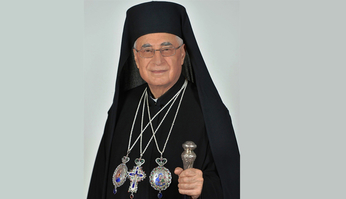
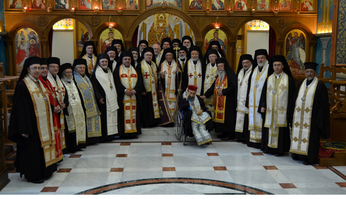
Patriarch Youssef
Paschal Letter 2005
Resurrection and the Eucharist
Gregorios, by the grace and mercy of God,
Patriarch of Antioch and of All the East, of Alexandria and of Jerusalem:
May divine grace and apostolic blessing fill
our brother bishops, members of the Holy Synod,
and all faithful clergy and laity of our Melkite Greek Catholic Church.
Christ is a New Passover and a Living Sacrifice
The Feast of the Glorious Resurrection reveals itself to our eyes at a time of great political tension in the Arab region, which has become, during recent weeks, the main focus of daily media attention. That is why we have great need of the atmosphere of the feast, with its joy and security and why we are prompted to address our brethren, our children and all our faithful parishioners and fellow-citizens with words of faith, hope and love on the Feast of the Resurrection of our Lord God and Saviour, Jesus Christ.
Christ is our Passover
He is life and resurrection; he is the living sacrifice with whom we communicate on the Day of the Glorious Resurrection, as we are invited by St. John Chrysostom in the sermon of Easter Sunday, saying, “Enter ye all, therefore, into the joy of our Lord…. Let all partake of the banquet of faith. Let all partake of the riches of goodness. ”
The Eucharist a Continual Passover
Always new; always renewed, Christ is a living sacrifice and whole-burnt offering that we celebrate in the Divine Liturgy. Moreover, the Eucharist is the whole of the divine economy that Christ has accomplished in his earthly life, so that in the Eucharist are realised all the stages of salvation. In fact, it reminds us of the glorious nativity, the divine epiphany or baptism in the Jordan, the proclamation of Jesus, his teachings, his miracles and parables and moreover it makes present to our eyes the whole of the divine passion, the crucifixion and life-giving death, the resurrection on the third day and the ascension into heaven and the second and glorious coming, so much awaited. That is what we repeat in the prayers of the Divine Liturgy of St. Basil, where we read in the penultimate prayer by the celebrant, “The mystery of thine economy, O Christ our God, has been accomplished and perfected as far as in us lay. We have commemorated thy death; we have seen the symbol of thy resurrection. We have been filled with thine endless life; we have enjoyed thine inexhaustible bliss.” We pray also, “Remembering the Saviour’s command –that is, to celebrate the Eucharist- and all that happened for our sake, the cross, the tomb, the resurrection on the third day, the ascension into heaven, the sitting at the right hand of the Father and the second and glorious coming…” and at the end we sing, “We have seen the true light, we have received the heavenly Spirit, we have found the true faith. We worship the undivided Trinity, for the same hath saved us.”
That is what we repeat in the service of the Divine Body (Corpus Domini) which is a Western feast, adopted by our church and given a beautiful and original Eastern emphasis: “It is indeed a tremendous miracle to see God incarnate and become man, and more wonderful still to see him hanging on the cross, but the sum of all wonders, O Christ our God, is thine ineffable presence in the mystic species. Thou hast truly instituted in this mystery a remembrance of all thy wonders.”
Resurrection and the Eucharist are the Same
Christ our God is with us: he hears our call as he heard the call and invitation of the two disciples on the way to Emmaus, “Abide with us, thou, the eternal Pascha, the divine sacrifice!”
Thus the risen Jesus accompanies us in the mystery of his love in the Eucharist along the roads of our life, especially through the holy mysteries, all celebrated in the course of the Divine Liturgy. Christ comes to us in all the sacraments, or mysteries, just as he comes to us in the Eucharist, when we receive him on the day of his resurrection. Through baptism, we put on Christ, accepting his love and with faith in him we welcome him into our lives. The risen Christ is he who unites those who are joined in the sacrament of holy matrimony. Christ is he who raises those who have fallen into sin, granting them the forgiveness that springs from his holy tomb. The living Christ is he who by the grace of his Holy Spirit completes the imperfect and fills them with the grace of his holy priesthood, so that they may feed the faithful people by the bread of life, which leads anyone who feeds on it to life eternal.
The Eucharist and the Resurrection are Linked
The Eucharist, with Christ risen from the dead to conquer evil, sin and death, is the link of love between our families, our generations, our eparchies and our parishes. So we celebrate it with veneration, with great festivity, with good discipline and great beauty in all the regions of our Patriarchate in Arab countries and the countries of emigration.
The Eucharist is Christ living in us, who helps us to acquire harmony amongst ourselves, enabling collaboration between us, to fight poverty, continuing our projects and work yards of development on all levels of our eparchies, religious congregations and welfare associations. The Eucharist is the living Christ who unites heart to heart and makes us discover the importance of our role in the service of Christian unity, just as he helps us fulfil our splendid, very specialised role in our Arab world with its Muslim majority, as an Arab Church, Church of the Arabs, Church of Muslims and Islam, Church of every man, Church without borders.
This is the mission of Christ, risen from the dead and living amongst us and with us in the holy Eucharist: he addresses to us the same appeal he made to his disciples before his ascension to heaven, “Go into all the world and preach the gospel to every creature.” (Mark 16:15)
The discovery of our mission within (in our Church and parish) and without (amongst other Churches, with Muslims in society and in the whole world) is a very great source of strength and encouragement for us to overcome all that we first mentioned above, those causes of despair, breakdown, isolation, nervousness, individualism, meaninglessness, selfishness, lack of vision and prospects.
Christ, risen from the dead, who destroys the darkness of passion and suffering, vengeance, enmity, hatred and sin is he whom we receive in the Eucharist, the sacrament of the living, believing community. It is Christ himself, risen, living, who is found in the sacrament of Holy Communion. For us it is an encouragement to become involved in our society, in economic, cultural, social, political and national life. The faithful are those who best serve their country, with sincerity and great zeal, with devotion and disinterestedness, with success and excellence. To all that we summon our beloved brother bishops, our sons the priests and deacons, and male and female religious.
St. John Chrysostom compares Christians’ strength to that of lions, saying, “Christians go forth from the church with an extraordinary strength, because they have fed on the Holy Eucharist, the bread of the strong” and they deploy all their potential, the strength they derive from their communion with the risen Christ in the service of their society and native land, building together a new world, of dialogue of civilizations and cultures, the cultivation of love on the earth of mankind.
The fact of participating frequently and preparing ourselves for the sacrament of Holy Communion activates in us all the sacred mysteries that we have received throughout the different stages of our life. So the Lord changes the body of our wretchedness and his life grows in us, bestowing on us many fruits, living fruits, flourishing through love, hope, faith and good works and different kinds of service, that the Lord, the living Christ, causes to spring up in us. So we may say with St. Paul, “Nevertheless I live; yet not I, but Christ liveth in me; and the life that I now live in the flesh I live by the faith of the Son of God, who loved me and gave himself for me.” (Galatians 2:20)
The Feast of the Resurrection is not for us alone. We ask the Lord that there may be a resurrection for our countries and our peoples and for all our compatriots in our Arab countries and especially for our children, our sons and daughters throughout the whole world.
We say to Christ the Lord, “Abide with us” and we ask him to abide with the world, which has the greatest need today of his presence, a presence of goodness, love and blessing. With hope and love, we repeat the shout of this great Feast, “Christ is risen! He is risen indeed.”
Gregorios III
Translated from the French by V. Chamberlain