

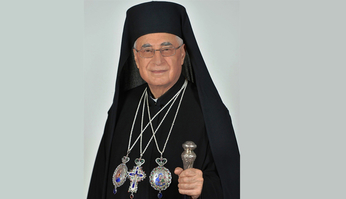
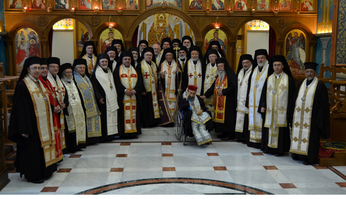
Patriarch Youssef
Patriarchal Paschal Message, 2006
The Feast of the Glorious Resurrection – Charity and Resurrection
Charity is Resurrection
Gregorios, by the grace and mercy of God,
Patriarch of Antioch and of All the East, of Alexandria and of Jerusalem:
May divine grace and apostolic blessing fill
our brother bishops, members of the Holy Synod,
and all faithful clergy and laity of our Melkite Greek Catholic Church.
My Paschal Letter for this year is a meditation on the two words “charity” and “resurrection.” These two headings sum up the principal meanings of this glorious feast of the resurrection of our Lord God and Saviour, Jesus Christ. I discovered this while reading and meditating on the First Epistle of St. John the Evangelist.
The life of our Lord Jesus Christ is totally linked to charity: firstly, because of his charity (love) for his Father, as he says, “My Father loves me and I love my Father,” and secondly, because of his love for mankind, his creature, as we read in John 13:1, Christ “having loved his own … he loved them unto the end.” Our fathers defined their faith in the resurrection by saying, “I believe in one God … Jesus Christ, the only-begotten son, who for us men and for our salvation came down from heaven... and was crucified for us, he suffered and was buried and on the third day, he rose from the dead.”
Jesus Loved: He Died and Rose
Saint John the Beloved says, “God so loved the world, that he gave his only-begotten son, so that whoever believeth in him shall not die, but have ever-lasting life.” (John 3:16) He also says, “Greater love hath no man than this, that a man lay down his life for his friends.”(John 15:13) Giving one’s life, in Holy Scripture, means death: we read in fact that “it is expedient for us, that one man should die for the people, and that the whole nation perish not.” (John 11:50) And Jesus said, “Except a corn of wheat fall into the ground and die, it abideth alone: but if it die, it bringeth forth much fruit.” (John 12:24)
The Miracles of Jesus: all Miracles of Love and Resurrection
The life of our Lord and Saviour Jesus Christ is really love and resurrection. Since Jesus loved and taught love, he has called us to love. He healed every illness by his love and said, “I came that they might have life and have it in abundance.” (John 10:10) Jesus loved and healed; loved and fed the hungry in the wilderness; loved and gave drink to the thirsty; loved and raised from the dead the widow’s son at Nain; loved and raised the head of the woman bent double; loved and purified the lepers; loved and pardoned the prostitute all her sins, saying, “Her sins, which are many, are forgiven: for she loved much: but to whom little is forgiven, the same loveth little.” (Luke 7:47) He loved and declared justified the publican rather than the Pharisee; loved and healed the madman; loved and calmed the storm; loved and called to forgive seventy times seven. (Matthew 18:22) He loved and called to love of enemies. (Matthew 5:44) He called to a love that is free, spontaneous, absolute, unconditional, without ties. He loved and called children to him; loved and gathered sinners all around him.
All his works are works of love, charity, pity and compassion: they are in fact a resurrection: restoration; healing; raising; placing in a good straight, posture; consolation; trust; courage: all those things are elements of the resurrection; appearances of resurrection, transfiguration; modes of resurrection. They signify the complete healing of mankind and constitute the summoning of mankind to life. As he said, “Rise, take up thy bed and walk.” (John 5:8) And elsewhere, “Lazarus, come forth.” (John 11:43)
So, the whole life of Jesus is love and it can also be said to be wholly resurrection. He was not just raised on the third day: his whole life was a continual act of resurrection for all those who came to him. He came to awaken Adam, the first man, to lift him up after his fall. That is why Simeon the Elder said, “this child is set for the fall and rising again of many…” (Luke 2:34) And, as we said above, he came, “that they might have life.” (John 10:10) And he said himself, “I am the resurrection and the life: he that believeth in me, though he were dead, yet shall he live.” (John 11:25) “He that eateth of this bread shall live for ever.” (John 6:58b) And earlier, he says, “I am the living bread which came down from heaven: if any man eat of this bread, he shall live for ever: and the bread that I will give is my flesh, which I will give for the life of the world.” (John 6:51)
When Jesus says here, “I will give” he means, “I am dying for the love of the world.” It means, “I want to give my body to be destroyed for the life of mankind, because I love them and want them to live too and I shall rise on the third day, for those for whom I died.” So the life of Jesus is for our life and his death is for our life, as St. Paul said, Christ “died for all, that they which live should not henceforth live unto themselves, but unto him which died for them, and rose again.” (II Corinthians 5:15) St. Paul says, “The life which I now live in the flesh I live by the faith of the Son of God, who loved me, and gave himself for me.” (Galatians 2:20) He died for me and he was raised also for me: so the whole life of Jesus is linked to these two poles: charity (love) and resurrection.
Charity (love) as the Condition for Participating in the Resurrection
So that is what St. John the Evangelist, (the Theologian, the Eagle soaring aloft in his spiritual expressions) expressed so well, declaring the most beautiful name of God, in the phrase “God is Love.” (I John 4:16) He also gave us in his Epistles General most beautiful explanations of love and resurrection: as in these verses from his First Epistle General, “He that saith he is in the light and hateth his brother, is in darkness even until now.” (I John 2:9) And the light of Jesus risen from the dead does not yet illuminate him, because he does not love. St. John says elsewhere, “(And be) not as Cain, who was of that wicked one and slew his brother. And wherefore slew he him? Because his own works were evil,” (I John 3:12) - because he was not firm in love. St. John affirms it in an extraordinary way: “Hereby perceive we the love of God, because he (Jesus) laid down his life for us.” (That is to say, he died for us.) “And we ought to lay down our lives for the brethren.” (I John 3:16) That means that I must show the veracity of my love for the brethren and be ready to die for them so that they may live.
And St. John says these very beautiful words, which were at the beginning of my meditation: “We know that we have passed (the passage of Pascha) from death unto life, because we love the brethren. He that loveth not his brother abideth in death. Whosoever hateth his brother is a murderer: and ye know that no murderer hath eternal life abiding in him.” (I John 3:14, 15) “He that loveth not knoweth not God; for God is love.” (I John 4:8) Finally, he says, “Herein is our love made perfect, that we may have boldness in the day of judgment.” (I John 4:17) So, love is the condition of resurrection: there is no resurrection without love.
Judgment is Love
These last verses link up for us with the description of the Judgment in Matthew’s Gospel, when God will judge us according to our works of charity, love and compassion, which are works of resurrection and life. We can enter into life, we shall participate in the resurrection, seated at the Father’s right hand and inherit the Father’s Kingdom, if we practice works of compassion and love, which are: feeding the hungry, giving drink to the thirsty, giving asylum to foreigners, clothing the naked, visiting the sick and visiting prisoners. (Matthew 25:35, 36) And on the contrary, we shall not merit life and have no right to the resurrection, the Kingdom and the vision of God face to face if we do not do the works of charity cited above.
So, works of charity or love are works of life and resurrection and to neglect practicing works of charity means exposing oneself to death and perdition. To practice love, then, is the basis for the construction of the world. If love is lacking it means the destruction of the world and the end of the world. As Jesus told us, at the end of the world “and because iniquity shall abound, the love of many shall wax cold.” (Matthew 24:12)
On the contrary, “love is strong as death” (Song of Songs 8:6) and love is stronger than death: that means, love can raise the dead and even prevent death, by setting aside the reasons for death. Love heals and binds up wounds, love wipes away tears, love gives hope, love arouses trust and security, love purposes the good and mercy, love consoles, love counsels, truly, love is resurrection and, from its acts of resurrection, one can say of love what Jesus said of his body and blood, “if any man eat of this bread (of this bread of love), he shall live for ever.”(John 6:51)
Sin is Death: Love is Resurrection
It is to that which St. Paul alluded, when he established the link between sin and death: death and sin really banish love and cause all sorts of passions to burst out. So lack of love is sin, leading to death. So St. Paul says, “Reckon ye also yourselves to be dead indeed unto sin, but alive unto God through Jesus Christ our Lord.” (Romans 6:11) That means, make yourselves participants with Christ in his resurrection. St. Paul continues, “Let not sin therefore reign in your mortal body, that ye should obey it in the lusts thereof. Neither yield ye your members as instruments of unrighteousness unto sin: but yield yourselves unto God as those that are alive from the dead.” (Romans 6:12, 13) “Know ye not, that to whom ye yield yourselves servants to obey, his servants ye are to whom ye obey, whether of sin unto death, or of obedience unto righteousness?” (Romans 6: 16) Either one is slave to sin or slave to good, “for the wages of sin is death; but the gift of God is eternal life through Christ Jesus our Lord.” (Romans 6:23) All that means participating in the holy resurrection of Christ: so St. Paul continues, in his epistle, to describe life as obedience, or as holiness; they are so many expressions meaning charity and the reward for all that is resurrection in Jesus Christ.
Works of Charity are Works of Life and Resurrection
So, works of charity springing from love are works of life: neglecting them, that is to say, neglecting love is killing.
The life of the world, then, is based entirely on love. The world’s perdition, its death and destruction, are caused by the lack of love in human hearts: as Fairouz, the great Lebanese singer has said, “Love has backed away in people’s hearts, and in those hearts, love’s abode has been seized by war.” So, hatred is death. Envy is death. Slander is death. Lying is death. Passion is death. Violence is death. Pursuing evil is death. Vengeance is death. Despair is death. Aggressiveness is death. Speaking ill of one’s neighbour is death. Prefabricated judgments are death. Exploiting others is death. Attacking others’ reputations, lives, possessions, customs is death. Disputes are death. Struggles are death. Denigrating others is death.
On the other hand, devoting oneself for others is life and resurrection. Solidarity with others is life and resurrection. A smile is life and resurrection. Making others happy is life and resurrection. Defending the rights of others is life and resurrection. Loving the poor, people on the margins of society, repudiated by society, who are in doubt, handicapped, small, weak, needy, loving all these is life and resurrection. Working to make the world grow and progress in prosperity, working with sincerity and fidelity, remaining faithful is life and resurrection.
If we devote and spend ourselves for others, we live and become the object and cause of life and resurrection for others. If we refuse mortification, devotion and help to others, we shall die and become the cause of spiritual death for others.
“She was born to die, and she dies to live.” That is how a nun prepared the text of her memorial photo to be distributed after her death. She was born (at such a date) to die: she died (at such a date) to live for eternity. That is what St. Paul said, “Christ liveth in me: and the life which I now live in the flesh I live by the faith of the Son of God, who loved me and gave himself for me.” (Galatians 2:20) That giving of life is the cross, passion and death: these are the constituents of and conditions for the resurrection.
That is really the golden rule in the lives of individuals, in the conscience of the person himself and in his own witness before his own conscience: it is the golden rule in all dimensions and fields of action in life: in the family, in societies, in monastic and dedicated religious communities, in jobs, in civic and political life, in social relations, in international relations, in our behaviour with individuals, adherents of different religions, between friends, students, different generations, young and old.
Love is the ground of respect for life (resurrection) for the other, be he weak, sick or powerless. Love is the ground of service for the life of others. When Jesus wept for his friend Lazarus and raised him, the Jews said, “Behold how he loved him!” (John 11:36) So love and charity are linked to the resurrection: that is why the resurrection itself is the miracle-worker; the miracles of family happiness, friendship, the happiness of being healed, of veracity and all that was the basis for the miracles of Jesus.
Growth of Love and Growth of Life in the World
The one who does not love abides in death, in isolation, turned in upon himself, in despair, through selfishness, in egocentricity, in withdrawal and introversion of himself. He is really within a continuous death.
He who loves is really raised from among the dead; he conquers every day; triumphing every day over death, sin and reasons for the causes of death in his life. He finds in love reasons for life and resurrection, reasons for courage, optimism, forgiveness, friendship, compassion, adventures, strength, giving, service, triumphing over evil and corruption, over illness and pain. He who loves is trusting, adventurous, courageous, optimistic, open, always valiant, a faithful friend. He serves with much friendship, gives advice, and is a brother. He who loves is not afraid of life, but from his heart “shall flow rivers of living water” which flow to eternal life. (John 7:38) because love casts out fear and where there is love, there can be no fear. (cf. I John 4:18)
St. Paul says in his Epistle to the Ephesians, summing up the different precepts for the believing family, that the wife should love her husband and be obedient to him, but that the husband should love his wife as himself and give his life for her: that is love. (cf. Ephesians 5:22, 25)
So the man dies for his wife and children, that they may have life and have it in abundance. The mother loves her children and dies every day for them and in the twilight of their life, their children devote themselves to and spend themselves for their parents. In the final analysis, the parents die that their children may live: the life and death of the mother is resurrection for her children. As we read in the funeral hymns for Christ (addressed to the Virgin Mary) in the Maronite rite, “Make the death of thy Son life for those who seek it.” The mystery of life is the mystery of death and resurrection. Mysterium vitae, mysterium mortis et resurrectionis.
The grain of wheat, if it does not die, remains alone. If it dies, it bears much fruit. (cf. John 12:24) That is what we sing in the funeral rite for Christ of the Byzantine tradition: “The life-giving Seed, twofold in nature, today is sown with tears in the furrows of the earth; but springing up He will bring joy to the world.”
That is what we sing on the glorious Day of Resurrection: “Yesterday, O Christ, I was buried with thee, and today, I rise again with thy rising. Yesterday, I was crucified with thee: do thou thyself glorify me, O Saviour, in thy kingdom.”
Walk according to love. Conduct yourselves according to love. Live in love. That is the way of resurrection.
Prayer: Invocation
Let us pray that the equation “charity is resurrection” be an equation of life for our brothers, for my venerable brother bishops, members of the Holy Synod, my sons the priests, monks and nuns, the faithful of all our eparchies and parishes in the Arab world and in the countries of emigration.
We pray very insistently that this equation, charity is resurrection, may be the way of peace, security and prosperity, solidarity, development, freedom, justice, dignity for all citizens of our beloved Arab countries.
We pray especially that this equation, charity is resurrection, be a reality in the Holy Land, in Palestine, in Sudan, in Iraq and all the countries which have need of security and peace, justice and means of living, opportunities for work, earning their daily bread in worthy a way, in our society and throughout the whole world.
We pray especially for young people, so that they themselves and in themselves may experience this beautiful royal road of love and resurrection, so that for them life may abound and that before them may open wide the road of the future and that in their hearts, hope, joy and happiness may spring up.
So may the joy of the resurrection spread throughout the whole world, the joy of life, despite wars, calamities and catastrophes. So may we spend all our efforts in building together the civilization of life and resurrection. So may we sing together, “Christ is risen from the dead, trampling down death by death and to those in the tombs he has given life.”
Gregorios III
Translation from the French: V. Chamberlain