

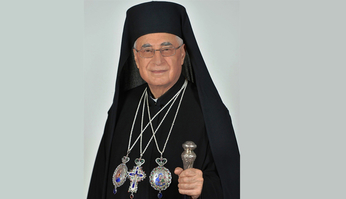
Patriarch Youssef
Christmas letter 2006
Peace, Living Together and the Christian Presence
in the Arab Middle East
Gregorios, by the mercy of God,
Patriarch of Antioch and of All the East, of Alexandria and of Jerusalem:
May the divine grace and apostolic blessing spread and descend upon
our brother bishops, members of the Holy Synod
and on all the faithful clergy and laity of our Melkite Greek Catholic Church
in Arab countries and countries of diaspora.
Peace is one of the names of God: it is the name of our Lord God and Saviour, Jesus Christ, Prince and King of Peace. The term, “peace” is mentioned right at the beginning of the Gospel of Luke in the event of the annunciation, when the Archangel Gabriel brought the greeting of peace to the Virgin Mary, announcing that she would be the Mother of God and saying, “Hail, (Mary, peace be with you) thou that art highly favoured…”
After the birth of John the Fore-runner, his father Zacharias sings a hymn of praise for his son, who will go before the face of the Lord and announce the coming of Christ, “to guide our feet into the way of peace.” During the birth of our Lord, Jesus Christ, six months later, in the city of Bethlehem, the angels sing in the hearing of the shepherds of Beit Sahour, the pastors’ hymn, the eternal Christmas hymn, saying, “Glory to God in the highest and on earth peace to men of good will.”
Peace: Jesus’ Mission Programme
So this song really becomes the programme for Jesus’ life: his gospel is the gospel of peace. (“He is our peace… And came and preached peace to you which were afar off and to them that were nigh.” ) So the constituent parts of this song are joined together into one single symphony: glory to God, peace, goodwill and joy.
We begin the Divine Liturgy with this very beautiful, pleasant call, “In peace, let us pray to the Lord. … For the peace from above, let us pray to the Lord… For the peace of the whole world… let us pray to the Lord.” Further, we pray that our day may be “holy, peaceful and sinless” and we ask of the Lord “an angel of peace, a faithful guardian of our souls and bodies.” At the end of the Midnight service, the priest asks, “Make our life peaceful, O Lord.” And we sing, “O Lord, save thy people and bless thine inheritance… Give peace to thy world.”
With the Prophet Isaiah, we pray, “O Lord our God, give us peace, for thou hast rendered to us all things.” Jesus speaks to his disciples, saying, “Peace to you.” And he promises them, saying, “My peace I give unto you.”
In this atmosphere of peace, we praise the Lord. The fruits of peace are joy, goodwill and security amongst mankind. These three things are linked together: glory to God, peace on earth and goodwill and joy amongst people.
So there can be no peace, no goodwill, without the glory of God, which is also linked to the glory of mankind, for as St. Irenaeus, Bishop of Lyons, says, “The glory of God is a living man.” So, God has respected man’s dignity, by creating him “in his image and after his likeness,” adorning him with all his graces and charismata and giving him “dominion over every living thing that moveth upon the earth.”
Man in his turn must venerate the image or icon of God in his brother man. So this song of Christmas is really a spiritual symphony of dazzling beauty.
Harmonies
Just as the chords of this Christmas song are in three-part harmony, so are combined three themes in the heading of our Christmas Letter: “Peace, Living Together and the Christian Presence in the Arab world.”
These three themes are firmly linked in an existential way, as we explained in the various letters we sent (consequent upon the destructive, hateful war on Lebanon during July and August, 2006) to the heads of Arab countries, of the Big Eight meeting at St. Petersburg, of the countries of the European Community meeting in Brussels, to the assembled Foreign Ministers of the Great Powers met at Rome, to President Chirac, to U.N. Secretary-General Kofi Annan, to His Holiness, Pope Benedict XVI, and to the President of the principal Conferences of Catholic Bishops throughout the world. Through these letters, we wanted to emphasize the importance of peace in the region, peace which is the key to all good things needed by this area that has been suffering for decades.
Here, we wish in this Christmas Letter to bring the content of those letters to all people of good will. This chimes in with our previous Christmas Letters, in which I have always insisted upon the importance of the Christian presence in the Arab world. This unique presence is unfortunately threatened by the cycle of wars, crises and calamities that assail this region, which saw the birth of Christ, the Apostle of Peace and which is the cradle of Christianity.
Our great concern, expressed through our annual letters, has been and always will be how to preserve the Christian presence as actual, witnessing and serving in our Arab society with its Muslim majority.
We shall set out in this letter the three constituent parts: peace, living together and the Christian presence in the region. Indeed, we shall be saying that the Christian presence in this region is fundamental for living together, even though it is dissolving little by little, because of emigration ensuing upon each war and crisis. To preserve this living together, we have to make universal, just, and lasting peace reign in this region.
The Cause: the Israeli-Palestinian Conflict
We consider that the calamities, crises, wars and depredations of the Middle East are the products and results of the Israeli-Palestinian conflict. Fundamentalist movements such as Hamas, Hizbollah and others, are similarly the results and products of this conflict, as are the discords inside Arab countries, the slowness of their development and prosperity and the growth of hatred, enmity, hopelessness and disappointment among the youth, who make up sixty per cent of their inhabitants.
Concord, which alone can re-establish peace and justice in Palestine and the whole Middle East, presupposes a unified, firm, active, frank Arab position on the Palestinian question and solution, but also an equally sincere, firm and unified American and European position.
However, the most important thing for all of us in this region today is to win the fights both for peace and war in a sincere struggle for justice, security, stability and development. That is what the young Arab generations are expecting, Christians and Muslims, as well as all our political parties, all our communities and our whole people.
Unity of the Arab World
It is this Arab unity, which, by its very existence must impose on Israel, the United States of America, Europe and the United Nations, a peaceful solution to the conflict.
Destroying bridges and building walls is what is happening today in the Middle East. Now, that is just the opposite of what should be happening. Building bridges, so that people can meet each other, and destroying walls of partition: therein lies the warranty of a life worthy of men on this earth, in our Arab world, instead of burning fire and death-dealing weapons causing weeping and wailing in Palestine, Iraq and Lebanon.
After the War on Lebanon, we all find ourselves at a vital, historic and dangerous turning point, which may yet lead to further considerable calamities. That is why it is absolutely necessary for Arabs and Israelis to draw true lessons from that hateful, destructive and bloody war on the Lebanon, the ferocity of which exceeded all other wars in the region.
We consider that the policy which consists of pressuring this or that Arab country, such as Syria, or, outside the Arab world, Iran, and the condemnations of Hamas, Hezbollah, and all types of Islamic fundamentalism and extremism are all a headlong flight from reality; it is realpolitik that shows an unwillingness to shoulder real responsibility, which requires of all sides to place themselves on a true footing and make progress together towards agreement and true unity, allowing peace and justice to reign in the Holy Land, which for more than half a century has been a land of war and key to all warfare and conflicts in the region and beyond.
We, as an Arab Church, Church of the Arabs, Church of Islam, are speaking very firmly and forcefully to our Arab brethren, to European countries and to America, telling them, “Beware!” for if there is a seemingly interminable wait to resolve the Palestinian case, that means, losing all hope of any solution.
Christian Emigration
One of the most dangerous results of the Israeli-Palestinian conflict, and a cause of the inability to find a just and firm solution to it, is emigration. The brain-drain, the emigration of thinkers, young people, moderate Muslims and especially Christians: all that weakens progress and its future; the Arab world’s freedom, democracy and openness.
The great danger is above all in the emigration of Christians which has grave, painful and dangerous consequences. In fact Christian emigration, severely affecting all our parishes and communities in the Arab world, especially in the Lebanon, Syria, Palestine, Jordan, Egypt and Iraq, means the East becoming void of Christians.
Above all, emigration means the gradual loss of pluralism and diversity in the Arab world and of its great opportunities for human and religious Islamic-Christian dialogue and daily, social co-existence of cultures and consciences, visible in the various aspects of the fabric of daily life in Arab societies.
Christian emigration represents a continual haemorrhage, causing Arab society to become monochrome, an entirely Muslim Middle East, over against a European society called Christian, although Europe and America are rather secularized than believing. If it were to happen that the East were emptied of its Christians, it would mean that any occasion would be propitious for a new clash of cultures, civilizations and even of religions, culminating in a destructive confrontation between the Arab and Muslim East and the Christian West, a conflict between Islam and Christianity. What a disaster that would be!
Trust between East and West
Faced with the consequences of the War in Lebanon and what we see every day in the media about the growth of fundamentalism and religious, ethnic and social tensions in human relations, we feel that there is a great lack of trust between East and West, between Arab countries, in the majority Muslim, and the European and American West.
In this atmosphere we see a rising desire for the birth of a new Middle East amidst the torrent and tide of wars and conflicts, but we are sure and convinced that a new Middle East can only be realized through the solution of the Palestinian case and the ending of the Israeli-Palestinian conflict. It would be a great error for the leaders of the West, Europe and America, to believe that dividing the Arab world would bring about a good atmosphere for the creation of a new Middle East. On the basis of our faith and spiritual, social and national experience, we would like to warn those who make propaganda for this divisive way of thinking and tell them very frankly, “No new Middle East with a divided Arab world!”
As for those who throw down the gauntlet for splitting the Arab world into an archipelago of religious communities and cantons in the name of bringing into being a new Middle East, theirs is certainly a losing wager, for there will be no democracy or democratic society in one Arab country without the others.
Attempts at creating pacts to divide the Arab world into little states, along community and religious lines means destroying the region’s future. On the contrary, strength is in unity and the strength of our Arab world is in its unity and trust among different groups within Arab countries. Moreover, the success of the birth of the new Middle East, over against Europe and America, can only come from trust between East and West, between Europe and Arab countries, between Christians and Muslims, indeed between all citizens of every country.
Therein may be discovered the role of Christians in the Arab world and for the birth of a truly, new Middle East. Their role is to work, to harness themselves to creating an atmosphere of trust between the West on the one hand and the Arab and Muslim world on the other. Our Arab history and the fact that we have a stake in the Arab and Muslim world gives us this very important role in East-West relations.
That is why we Arab Eastern Christians are telling the European community and the United States of America, “Give us your trust and we in turn shall give you ours. Have confidence in the Arab world and it will return your confidence. Don’t try to divide Arab countries through pacts, but rather help the Arab world realize its unity and solidarity. Don’t seek to sow the tares of division in the Arab world, especially between Christians and Muslims, for we are all Arabs, whether we are Christians or Muslims. We tell you frankly, if you succeed in dividing the Arab world and Christians and Muslims from each other, each into their own groups, you will always live in fear of the Arab and Muslim world.”
The Work of the Apostolic See of Rome
We wish to mention here the importance of the role of Christian Europe in the process of creating trust between East and West. We as Christians and Catholics are in continual relations with our Arab world and Muslim society. We are also in conversation with our elder sister Church of Rome, that “presides in charity” (Saint Ignatius of Antioch) and with the Apostolic Roman See and our brethren in the Catholic Churches of the West in Europe and America, calling on them all to redouble their efforts by lobbying their governments and showing their fellowship with us Eastern Christians, in order to reach the single, common goal of bringing about the reign of peace.
At the same time, we wish here to give our great thanks to the Episcopal Conferences, especially of Europe, that showed a great feeling of solidarity with us and our causes in the Arab world. We mention above all the Popes, who have shown exemplary concern for the Palestinian case since its beginning in the time of Pope Pius XII, through that of the Blessed John XXIII, of Paul VI, and of the Servant of God John-Paul II up to the present with His Holiness Benedict XVI, who is following the tragic and painful developments in this region, with a deep sensitivity and a keen sense of responsibility. It is he who said, “It is immoral to excuse ourselves from responsibility for bringing about the reign of peace in the Middle East.” So he followed the different stages of the murderous, destructive war on the Lebanon with great care and attention, recalling (at the Angelus prayer, 6 August, 2006) the responsibility of each and every one for bringing about peace in the region.
Words of the Holy Gospel
Beginning from our Christian convictions, based on the teachings of our Lord, Jesus Christ, in the Gospel, we are talking to our Christian brothers and sisters here in the East and especially in the West, bearing in mind our deep responsibility, saying, “Love the Arab world. Love Muslims, for we, they and we, you and we, are all created ‘in the image and likeness of God.’”
We are called to that by the holy Gospel, in which we read, “God so loved the world, that he gave his only-begotten son…that the world through him might be saved.” We are sure and certain that the Gospel and Jesus are always right: in fact the only cure for the world’s violence, wars, killings and ideology of terrorism, is love.
As we address these words to the communities of our Melkite Greek Catholic Church and to our brethren in the West, so we addressed on 6 October, 2006 the assembly of the Council of Episcopal Conferences of Europe, held at St. Petersburg in Russia. These words, written and pronounced by an Arab Christian Patriarch in an Arab Church, in the Arab world, spring from the depths of the holy Gospel, which contains the words of life, that go beyond any political logic or human wisdom and all calculation and strategy, being, as we say in our prayers, “strength beyond weaponry.”
Faith is the Weapon of Peace
That is the true expression of our deep conviction and of our Orthodox faith. We may even affirm with profound conviction that our faith - of Christians, Jews and Muslims - tells us that the most cutting weapon of our world, (despite all political crises, conflicts, fundamentalist tendencies and ideology of terrorism and violence, those destructive ways of thinking, that in any society have nothing to do with religion, conviction or community) is faith itself. If we lay aside the weapon of faith, despising it in order to show off our prudence and human, political wisdom, the world will remain in a terrible, tragic, bloody cycle of wars, killings, violence, terrorism and fundamentalism.
Have we really examined our conscience concerning the values of our faith? Is it not rather true that there is a great weakness in our Christian faith and in its realities and convictions? There is besides a great lack of Christian solidarity both inside our communities and between them. Yet our faith is what the Apostle John called, “the victory that overcometh the world.”
So, here we appeal to the governments of countries of the Arab world and throughout the whole world. We, in this atmosphere of the Feast of the Nativity of our Lord God and Saviour, Jesus Christ, the Prince of Peace, call upon them to work to realize the angels’ hymn, with which we began this Christmas Letter. In fact, this hymn is a programme of life for our world which needs to be in continual relationship with God, glorifying God and allowing peace to reign and realizing joy and prosperity among the children of men.
A New Middle East without War
After the experience of consecutive wars, we consider the current conditions and situations of the Arab world, especially in Palestine, Iraq and the Lebanon, propitious, indeed, an excellent opportunity for Arabs and Israelis to understand the lessons of history. We ask all to throw aside their weapons and make them into “pruning hooks” for that great harvest of goodness, security and prosperity, a new Middle East without war. That is why we are telling all of them to work at making our Arab Eastern region into a weapon-free zone, without war, hatred or enmity, so that this land that God has sanctified may be as he willed, one where Jews, Christians and Muslims, all children of the three great monotheistic religions, may live together in peace and harmony. This land is their common spiritual cradle, where we are called to bear fruits of peace and be renewed by the Spirit of God.
Instead of this region being subject to clashes and bloody conflicts, consecutively repeated over more than fifty years; instead of these conflicts being a sign of the end of the world, let them be rather a sign of the beginning of a new world, “a new heaven and a new earth,” where, as the Psalmist says, “righteousness and peace have kissed each other.”
Reconciliation in the Teaching of St. Paul
We are writing this letter in a spirit very far from any hatred, enmity, vengeance or the logic of victor and vanquished. The logic of our holy faith is very far from all these negative feelings and positions.
On the contrary, our logic calls us to friendship and love: love of enemies, unreciprocated love, constructive love, trusting and believing all things, hoping all things, optimistic, never thinking evil, not boastful: that is why it is never-failing.
St. Paul, in his Epistle to the Ephesians, invites us to go beyond the logic of war, violence and terrorism, vengeance, destruction, force and strength of arms. In fact, if we read that Epistle with new eyes, we can see in it a prophecy for our century and for our present situation, a call for reconciliation between countries, peoples and religions, reconciliation which is the basis for peace. Here are some passages from that letter:
“But now in Christ Jesus, ye who were sometimes far off are made nigh by the blood of Christ.
“For he is our peace, who hath made both one, and hath broken down the middle wall of partition between us; having abolished in his flesh the enmity, even the law of commandments contained in ordinances; for to make in himself of twain one new man, so making peace; and that he might reconcile both unto God in one body by the cross, having slain the enmity thereby: and came and preached peace to you which were afar off, and to them that were nigh. For through him we both have access by one Spirit unto the Father.
Now therefore ye are no more strangers and foreigners, but fellow-citizens with the saints, and of the household of God; and are built upon the foundation of the apostles and prophets, Jesus Christ himself being the corner-stone; in whom all the building fitly framed together groweth unto an holy temple in the Lord: in whom ye are also builded together for an habitation of God through the Spirit.”
Today, we more than ever need this vision which looks beyond current crises, the realities of peace and conflict in Palestine, Iraq and the Lebanon: we must go beyond the logic of fundamentalism, which sees force of arms as the only means to an end; beyond the reality of movements that frighten us, such as Hizbollah, Hamas, Jihad and Muslim Brothers. In fact, all those movements are the products of injustice and despotism, and will no longer have any justification for their existence in a world where peace and social justice reign and where prosperity and security are realized.
This vision sketched out by St. Paul is the foundation for a new Arab Middle East, for a new heaven and a new earth. This vision of faith helps us Christians, Muslims and Jews to continue our progress, beginning from the revelation of God to us all in this region of the world, where God has wished us to be and where he spoke to his children.
If we succeed in this common journey, accepting one another, (each in his own religion with great respect for its dogma) and according to each his rights and dignity, there will be the real, dazzling proof of the truth of our faith. It will also make a very attractive case for our young people to accept the faith of their parents and ancestors with great respect and esteem and to live out the values of this faith in their society.
Appeal for Patience and Trust
We would like here to speak to our Melkite Greek Catholic children with words of encouragement for their daily lives, sufferings and problems. We also think that these words may apply to all Christians in our Arab world and in the countries of emigration.
Dear brothers, dear friends, your belonging to the Church comes of your true faith, and this is your strength in the face of difficulties that are the realities of life in every society in East and West, between Christians and Christians, Christians and Muslims, and even between Buddhists, Christians and Muslims! Do not think that you, as Christians, are the only ones suffering and having problems in the East. Muslims themselves have problems in living out their faith here in the East and outside Arab countries. European Christians in Europe, a continent called Christian, but secularized and threatened by different aspects of practical atheism, also have problems in living out their faith in a secular atmosphere, where faith has become cloistered and enclosed inside church walls. That represents a more serious danger for them than our own problems do for us. Christians in Eastern Europe have suffered further under the yoke of Communism, things that neither Muslims nor Christians of West or East have had to undergo! Recently, in September, 2006, I was in Slovakia, the Czech Republic and in Russia, having already visited Romania and the Ukraine. There I heard tell of New Martyrs, those who died and those who survived and gave witness by their blood to their resistance and perseverance in the faith. I tell you, there is no comparison between the problems and difficulties we have in living our faith at home and what our brothers and sisters in Eastern Europe have had to endure!
There is no faith without difficulties, but these are not difficulties of faith: they are rather social, political, economic and cultural difficulties, to which every believing (and unbelieving person) is exposed, whether Christian or Muslim, regardless of their faith, religion, or the geography or history or culture of their country.
“Fear not, little flock.”
We are talking now to all our children and to each one individually, saying to them, “Fear not, little flock.” Do not be afraid to be what Jesus asked you to be: light, salt and yeast, servants, witnesses and imitators of Christ, strong in the pursuit of his teachings contained in the holy Gospel, with complete openness to your fellowmen, who have their own faith and values. Instead, say to them:
I am a fellow-citizen.
I am a believer with you.
I am a servant with you.
I am a witness with you.
I am building with you, in one and the same homeland.
My future is your future.
My progress is your progress.
My language is your language.
My Arab identity is one with yours.
I am and will remain with you and for you.
Just as we have journeyed along the same road for the last fourteen hundred years, so we wish to continue with you in this third millennium.
Appeal to our Muslim Brethren and Fellow Citizens
In seeking to convince our Christian faithful to stay in their homelands, where God has planted them, we find we absolutely must talk, with them and in their name, on the basis of our responsibilities as Arab citizens in Arab countries, to our Muslim brethren, those in government, sheikhs, theologians, cultured people, muftis and all Muslims and tell them frankly what the fears are that haunt us and what kind of fearful attitudes amongst us, impel some of us to emigrate.
They are not just purely religious reasons, but they also have a social, ethical and cultural aspect.
So when we are talking about living together and citizenship, their concomitant conditions and principles absolutely must be recognized as permanently binding duties for Muslims, just as they are for Christians: this is what we mean by speaking of separation between religion and state, Arabism, democracy, the Arab nation, and human rights. Laws which are based on Islam as sole or chief source of legislation and application are a source of division and quasi racial distinction between citizens on the basis of religion and are an obstacle to equality before the law, diminishing equality of citizenship. One could say the same about fundamentalist parties, that strictly follow the Islamic Qur’an and those fundamentalist movements here and there to which are attributed (whether truly or not and with or without reason) acts of violence, terrorism, murder, church burning and extortion and exploitation of citizens on the basis of religion, while the perpetrators rely on the fact of being in the majority, to humiliate their neighbours and workmates.
Those things make Christians feel troubled, fearing an unknown future in a society that is in the majority Muslim. Often they are characterized and stigmatized by epithets such as fifth columnists, crusaders, impious (kuffar), and collaborators with the West and with Israel.
Those and many other such things are the cause of fear amongst Christians and ought to be, to our way of thinking, the subject of study circles, congresses, conferences and meetings in the Arab and Muslim world. Those problems should be treated with a great deal of objectivity and Christians and Muslims together should identify the real wound underlying the haemorrhage of Christian emigration.
Neither Protégés nor Dhimmis
Through this Christmas Letter, we are speaking to our Muslim brethren in all confidence and charity and that is the reason for our frankness. We tell them plainly, we and all our faithful, want to live together and continue the journey of previous centuries, but we wish that our Muslim brothers would not call us dhimmis, or protected people. We would like them to consider us as real citizens, like they are, having the same rights and the same obligations as them. We wish to build our countries, our homelands, together and collaborate towards a better future for them and for us all. That has always been the role of Christians throughout history and that must still be our role today in the third millennium of the Nativity and in the fifteenth century of the Hijrah.
We do not ask for the protection of our Muslim fellow-citizens, but equality and an equal opportunity for work and a job. We want a common life, living together with all that that implies, charity, trust, respect, dignity, shared responsibility, solidarity and progress together, to which we are prepared to devote ourselves sacrificially for the sake of our homelands. We wish to feel this atmosphere in all Arab countries without exception. Christians are Arab fellow-citizens in every Arab country, whether their numbers are small or large, whether they are poor or rich. All have the right to full citizenship in every Arab country without exception. They have the right to complete freedom in the practice of their religion and the building of their churches, alongside the mosques of their Muslim brethren.
Those are the kinds of attitude and behaviour which would really give Christians the feeling that they were in security and would lessen the load of emigration.
We say to our Muslim brethren, we Christians have an extraordinary strength: we have our convents, monasteries, schools, universities, welfare societies, our social and cultural societies, our medical centres and hospitals; all those we are ready to place at your service. But if we emigrate, all these capabilities will be scattered and destroyed. The losers will be Arabs, Christians and Muslims alike.
We wish here to affirm again that our positive living together and the preservation of the values of Christian and Muslim faith are the bases of our real co-citizenship. The greatest challenge for Christians and Muslims is how to be able to live our faith in the world of globalization and how manage to pass on this precious, holy deposit to new generations, especially young Christians and Muslims, who are both exposed to the same dangers in today’s world.
Appeal of our Eastern Catholic Brother Patriarchs
The Eastern Catholic Patriarchs have treated in their sixteenth Congress of their Council, from 16 to 20 October last, the same subject as is dealt with in this letter. The title of their congress was “The Church and the Homeland.” This congress followed on from what they had studied in their previous one of 2005 in Jordan, “Peace and Justice in the Middle East.” We are happy to pass on to you some passages from their communiqué, so that our children may hear the voices of their fathers, the Patriarchs, who feel the hopes and sufferings of their children as their own:
3. “Our presence in the East is the expression of the will of God, obliging us to be faithful to Christ, involved in witnessing to his love, putting into action the teachings of the Holy Gospel and fulfilling the duty of service to the societies in which we live. However insurmountable the difficulties, we nevertheless detect radiant signs of hope in the spiritual, cultural, social and national wealth which adorns with the jewels of its liturgical, theological and spiritual heritage, well-ordered in conformity with the Alexandrian, Syriac and Maronite Antiochian, Melkite Greek, Chaldean, Armenian and Latin traditions, the Church of Christ that is both one and diverse that John, the Beloved Disciple saw “coming down from God out of heaven, prepared as a bride adorned for her husband. “ And he heard a voice that cried aloud, “Behold, the tabernacle of God is with men, and he will dwell with them, and they shall be his people, and God himself shall be with them, and be their God. And God shall wipe away all tears from their eyes.” (Revelation 21:2-4).
4. Christianity, being an essential component of the regional culture, enriching the latter by its traditions (cf. A new hope for Lebanon, 1) it follows that the Church calls for a presence and a mission. So it becomes imperative to set up an exchange of ideas with the faithful of other religions about spiritual, moral, social and cultural values with a view to promoting social justice, equality and freedom and laying the foundations of peace. (Conciliar decree Nostra Aetate regarding the relationship of the Church with non-Christian religions, 2 and 3)
5. Our Christian faith implies being incarnate and lived out in a mission springing from the heart of our faithfulness to Christ, our union with him and our determination to imitate him and take him for our model, which supposes, to begin with on our part, preserving our existence and presence in our land, in a spirit of fellowship, mutual help and shared responsibility. The economic and social crisis requires Church and State, all competent authorities and all people of good will, to take an initiative designed to develop economic life and instigate development projects that would provide job opportunities to young people and help them put down roots in their native land, fulfil their potential and give families the possibility of earning a decent, respectable living in their own country.
6. As for the mission, it begins, in fact, by preserving living together in the face of the growing conflict of cultures and religions. It is a living witness of the possibility of co-existence in peace and creative complementarity in the heart of difference. For religions, in their essence, are a factor for gathering and not division, since the essence of each is worshipping God and respecting his creatures. Eastern Christians are Eastern in their belonging and citizenship and in fact are profoundly involved in their respective countries’ cause.”
No to Emigration
Speaking of that, may I remind our children, beloved brothers and sisters, especially young people, of my first Patriarchal Letter: no emigration! I ask them to take this message seriously. In fact we need to encourage each other mutually to stay here and try to convince each other and respond to the doubts of objectors who say, “What can we do? This country is not for us. What is to be done here?”
We say to all, “No. No running away from responsibilities! No withdrawal and leaving the field of social, political, ethical and national life. No to isolation. No to internal migration or emigration outside the country. No to feelings of inferiority. No to marginalization: no to marginalization by others and no to those who marginalize themselves. No to despair because of situations in our Arab countries! No letting ourselves fall into disappointment and defeatism in the face of events here and there, from which our children are suffering, whether because they have experienced them themselves or because they have heard tell of them. No shrivelling up and turning in on oneself or to one’s own community. No to fear in the face of certain aspects of fundamentalism, extremism and movements and acts of terrorism and cases of religious superiority and discrimination.”
All these realities have nothing to do with Christian or Muslim religion, (although sometimes some Muslims may do these things or such things are attributed to them) or with those people who live with us, alongside us as workmates at our place of work and neighbours in our district.
The Lord Jesus Christ says to us, reminding us of the difficulties which may lie in life’s way for the faithful, “Take heed that no man deceive you.…
For nation shall rise against nation, and kingdom against kingdom: and there shall be famines, and pestilences, and earthquakes, in diverse places. All these are the beginnings of sorrows.
Then they shall deliver you up to be afflicted, and shall kill you: and ye shall be hated of all nations for my name’s sake. And then shall many be offended, and shall betray one another. And many false prophets shall rise, and shall deceive many. And because iniquity shall abound, the love of many shall wax cold.
But he that shall endure unto the end, the same shall be saved.”
St. Paul, or the author of the Epistle to the Hebrews, reminds us of the heroes of faith, in chapters 11 and 12: “(Some) had trial of cruel mockings and scourgings, yea, moreover of bonds and imprisonment: they were stoned, they were sawn asunder, were tempted, were slain with the sword: they wandered about in sheepskins and goatskins; being destitute, afflicted, tormented; of whom the world was not worthy: they wandered in deserts, in mountains, and in dens and caves of the earth…others were tortured, not accepting deliverance; that they might obtain a better resurrection…Ye have not resisted unto blood, striving against sin…Wherefore seeing we are also compassed about with so great a cloud of witnesses, let us lay aside every weight, and the sin which doth so easily beset us, and let us run with patience the race that is set before us, looking unto Jesus the author and finisher of our faith: who for the joy that was set before him endured the cross, despising shame, and is set down at the right hand of the throne of God.”
Why Stay in the Arab Middle East?
I made a remark in Paris, during my participation in the 150 Year Jubilee of “L’œuvre d’Orient,” saying to them, “You French Catholics are giving us material, financial help to maintain our presence in the Middle East, but it is up to us to discover reasons and motivations for that presence and witness in the region.”
We Christians are not allowed to file all or most of our life’s difficulties under the heading of Islamic-Christian relations. Neither is it quite true that the principal reasons for emigration are religious difficulties, as some local and international media imagine, raising cries of despair about the challenges for Christians of continuing their presence in the Middle East. In fact inquiries and questionnaires on the subject of reasons for emigration were prepared by specialists for the Assembly of Eastern Catholic Patriarchs last October. Their results showed that religious causes are least important, virtually inexistent.
Freedom of Worship Assured
Basing ourself on our personal experience about the situation of Christians in Arab countries, we may affirm that Christians are able to practice their faith without any opposition in all Arab countries, except Saudi Arabia. Indeed, freedom of worship is assured in the countries of Syria, Lebanon, Jordan, Palestine, Egypt, Sudan, Iraq, Kuwait, the United Arab Emirates, Bahrain, Qatar, Oman and Yemen.
In all these countries there are churches, catechism classes, religious books, the possibility of celebrating prayers and festivals, sacraments, spiritual retreats; there are schools, social institutions, clinics, hospitals, monasteries, brotherhoods, youth groups, Christian pamphlets and reviews, all basic elements for Christian living. In the Arab world, no-one can prevent me from living a holy Christian life. No-one can prevent families from living together in peace and security and from educating their children in a true Christian atmosphere. There are difficulties and problems, sometimes daily pressures, which are part of any life, but the same can happen in other societies, religious or otherwise, Eastern or Western, or elsewhere.
Rights and Privileges
As for civil, political and social rights, privileges and the like, these are so many themes that have nothing to do with religion and faith. Of course, they form important and basic parts in the life of every citizen: they may have a positive or negative effect, and may yet be the reason for many crises, calamities and difficulties in the family, but they must be dealt with in the civic domain, not from the point of view of religion in the community. Of course it is difficult to make a distinct separation between life’s religious and social demands, but the Christian needs to deal with all these problems, taking faith as his starting point, then his citizenship, civil rights and human rights, which are the same for everyone. Besides, he must demand by all permissible and legitimate means that these rights be respected.
But, to reach this level of interaction with our society and with its different currents and outlooks, there have to be open-minded Christians, who give witness in their society by their presence and are involved in social, political and economic life, participating whole-heartedly in the life of their homeland, taking their citizenship as their starting point and after that, their faith and Gospel values. It is a conflict of interest, not a religious or Christian-Muslim conflict, or a conflict of faith. The poet said, “One can only face up to life through strength.”
That is what His Holiness, Pope Benedict XVI explained in his first encyclical letter, Deus Caritas Est, 25 December 2005, and which was quoted in the final report of the Assembly of Catholic Patriarchs and Bishops of the Lebanon in October, 2006:
“(The) aim (of the Church’s social teaching) is simply to help purify reason and to contribute, here and now, to the acknowledgment and attainment of what is just….
… the Church wishes to help form consciences in political life and to stimulate greater insight into the authentic requirements of justice as well as greater readiness to act accordingly, even when this might involve conflict with situations of personal interest.”
That is why it is not allowed to class these difficulties under the heading of Islamic and Christian religious cultures.
The Role of the Antiochian Church
The Antiochian Church, with all its five denominations (Greek Orthodox, Melkite Greek Catholic, Syriac Orthodox, Syrian Catholic and Maronite) is a privileged ecclesiastical place for living together with Islam and for Islam, in the Arab world and for the Arab world. It is a privileged place for bringing to fruition our Christian presence and putting it to work.
More important than this historical and geographical reality is learning to discover, if possible, the true role of Christians in the Patriarchate of Antioch, in Islamic-Christian history, geography, culture and civilization. By all possible means, we must learn to see its history, geography and civilization in the light of salvation.
Some could say (and I read it in a French review) that I only go on repeating these ideas in all my letters. I know that and do it willingly, because I have a firm conviction, which I discover ever more profoundly. It is my daily care, concern and responsibility: how can I remain in touch with my brother bishops, priests and deacons, monks and nuns and all our children in all communities throughout our Church on the subject of our duty to remain? How can I spread this conviction, so that it becomes that of the whole Church with all its parishes and parishioners? I repeat then, what I have always said, “If we do not reach this certainty, there is no future for the Christian presence or for our witness and Christian service.”
Summary
Finally, at the end of this letter, I return to the beginning and to the three terms in
its title, “Peace, Living Together and the Christian Presence in the Arab Middle East” and I sum it up in the following paragraphs:
1. Living together is the future of these Arab countries and is valuable for both Christians and Muslims. It means accepting the other as he is, respecting him and venerating him, recognizing him as fellow-citizen, with all concomitant human rights, those of every one on earth and especially in the East.
2. Christians are an important element in that living together. There is no living together without pluralism, meaning that our society comprises Christians in all communities, Muslims in all their groups, Druzes and Jews.
3. This living together is threatened by emigration, whose most important and dangerous reasons are the wars, calamities and crises whose origin is the Israeli-Palestinian conflict and the injustice that flows from that. In the same way, products of this conflict are extremism, fundamentalism, violence, the ideology of terrorism and feelings of enmity and hatred in society and lack of equality in rights and job opportunities. There is also a lack of opportunity for participating in different posts of responsibility in the countries, their governance and parliament, ministries and other services.
4. If the haemorrhage of emigration continues, it means the East will be void of its pluralism. There will be a collapse of what we call living together. In those circumstances, Christians would not able to resist the series of calamities, crises, wars and conflicts.
5. But what may yet help Christians to resist in the face of all these difficulties and not emigrate is the conviction of faith that remaining in Arab countries, where Christianity was born and where God has planted them, is in itself an apostolate, vocation and mission. The framework of this mission is the Church, especially from the fact that the Antiochian Christian Church here, as I always repeat, is an Arab Church from its roots and ethnicity. Moreover it is Church of the Arabs and Church of Islam and Emmanuel Church, God with us and for us. It is also the Church with and for the other: the other is the Muslim fellow-citizen in our Arab society which is in the majority Muslim, in which Christians are responsible for bearing the Gospel message, and proclaiming its values in society, so that the Church may be present and witnessing in society, participating and interacting with it.
6. The atmosphere suitable for all these elements cited above - pluralism and living together with all that goes with that - is peace in the region; peace that is lasting, complete and firm, that may be the warranty for ending the Israeli-Palestinian conflict.
7. On the other hand, if Arab countries and Muslim citizens really care about pluralism and living together and if they feel the Christian presence is important in the region, then Christians have to be able to enjoy full fellow-citizenship with all the rights that go with it. It is absolutely indispensable that Arab countries unite their voices to bring about a civilized, just and peaceable solution for the Palestinian question.
8. If that does not happen in the near future, the haemorrhage of emigration will grow, as will Islamic fundamentalist movements, violence and terrorism and young Muslims will very simply fall victim into their net. That means that we should pass on to our young up and coming Arab generations a sombre inheritance and a black future. Then Arab Muslim society would lose the components of its pluralism and living together and there would be realized, unfortunately, the prophecy about the clash of civilizations, religions and cultures.
Peace-making is the Great Challenge
In order to avert all these calamities, we make an appeal both new and old, that we have mentioned in our previous letters, during the War on Lebanon in the summer of 2006. We appeal to Arab countries, to their kings, princes and heads of state: it is an appeal that arises out of our love for them and for our Arab homelands, saying to them, “Make peace. Hurry to make peace, today and not tomorrow. You are responsible, with a moral responsibility for peace. Otherwise, the accusations that are made against Islam about violence, terrorism and killings are going to continue to be levelled, despite the fact that Islam is completely innocent: but the Gospel says, “By their fruits ye shall know them.”
Peace today is the great challenge: it is the great jihad for the greatest good. It is true victory and the true guarantee for future freedom, progress, prosperity and security for our young generations, our Christian and Muslim youth, who are the future of our countries and who can really make their history, carrying the banner of faith and values in their homelands.
Among Mankind, Goodwill
At the end of the Divine Liturgy, the priest says in a low voice this prayer, “Christ our God, thou art truly the fulfilment of the Law and the Prophets. Thou hast accomplished all the economy of the Father towards us. Fill our hearts with joy and gladness, now and for ever and ever. Amen.”
After receiving Holy Communion we sing together, “We have seen the true light, we have received the heavenly Spirit, we have found the true faith,” and, “May our mouths be filled with thy praise… Keep us in thy holiness, so that every day we may sing of thy glory.”
This is a call to the faithful, after their existential participation in Christ in Holy Communion, for them to be strong, joyful, resistant and proud of their faith, laying aside all feelings of despair and defeatism, and participating in the joy that our Lord, Jesus Christ has given us through his birth and that the angels proclaimed in their song. So we may go beyond the cycle of fear for the benefit of our Christian presence, our role and future in these Arab countries and in the countries of emigration.
And to us all, pastors and faithful, Patriarch, bishops, priests, monks, nuns and laypeople, St. Paul speaks in his Epistle to the Ephesians, a letter addressed to each eparchy, parish, religious congregation and to each one of the faithful, “Finally, my brethren, be strong in the Lord, and in the power of his might. Put ye on the whole armour of God, that ye may be able to stand against the wiles of the devil. For we wrestle not against flesh and blood, but against principalities, against powers, against the rulers of this world, against spiritual wickedness in high places. Wherefore take unto you the whole armour of God, that ye may be able to withstand in the evil day, and having done all, to stand. Stand therefore, having your loins girt about with truth, and having on the breastplate of righteousness; and your feet shod with the preparation of the gospel of peace; above all, taking the shield of faith, wherewith ye shall be able to quench all the fiery darts of the wicked.”
And together we sing with great joy and great hope, “Glory to God in the highest and peace on earth to men of good will. ”
Gregorios III
Damascus, 1 December 2006
Translated from the French by V. Chamberlain